

specialis. For instance, F. oxysporum f.sp. lycopersici causes wilt in tomato, while
F. oxysporum f.sp. cubense causes Panama disease on banana. Other specific examples of Fusarium plant diseases (also called fusiariosis) are ear rot of maize
(F. verticillioides), Fusarium head blight of wheat and barley (F. avenaceum,
F. culmorum, F. graminearum), and root rot of soybean (F. solani) [17].
Species belonging to Fusarium genus are generally saprotrophic, and
necrotrophs, being potentially pathogenic, are not obligatory pathogens, like
biotrophic Puccinia spp. causing rusts in small grain cereals (mainly wheat, barley,
and triticale). After the harvest, fragments of infected tissues get into the soil, where
the fungi develop feeding on decayed organic matter and can survive unfavorable
environmental conditions. Some of the species can form fruiting bodies which
can remain viable for a very long time and then germinate at the appearance of
appropriate conditions to infect plant roots. This process is a part of the vegetative
development of some Fusaria, for example, F. culmorum, F. oxysporum, and F.
graminearum [18–21].
Animal and human fusariosis are not as common as plant fusariosis. Human
fusariosis usually occur in people with tissue breakdown or patients with impaired
immune system. The symptoms of these diseases are usually keratitis
and onychomycosis which are caused by F. verticillioides, F. oxysporum, and F.
solani [22]. Mycotoxicoses occur more often than fusariosis and are the effects of
ingestion of toxic fungal secondary metabolites. Exposure to mycotoxins occurs
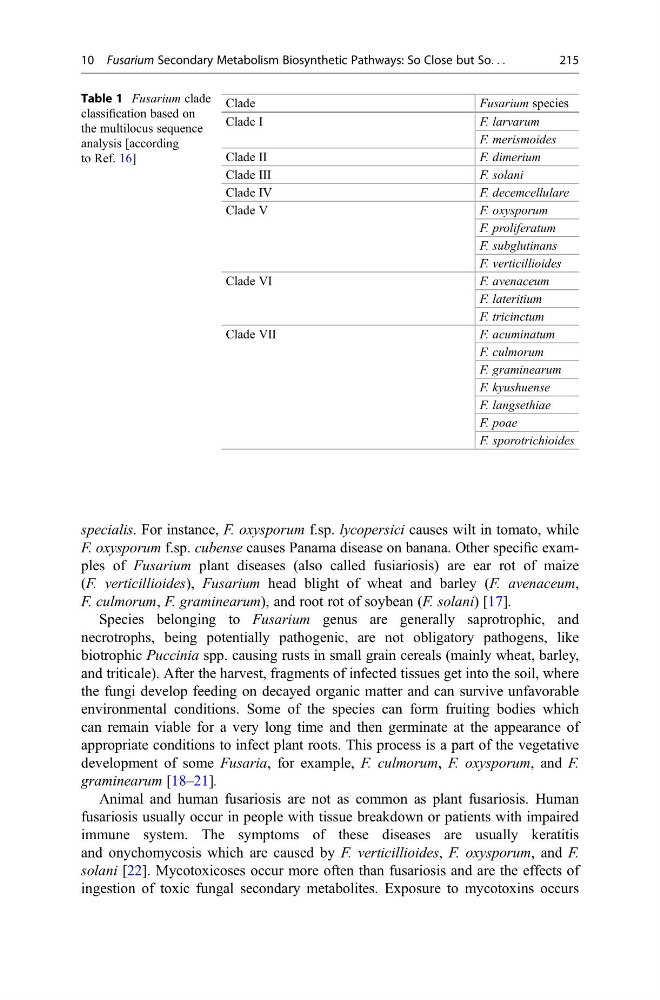
Table 1 Fusarium clade
classification based on
the multilocus sequence
analysis [according
to Ref. 16]
Clade
Fusarium species
Clade I
F. larvarum
F. merismoides
Clade II
F. dimerium
Clade III
F. solani
Clade IV
F. decemcellulare
Clade V
F. oxysporum
F. proliferatum
F. subglutinans
F. verticillioides
Clade VI
F. avenaceum
F. lateritium
F. tricinctum
Clade VII
F. acuminatum
F. culmorum
F. graminearum
F. kyushuense
F. langsethiae
F. poae
F. sporotrichioides
10 Fusarium Secondary Metabolism Biosynthetic Pathways: So Close but So. . .
215
F. oxysporum f.sp. cubense causes Panama disease on banana. Other specific examples of Fusarium plant diseases (also called fusiariosis) are ear rot of maize
(F. verticillioides), Fusarium head blight of wheat and barley (F. avenaceum,
F. culmorum, F. graminearum), and root rot of soybean (F. solani) [17].
Species belonging to Fusarium genus are generally saprotrophic, and
necrotrophs, being potentially pathogenic, are not obligatory pathogens, like
biotrophic Puccinia spp. causing rusts in small grain cereals (mainly wheat, barley,
and triticale). After the harvest, fragments of infected tissues get into the soil, where
the fungi develop feeding on decayed organic matter and can survive unfavorable
environmental conditions. Some of the species can form fruiting bodies which
can remain viable for a very long time and then germinate at the appearance of
appropriate conditions to infect plant roots. This process is a part of the vegetative
development of some Fusaria, for example, F. culmorum, F. oxysporum, and F.
graminearum [18–21].
Animal and human fusariosis are not as common as plant fusariosis. Human
fusariosis usually occur in people with tissue breakdown or patients with impaired
immune system. The symptoms of these diseases are usually keratitis
and onychomycosis which are caused by F. verticillioides, F. oxysporum, and F.
solani [22]. Mycotoxicoses occur more often than fusariosis and are the effects of
ingestion of toxic fungal secondary metabolites. Exposure to mycotoxins occurs
Table 1 Fusarium clade
classification based on
the multilocus sequence
analysis [according
to Ref. 16]
Clade
Fusarium species
Clade I
F. larvarum
F. merismoides
Clade II
F. dimerium
Clade III
F. solani
Clade IV
F. decemcellulare
Clade V
F. oxysporum
F. proliferatum
F. subglutinans
F. verticillioides
Clade VI
F. avenaceum
F. lateritium
F. tricinctum
Clade VII
F. acuminatum
F. culmorum
F. graminearum
F. kyushuense
F. langsethiae
F. poae
F. sporotrichioides
10 Fusarium Secondary Metabolism Biosynthetic Pathways: So Close but So. . .
215