

Vulpinic Acid
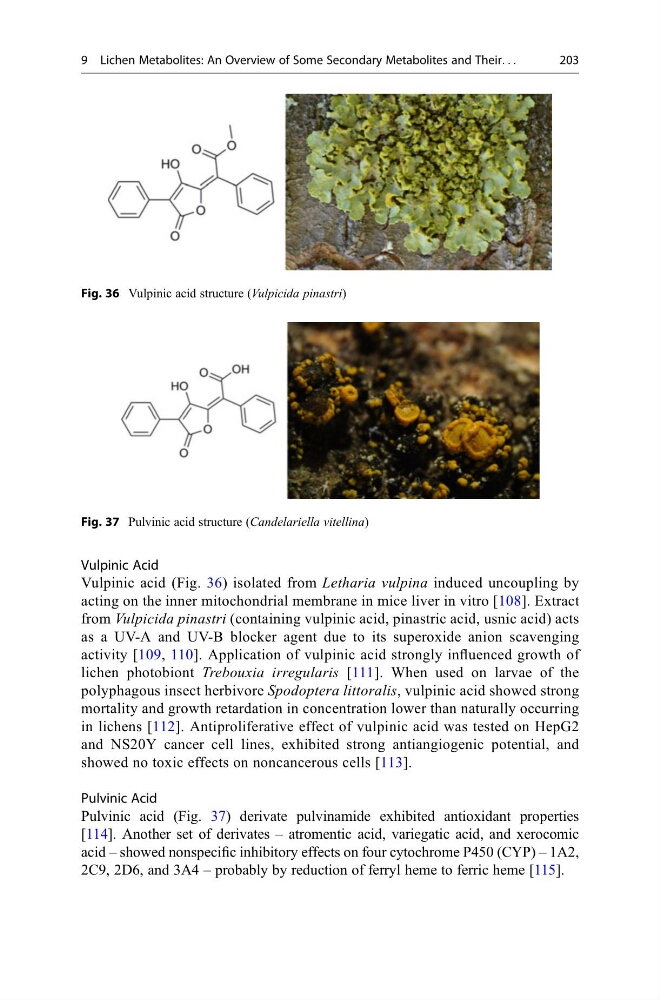
Vulpinic acid (Fig. 36) isolated from Letharia vulpina induced uncoupling by
acting on the inner mitochondrial membrane in mice liver in vitro [108]. Extract
from Vulpicida pinastri (containing vulpinic acid, pinastric acid, usnic acid) acts
as a UV-A and UV-B blocker agent due to its superoxide anion scavenging
activity [109, 110]. Application of vulpinic acid strongly influenced growth of
lichen photobiont Trebouxia irregularis [111]. When used on larvae of the
polyphagous insect herbivore Spodoptera littoralis, vulpinic acid showed strong
mortality and growth retardation in concentration lower than naturally occurring
in lichens [112]. Antiproliferative effect of vulpinic acid was tested on HepG2
and NS20Y cancer cell lines, exhibited strong antiangiogenic potential, and
showed no toxic effects on noncancerous cells [113].
Pulvinic Acid
Pulvinic acid (Fig. 37) derivate pulvinamide exhibited antioxidant properties
[114]. Another set of derivates – atromentic acid, variegatic acid, and xerocomic
acid – showed nonspecific inhibitory effects on four cytochrome P450 (CYP) – 1A2,
2C9, 2D6, and 3A4 – probably by reduction of ferryl heme to ferric heme [115].
Fig. 36 Vulpinic acid structure (Vulpicida pinastri)
Fig. 37 Pulvinic acid structure (Candelariella vitellina)
9 Lichen Metabolites: An Overview of Some Secondary Metabolites and Their. . .
203
Vulpinic acid (Fig. 36) isolated from Letharia vulpina induced uncoupling by
acting on the inner mitochondrial membrane in mice liver in vitro [108]. Extract
from Vulpicida pinastri (containing vulpinic acid, pinastric acid, usnic acid) acts
as a UV-A and UV-B blocker agent due to its superoxide anion scavenging
activity [109, 110]. Application of vulpinic acid strongly influenced growth of
lichen photobiont Trebouxia irregularis [111]. When used on larvae of the
polyphagous insect herbivore Spodoptera littoralis, vulpinic acid showed strong
mortality and growth retardation in concentration lower than naturally occurring
in lichens [112]. Antiproliferative effect of vulpinic acid was tested on HepG2
and NS20Y cancer cell lines, exhibited strong antiangiogenic potential, and
showed no toxic effects on noncancerous cells [113].
Pulvinic Acid
Pulvinic acid (Fig. 37) derivate pulvinamide exhibited antioxidant properties
[114]. Another set of derivates – atromentic acid, variegatic acid, and xerocomic
acid – showed nonspecific inhibitory effects on four cytochrome P450 (CYP) – 1A2,
2C9, 2D6, and 3A4 – probably by reduction of ferryl heme to ferric heme [115].
Fig. 36 Vulpinic acid structure (Vulpicida pinastri)
Fig. 37 Pulvinic acid structure (Candelariella vitellina)
9 Lichen Metabolites: An Overview of Some Secondary Metabolites and Their. . .
203