

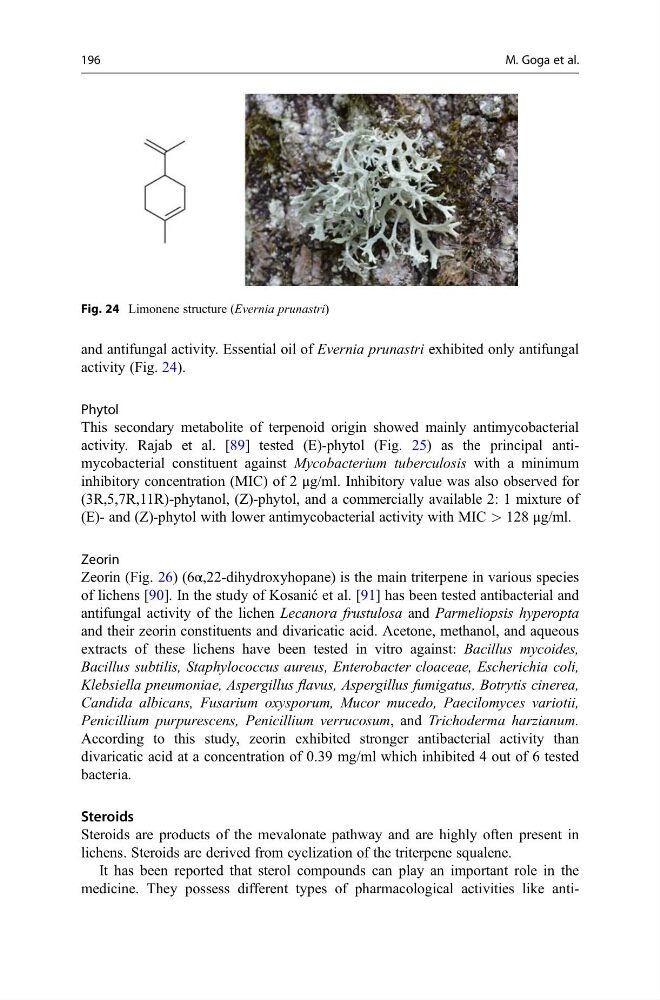
and antifungal activity. Essential oil of Evernia prunastri exhibited only antifungal
activity (Fig. 24).
Phytol
This secondary metabolite of terpenoid origin showed mainly antimycobacterial
activity. Rajab et al. [89] tested (E)-phytol (Fig. 25) as the principal antimycobacterial constituent against Mycobacterium tuberculosis with a minimum
inhibitory concentration (MIC) of 2 μg/ml. Inhibitory value was also observed for
(3R,5,7R,11R)-phytanol, (Z)-phytol, and a commercially available 2: 1 mixture of
(E)- and (Z)-phytol with lower antimycobacterial activity with MIC > 128 μg/ml.
Zeorin
Zeorin (Fig. 26) (6α,22-dihydroxyhopane) is the main triterpene in various species
of lichens [90]. In the study of Kosanić et al. [91] has been tested antibacterial and
antifungal activity of the lichen Lecanora frustulosa and Parmeliopsis hyperopta
and their zeorin constituents and divaricatic acid. Acetone, methanol, and aqueous
extracts of these lichens have been tested in vitro against: Bacillus mycoides,
Bacillus subtilis, Staphylococcus aureus, Enterobacter cloaceae, Escherichia coli,
Klebsiella pneumoniae, Aspergillus flavus, Aspergillus fumigatus, Botrytis cinerea,
Candida albicans, Fusarium oxysporum, Mucor mucedo, Paecilomyces variotii,
Penicillium purpurescens, Penicillium verrucosum, and Trichoderma harzianum.
According to this study, zeorin exhibited stronger antibacterial activity than
divaricatic acid at a concentration of 0.39 mg/ml which inhibited 4 out of 6 tested
bacteria.
Steroids
Steroids are products of the mevalonate pathway and are highly often present in
lichens. Steroids are derived from cyclization of the triterpene squalene.
It has been reported that sterol compounds can play an important role in the
medicine. They possess different types of pharmacological activities like antiFig. 24 Limonene structure (Evernia prunastri)
196
M. Goga et al.
activity (Fig. 24).
Phytol
This secondary metabolite of terpenoid origin showed mainly antimycobacterial
activity. Rajab et al. [89] tested (E)-phytol (Fig. 25) as the principal antimycobacterial constituent against Mycobacterium tuberculosis with a minimum
inhibitory concentration (MIC) of 2 μg/ml. Inhibitory value was also observed for
(3R,5,7R,11R)-phytanol, (Z)-phytol, and a commercially available 2: 1 mixture of
(E)- and (Z)-phytol with lower antimycobacterial activity with MIC > 128 μg/ml.
Zeorin
Zeorin (Fig. 26) (6α,22-dihydroxyhopane) is the main triterpene in various species
of lichens [90]. In the study of Kosanić et al. [91] has been tested antibacterial and
antifungal activity of the lichen Lecanora frustulosa and Parmeliopsis hyperopta
and their zeorin constituents and divaricatic acid. Acetone, methanol, and aqueous
extracts of these lichens have been tested in vitro against: Bacillus mycoides,
Bacillus subtilis, Staphylococcus aureus, Enterobacter cloaceae, Escherichia coli,
Klebsiella pneumoniae, Aspergillus flavus, Aspergillus fumigatus, Botrytis cinerea,
Candida albicans, Fusarium oxysporum, Mucor mucedo, Paecilomyces variotii,
Penicillium purpurescens, Penicillium verrucosum, and Trichoderma harzianum.
According to this study, zeorin exhibited stronger antibacterial activity than
divaricatic acid at a concentration of 0.39 mg/ml which inhibited 4 out of 6 tested
bacteria.
Steroids
Steroids are products of the mevalonate pathway and are highly often present in
lichens. Steroids are derived from cyclization of the triterpene squalene.
It has been reported that sterol compounds can play an important role in the
medicine. They possess different types of pharmacological activities like antiFig. 24 Limonene structure (Evernia prunastri)
196
M. Goga et al.