

These substances are typical for members of family Teloschistaceae within genera
Caloplaca, Teloschistes and Xanthoria [76]. Anthraquinones are produced by
lichens, as well as by nonlichenized fungi [77]. Biological activities of various
anthraquinones were confirmed in several studies such as antitumoral, antiinflammatory, and bactericide effects [77–79]. They are all pigmented compounds
which also acting as a light filters.
Emodin
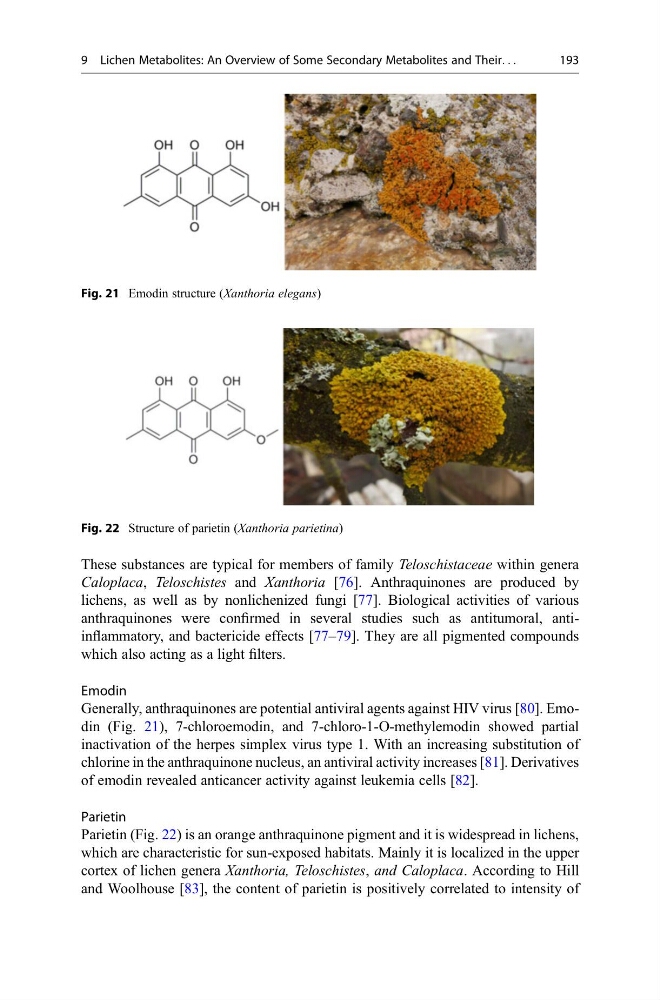
Generally, anthraquinones are potential antiviral agents against HIV virus [80]. Emodin (Fig. 21), 7-chloroemodin, and 7-chloro-1-O-methylemodin showed partial
inactivation of the herpes simplex virus type 1. With an increasing substitution of
chlorine in the anthraquinone nucleus, an antiviral activity increases [81]. Derivatives
of emodin revealed anticancer activity against leukemia cells [82].
Parietin
Parietin (Fig. 22) is an orange anthraquinone pigment and it is widespread in lichens,
which are characteristic for sun-exposed habitats. Mainly it is localized in the upper
cortex of lichen genera Xanthoria, Teloschistes, and Caloplaca. According to Hill
and Woolhouse [83], the content of parietin is positively correlated to intensity of
Fig. 21 Emodin structure (Xanthoria elegans)
Fig. 22 Structure of parietin (Xanthoria parietina)
9 Lichen Metabolites: An Overview of Some Secondary Metabolites and Their. . .
193
Caloplaca, Teloschistes and Xanthoria [76]. Anthraquinones are produced by
lichens, as well as by nonlichenized fungi [77]. Biological activities of various
anthraquinones were confirmed in several studies such as antitumoral, antiinflammatory, and bactericide effects [77–79]. They are all pigmented compounds
which also acting as a light filters.
Emodin
Generally, anthraquinones are potential antiviral agents against HIV virus [80]. Emodin (Fig. 21), 7-chloroemodin, and 7-chloro-1-O-methylemodin showed partial
inactivation of the herpes simplex virus type 1. With an increasing substitution of
chlorine in the anthraquinone nucleus, an antiviral activity increases [81]. Derivatives
of emodin revealed anticancer activity against leukemia cells [82].
Parietin
Parietin (Fig. 22) is an orange anthraquinone pigment and it is widespread in lichens,
which are characteristic for sun-exposed habitats. Mainly it is localized in the upper
cortex of lichen genera Xanthoria, Teloschistes, and Caloplaca. According to Hill
and Woolhouse [83], the content of parietin is positively correlated to intensity of
Fig. 21 Emodin structure (Xanthoria elegans)
Fig. 22 Structure of parietin (Xanthoria parietina)
9 Lichen Metabolites: An Overview of Some Secondary Metabolites and Their. . .
193