

of mycobiont is protection of photobiont from exposure to intense sunlight and
desiccation by production of secondary metabolites. There is a predominant view
that mycobiont has a higher tolerance to various environmental factors [17].
2.2
Photobiont
The role of photobionts in the lichen thallus can play nearly 40 genera of algae and
cyanobacteria [18, 19]. The vast majority are eukaryotic photobionts, which belong
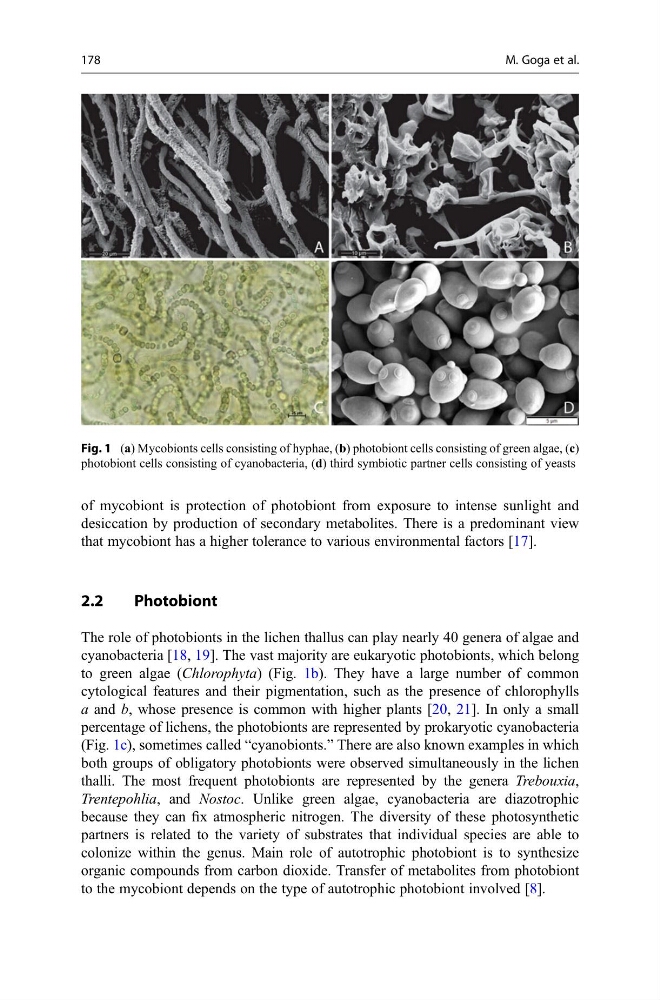
to green algae (Chlorophyta) (Fig. 1b). They have a large number of common
cytological features and their pigmentation, such as the presence of chlorophylls
a and b, whose presence is common with higher plants [20, 21]. In only a small
percentage of lichens, the photobionts are represented by prokaryotic cyanobacteria
(Fig. 1c), sometimes called “cyanobionts.” There are also known examples in which
both groups of obligatory photobionts were observed simultaneously in the lichen
thalli. The most frequent photobionts are represented by the genera Trebouxia,
Trentepohlia, and Nostoc. Unlike green algae, cyanobacteria are diazotrophic
because they can fix atmospheric nitrogen. The diversity of these photosynthetic
partners is related to the variety of substrates that individual species are able to
colonize within the genus. Main role of autotrophic photobiont is to synthesize
organic compounds from carbon dioxide. Transfer of metabolites from photobiont
to the mycobiont depends on the type of autotrophic photobiont involved [8].
Fig. 1 (a) Mycobionts cells consisting of hyphae, (b) photobiont cells consisting of green algae, (c)
photobiont cells consisting of cyanobacteria, (d) third symbiotic partner cells consisting of yeasts
178
M. Goga et al.
desiccation by production of secondary metabolites. There is a predominant view
that mycobiont has a higher tolerance to various environmental factors [17].
2.2
Photobiont
The role of photobionts in the lichen thallus can play nearly 40 genera of algae and
cyanobacteria [18, 19]. The vast majority are eukaryotic photobionts, which belong
to green algae (Chlorophyta) (Fig. 1b). They have a large number of common
cytological features and their pigmentation, such as the presence of chlorophylls
a and b, whose presence is common with higher plants [20, 21]. In only a small
percentage of lichens, the photobionts are represented by prokaryotic cyanobacteria
(Fig. 1c), sometimes called “cyanobionts.” There are also known examples in which
both groups of obligatory photobionts were observed simultaneously in the lichen
thalli. The most frequent photobionts are represented by the genera Trebouxia,
Trentepohlia, and Nostoc. Unlike green algae, cyanobacteria are diazotrophic
because they can fix atmospheric nitrogen. The diversity of these photosynthetic
partners is related to the variety of substrates that individual species are able to
colonize within the genus. Main role of autotrophic photobiont is to synthesize
organic compounds from carbon dioxide. Transfer of metabolites from photobiont
to the mycobiont depends on the type of autotrophic photobiont involved [8].
Fig. 1 (a) Mycobionts cells consisting of hyphae, (b) photobiont cells consisting of green algae, (c)
photobiont cells consisting of cyanobacteria, (d) third symbiotic partner cells consisting of yeasts
178
M. Goga et al.