

1.2
Functions of Plant Secondary Metabolites as Defense
Compounds
During the last decades, it became more and more evident that PSM are not
worthless waste products, but important for the survival and ecological fitness of
a plant producing them [2, 5, 6, 11, 12, 15]. It is a trivial observation that
plants cannot run away when they are attacked by an herbivore nor do they have
an adaptive immune system (as animals have) to ward off microbial pathogens or
parasites. The evolutionary solution of plants and often of other immobile organisms
was the synthesis of defense compounds, which could interfere with the physiology,
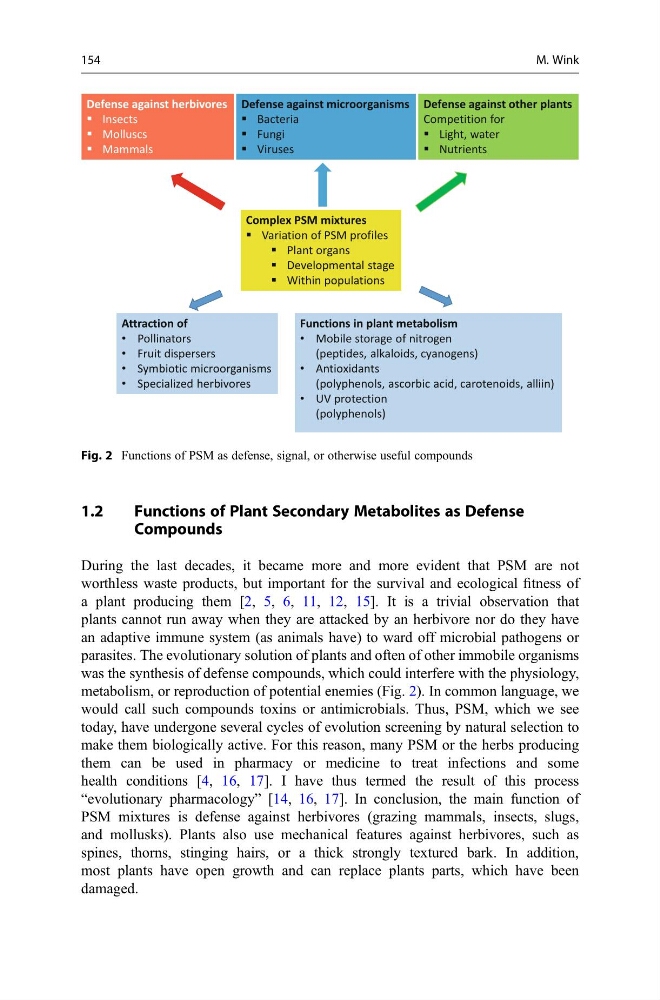
metabolism, or reproduction of potential enemies (Fig. 2). In common language, we
would call such compounds toxins or antimicrobials. Thus, PSM, which we see
today, have undergone several cycles of evolution screening by natural selection to
make them biologically active. For this reason, many PSM or the herbs producing
them can be used in pharmacy or medicine to treat infections and some
health conditions [4, 16, 17]. I have thus termed the result of this process
“evolutionary pharmacology” [14, 16, 17]. In conclusion, the main function of
PSM mixtures is defense against herbivores (grazing mammals, insects, slugs,
and mollusks). Plants also use mechanical features against herbivores, such as
spines, thorns, stinging hairs, or a thick strongly textured bark. In addition,
most plants have open growth and can replace plants parts, which have been
damaged.
Complex PSM mixtures
Variation of PSM profiles
Plant organs
Developmental stage
Within populations
Defense against herbivores
Insects
Molluscs
Mammals
Defense against microorganisms
Bacteria
Fungi
Viruses
Defense against other plants
Competition for
Light, water
Nutrients
Attraction of
• Pollinators
• Fruit dispersers
• Symbiotic microorganisms
• Specialized herbivores
Functions in plant metabolism
• Mobile storage of nitrogen
(peptides, alkaloids, cyanogens)
• Antioxidants
(polyphenols, ascorbic acid, carotenoids, alliin)
• UV protection
(polyphenols)
Fig. 2 Functions of PSM as defense, signal, or otherwise useful compounds
154
M. Wink
Functions of Plant Secondary Metabolites as Defense
Compounds
During the last decades, it became more and more evident that PSM are not
worthless waste products, but important for the survival and ecological fitness of
a plant producing them [2, 5, 6, 11, 12, 15]. It is a trivial observation that
plants cannot run away when they are attacked by an herbivore nor do they have
an adaptive immune system (as animals have) to ward off microbial pathogens or
parasites. The evolutionary solution of plants and often of other immobile organisms
was the synthesis of defense compounds, which could interfere with the physiology,
metabolism, or reproduction of potential enemies (Fig. 2). In common language, we
would call such compounds toxins or antimicrobials. Thus, PSM, which we see
today, have undergone several cycles of evolution screening by natural selection to
make them biologically active. For this reason, many PSM or the herbs producing
them can be used in pharmacy or medicine to treat infections and some
health conditions [4, 16, 17]. I have thus termed the result of this process
“evolutionary pharmacology” [14, 16, 17]. In conclusion, the main function of
PSM mixtures is defense against herbivores (grazing mammals, insects, slugs,
and mollusks). Plants also use mechanical features against herbivores, such as
spines, thorns, stinging hairs, or a thick strongly textured bark. In addition,
most plants have open growth and can replace plants parts, which have been
damaged.
Complex PSM mixtures
Variation of PSM profiles
Plant organs
Developmental stage
Within populations
Defense against herbivores
Insects
Molluscs
Mammals
Defense against microorganisms
Bacteria
Fungi
Viruses
Defense against other plants
Competition for
Light, water
Nutrients
Attraction of
• Pollinators
• Fruit dispersers
• Symbiotic microorganisms
• Specialized herbivores
Functions in plant metabolism
• Mobile storage of nitrogen
(peptides, alkaloids, cyanogens)
• Antioxidants
(polyphenols, ascorbic acid, carotenoids, alliin)
• UV protection
(polyphenols)
Fig. 2 Functions of PSM as defense, signal, or otherwise useful compounds
154
M. Wink