

are dominant in angiosperms, which comprise more than 90% of all
living plants. Angiosperms develop showy flowers to attract pollinators.
However, these pollinators should only feed on nectar but not on the aerial
parts or flowers of a plant. It is argued that the diversification of angiosperms
was a driving force for the radiation and diversification of insects, which comprise
the majority of animals with more than 1.4 million species. As a sort of coevolution, angiosperms, which rely on animal pollination, started to produce a
wide diversity of neurotoxic and fast-acting alkaloids to keep their animal visitors
under control.
Keywords
Plant phylogeny · Secondary metabolites · Alkaloids · Co-evolution ·
Pollination · Herbivory · Chemical defense
Abbreviations
AMP Antimicrobial peptide
PSM Plant secondary metabolite
1
Introduction: Evolution and Functions of Secondary
Metabolites
1.1
Plant Secondary Metabolism
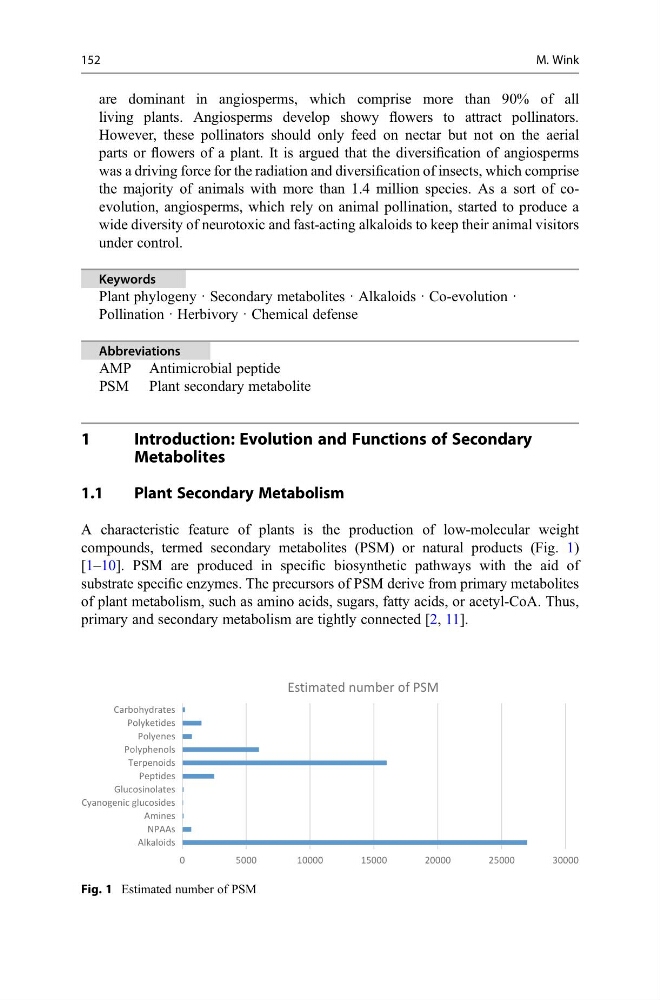
A characteristic feature of plants is the production of low-molecular weight
compounds, termed secondary metabolites (PSM) or natural products (Fig. 1)
[1–10]. PSM are produced in specific biosynthetic pathways with the aid of
substrate specific enzymes. The precursors of PSM derive from primary metabolites
of plant metabolism, such as amino acids, sugars, fatty acids, or acetyl-CoA. Thus,
primary and secondary metabolism are tightly connected [2, 11].
0
5000
10000
15000
20000
25000
30000
Alkaloids
NPAAs
Amines
Cyanogenic glucosides
Glucosinolates
Peptides
Terpenoids
Polyphenols
Polyenes
Polyketides
Carbohydrates
Estimated number of PSM
Fig. 1 Estimated number of PSM
152
M. Wink
living plants. Angiosperms develop showy flowers to attract pollinators.
However, these pollinators should only feed on nectar but not on the aerial
parts or flowers of a plant. It is argued that the diversification of angiosperms
was a driving force for the radiation and diversification of insects, which comprise
the majority of animals with more than 1.4 million species. As a sort of coevolution, angiosperms, which rely on animal pollination, started to produce a
wide diversity of neurotoxic and fast-acting alkaloids to keep their animal visitors
under control.
Keywords
Plant phylogeny · Secondary metabolites · Alkaloids · Co-evolution ·
Pollination · Herbivory · Chemical defense
Abbreviations
AMP Antimicrobial peptide
PSM Plant secondary metabolite
1
Introduction: Evolution and Functions of Secondary
Metabolites
1.1
Plant Secondary Metabolism
A characteristic feature of plants is the production of low-molecular weight
compounds, termed secondary metabolites (PSM) or natural products (Fig. 1)
[1–10]. PSM are produced in specific biosynthetic pathways with the aid of
substrate specific enzymes. The precursors of PSM derive from primary metabolites
of plant metabolism, such as amino acids, sugars, fatty acids, or acetyl-CoA. Thus,
primary and secondary metabolism are tightly connected [2, 11].
0
5000
10000
15000
20000
25000
30000
Alkaloids
NPAAs
Amines
Cyanogenic glucosides
Glucosinolates
Peptides
Terpenoids
Polyphenols
Polyenes
Polyketides
Carbohydrates
Estimated number of PSM
Fig. 1 Estimated number of PSM
152
M. Wink