

produce a variety of secondary metabolites [25] and several of them are woundactivated [26, 27]. Some wound activated compounds produced by benthic diatoms
after the ingestion by various grazers have the role of infochemicals [28] and they
influence the behavior of invertebrates [29], because they evolved chemotactic
reactions using the volatile organic compounds of diatoms to detect the possible
presence of predators or the locations of specific food items [30]. Other compounds
are toxic for various invertebrates but still, evolutionary relationships may tune their
activity [31]. For example, it has been demonstrated [29] that the toxicity of diatoms
[32, 33] is inversely correlated to the ability of animals to recognize their odors and
this fits the scope of their insidious defense compounds [13], but benthic invertebrates tend to develop “good noses” for those species that are stable components of
their environments, probably due to co-evolutionary processes [34]. Thus, the
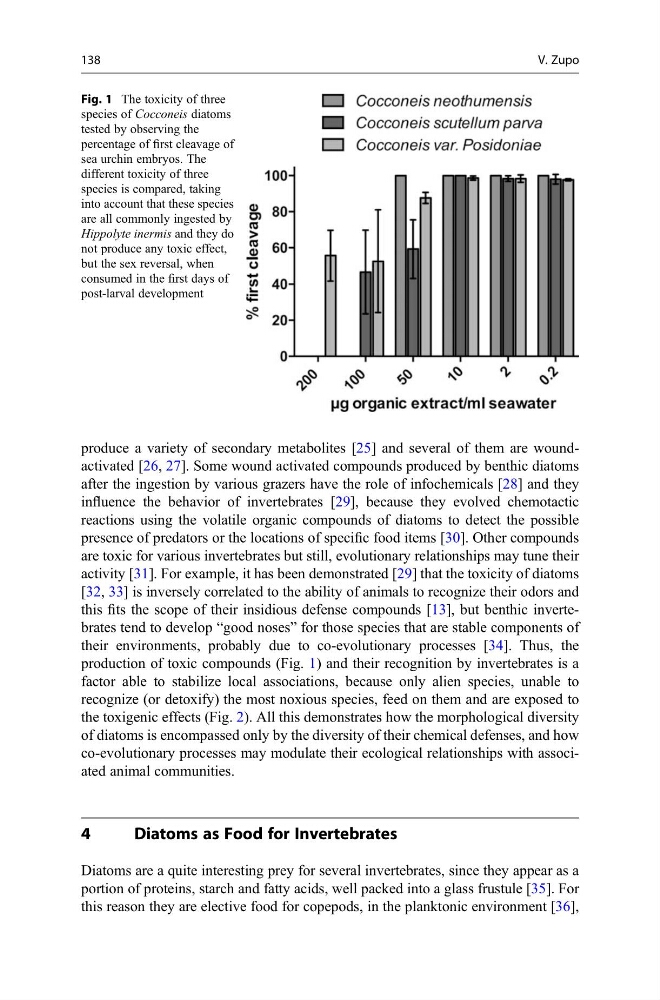
production of toxic compounds (Fig. 1) and their recognition by invertebrates is a
factor able to stabilize local associations, because only alien species, unable to
recognize (or detoxify) the most noxious species, feed on them and are exposed to
the toxigenic effects (Fig. 2). All this demonstrates how the morphological diversity
of diatoms is encompassed only by the diversity of their chemical defenses, and how
co-evolutionary processes may modulate their ecological relationships with associated animal communities.
4
Diatoms as Food for Invertebrates
Diatoms are a quite interesting prey for several invertebrates, since they appear as a
portion of proteins, starch and fatty acids, well packed into a glass frustule [35]. For
this reason they are elective food for copepods, in the planktonic environment [36],
Fig. 1 The toxicity of three
species of Cocconeis diatoms
tested by observing the
percentage of first cleavage of
sea urchin embryos. The
different toxicity of three
species is compared, taking
into account that these species
are all commonly ingested by
Hippolyte inermis and they do
not produce any toxic effect,
but the sex reversal, when
consumed in the first days of
post-larval development
138
V. Zupo
after the ingestion by various grazers have the role of infochemicals [28] and they
influence the behavior of invertebrates [29], because they evolved chemotactic
reactions using the volatile organic compounds of diatoms to detect the possible
presence of predators or the locations of specific food items [30]. Other compounds
are toxic for various invertebrates but still, evolutionary relationships may tune their
activity [31]. For example, it has been demonstrated [29] that the toxicity of diatoms
[32, 33] is inversely correlated to the ability of animals to recognize their odors and
this fits the scope of their insidious defense compounds [13], but benthic invertebrates tend to develop “good noses” for those species that are stable components of
their environments, probably due to co-evolutionary processes [34]. Thus, the
production of toxic compounds (Fig. 1) and their recognition by invertebrates is a
factor able to stabilize local associations, because only alien species, unable to
recognize (or detoxify) the most noxious species, feed on them and are exposed to
the toxigenic effects (Fig. 2). All this demonstrates how the morphological diversity
of diatoms is encompassed only by the diversity of their chemical defenses, and how
co-evolutionary processes may modulate their ecological relationships with associated animal communities.
4
Diatoms as Food for Invertebrates
Diatoms are a quite interesting prey for several invertebrates, since they appear as a
portion of proteins, starch and fatty acids, well packed into a glass frustule [35]. For
this reason they are elective food for copepods, in the planktonic environment [36],
Fig. 1 The toxicity of three
species of Cocconeis diatoms
tested by observing the
percentage of first cleavage of
sea urchin embryos. The
different toxicity of three
species is compared, taking
into account that these species
are all commonly ingested by
Hippolyte inermis and they do
not produce any toxic effect,
but the sex reversal, when
consumed in the first days of
post-larval development
138
V. Zupo