

swallowtail butterflies in Alaska started to use novel hosts, despite being well
adapted to their ancestral Apiaceae hosts, probably as the new hosts represent an
enemy free space [52].
All insect herbivores are trying to achieve optimal feeding efficiency and growth
rates. They pursue maximal nutrient value of their diet, while balancing other risks
[3, 53]. However, generalist insects often cannot fully benefit from high nitrogen and
nutrient content as they are not able to fully overcome toxic metabolites of their
hosts, as mentioned above. Therefore, they often show lower growth rates and
nitrogen content is a weaker predictor of their community composition than secondary chemistry of the host [54]. On the other hand, specialists are usually able to cope
with toxins of the host and can pursue high nutrients more efficiently, making
nitrogen an important factor structuring their communities [15]. As such, the
abovementioned adaptations help specialized insects to avoid predation and parasitism not only by using secondary metabolites of their hosts [55] but also by fast
growth, avoiding predators and parasitoids in time (if generalists are directly
defended, they seem to rely on physical defences, such as spines or shelters [54]).
Many herbivores use behavioral adaptations, such as staying cryptic, to avoid
their natural enemies in space [56]. Locating insect herbivores is thus not an easy
task for predators and parasitoids that often have to rely on cues provided by host
plants. Plants have evolved mechanisms to attract predators and parasitoids in order
a
b
c
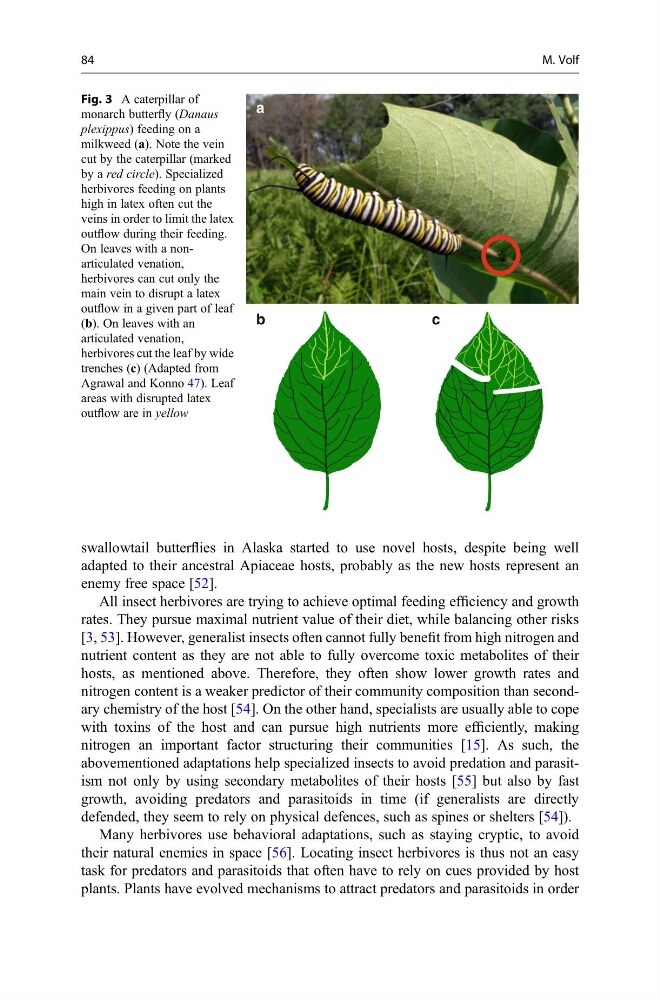
Fig. 3 A caterpillar of
monarch butterfly (Danaus
plexippus) feeding on a
milkweed (a). Note the vein
cut by the caterpillar (marked
by a red circle). Specialized
herbivores feeding on plants
high in latex often cut the
veins in order to limit the latex
outflow during their feeding.
On leaves with a nonarticulated venation,
herbivores can cut only the
main vein to disrupt a latex
outflow in a given part of leaf
(b). On leaves with an
articulated venation,
herbivores cut the leaf by wide
trenches (c) (Adapted from
Agrawal and Konno 47). Leaf
areas with disrupted latex
outflow are in yellow
84
M. Volf
adapted to their ancestral Apiaceae hosts, probably as the new hosts represent an
enemy free space [52].
All insect herbivores are trying to achieve optimal feeding efficiency and growth
rates. They pursue maximal nutrient value of their diet, while balancing other risks
[3, 53]. However, generalist insects often cannot fully benefit from high nitrogen and
nutrient content as they are not able to fully overcome toxic metabolites of their
hosts, as mentioned above. Therefore, they often show lower growth rates and
nitrogen content is a weaker predictor of their community composition than secondary chemistry of the host [54]. On the other hand, specialists are usually able to cope
with toxins of the host and can pursue high nutrients more efficiently, making
nitrogen an important factor structuring their communities [15]. As such, the
abovementioned adaptations help specialized insects to avoid predation and parasitism not only by using secondary metabolites of their hosts [55] but also by fast
growth, avoiding predators and parasitoids in time (if generalists are directly
defended, they seem to rely on physical defences, such as spines or shelters [54]).
Many herbivores use behavioral adaptations, such as staying cryptic, to avoid
their natural enemies in space [56]. Locating insect herbivores is thus not an easy
task for predators and parasitoids that often have to rely on cues provided by host
plants. Plants have evolved mechanisms to attract predators and parasitoids in order
a
b
c
Fig. 3 A caterpillar of
monarch butterfly (Danaus
plexippus) feeding on a
milkweed (a). Note the vein
cut by the caterpillar (marked
by a red circle). Specialized
herbivores feeding on plants
high in latex often cut the
veins in order to limit the latex
outflow during their feeding.
On leaves with a nonarticulated venation,
herbivores can cut only the
main vein to disrupt a latex
outflow in a given part of leaf
(b). On leaves with an
articulated venation,
herbivores cut the leaf by wide
trenches (c) (Adapted from
Agrawal and Konno 47). Leaf
areas with disrupted latex
outflow are in yellow
84
M. Volf