

a
b
OH
H
O
O
O
H
O
H
OH
OH
O
OH
c
d
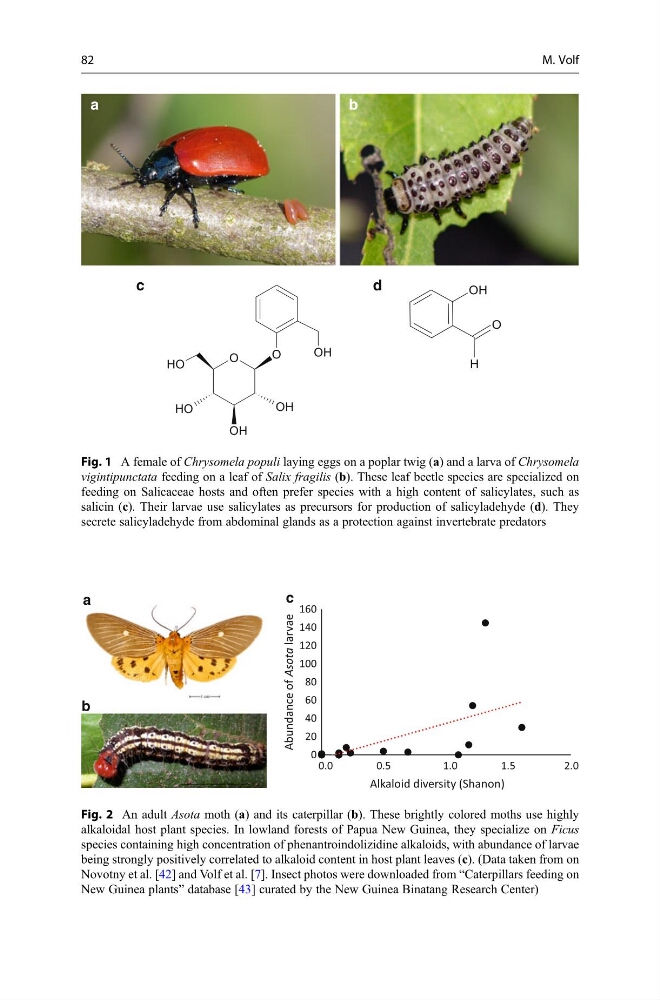
Fig. 1 A female of Chrysomela populi laying eggs on a poplar twig (a) and a larva of Chrysomela
vigintipunctata feeding on a leaf of Salix fragilis (b). These leaf beetle species are specialized on
feeding on Salicaceae hosts and often prefer species with a high content of salicylates, such as
salicin (c). Their larvae use salicylates as precursors for production of salicyladehyde (d). They
secrete salicyladehyde from abdominal glands as a protection against invertebrate predators
0
20
40
60
80
100
120
140
160
0.0
0.5
1.0
1.5
2.0
Abundance of Asota larvae
Alkaloid diversity (Shanon)
a
b
c
Fig. 2 An adult Asota moth (a) and its caterpillar (b). These brightly colored moths use highly
alkaloidal host plant species. In lowland forests of Papua New Guinea, they specialize on Ficus
species containing high concentration of phenantroindolizidine alkaloids, with abundance of larvae
being strongly positively correlated to alkaloid content in host plant leaves (c). (Data taken from on
Novotny et al. [42] and Volf et al. [7]. Insect photos were downloaded from “Caterpillars feeding on
New Guinea plants” database [43] curated by the New Guinea Binatang Research Center)
82
M. Volf
b
OH
H
O
O
O
H
O
H
OH
OH
O
OH
c
d
Fig. 1 A female of Chrysomela populi laying eggs on a poplar twig (a) and a larva of Chrysomela
vigintipunctata feeding on a leaf of Salix fragilis (b). These leaf beetle species are specialized on
feeding on Salicaceae hosts and often prefer species with a high content of salicylates, such as
salicin (c). Their larvae use salicylates as precursors for production of salicyladehyde (d). They
secrete salicyladehyde from abdominal glands as a protection against invertebrate predators
0
20
40
60
80
100
120
140
160
0.0
0.5
1.0
1.5
2.0
Abundance of Asota larvae
Alkaloid diversity (Shanon)
a
b
c
Fig. 2 An adult Asota moth (a) and its caterpillar (b). These brightly colored moths use highly
alkaloidal host plant species. In lowland forests of Papua New Guinea, they specialize on Ficus
species containing high concentration of phenantroindolizidine alkaloids, with abundance of larvae
being strongly positively correlated to alkaloid content in host plant leaves (c). (Data taken from on
Novotny et al. [42] and Volf et al. [7]. Insect photos were downloaded from “Caterpillars feeding on
New Guinea plants” database [43] curated by the New Guinea Binatang Research Center)
82
M. Volf