

generalized) [11]. Categorization of insects based on arbitrary observations of
feeding habits can “hide” the accurate distribution of diet breath across community
and lead to inherit limitation in the use of such categories. Nonetheless, some
groups of insect herbivores such as leaf miners, leafhoppers, butterflies, and
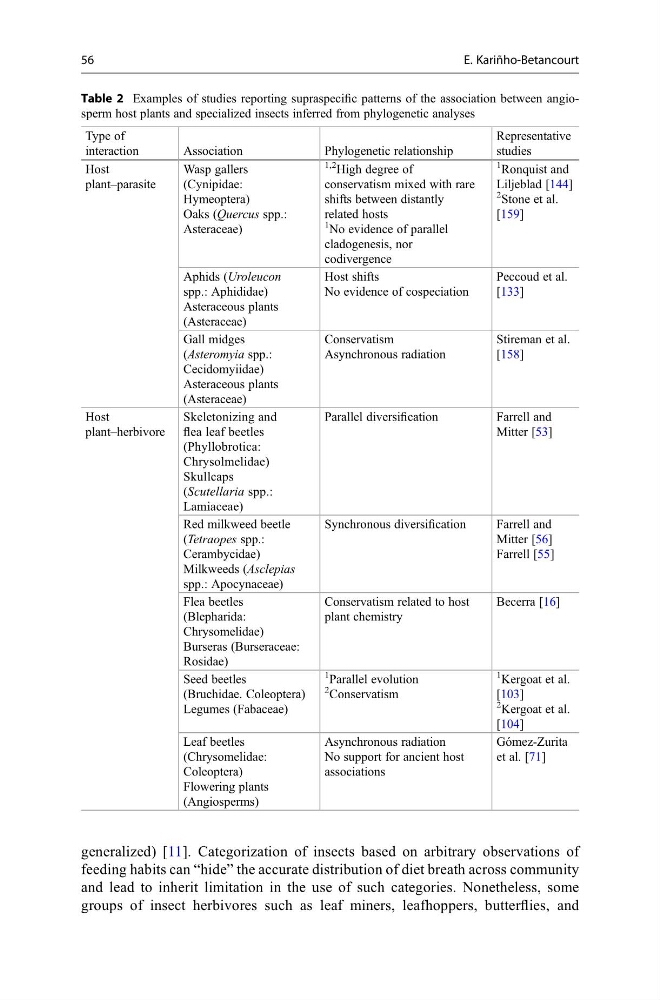
Table 2 Examples of studies reporting supraspecific patterns of the association between angiosperm host plants and specialized insects inferred from phylogenetic analyses
Type of
interaction
Association
Phylogenetic relationship
Representative
studies
Host
plant–parasite
Wasp gallers
(Cynipidae:
Hymeoptera)
Oaks (Quercus spp.:
Asteraceae)
1,2
High degree of
conservatism mixed with rare
shifts between distantly
related hosts
1
No evidence of parallel
cladogenesis, nor
codivergence
1 Ronquist and
Liljeblad [144]
2 Stone et al.
[159]
Aphids (Uroleucon
spp.: Aphididae)
Asteraceous plants
(Asteraceae)
Host shifts
No evidence of cospeciation
Peccoud et al.
[133]
Gall midges
(Asteromyia spp.:
Cecidomyiidae)
Asteraceous plants
(Asteraceae)
Conservatism
Asynchronous radiation
Stireman et al.
[158]
Host
plant–herbivore
Skeletonizing and
flea leaf beetles
(Phyllobrotica:
Chrysolmelidae)
Skullcaps
(Scutellaria spp.:
Lamiaceae)
Parallel diversification
Farrell and
Mitter [53]
Red milkweed beetle
(Tetraopes spp.:
Cerambycidae)
Milkweeds (Asclepias
spp.: Apocynaceae)
Synchronous diversification
Farrell and
Mitter [56]
Farrell [55]
Flea beetles
(Blepharida:
Chrysomelidae)
Burseras (Burseraceae:
Rosidae)
Conservatism related to host
plant chemistry
Becerra [16]
Seed beetles
(Bruchidae. Coleoptera)
Legumes (Fabaceae)
1
Parallel evolution
2
Conservatism
1 Kergoat et al.
[103]
2 Kergoat et al.
[104]
Leaf beetles
(Chrysomelidae:
Coleoptera)
Flowering plants
(Angiosperms)
Asynchronous radiation
No support for ancient host
associations
Gómez-Zurita
et al. [71]
56
E. Kariñho-Betancourt
feeding habits can “hide” the accurate distribution of diet breath across community
and lead to inherit limitation in the use of such categories. Nonetheless, some
groups of insect herbivores such as leaf miners, leafhoppers, butterflies, and
Table 2 Examples of studies reporting supraspecific patterns of the association between angiosperm host plants and specialized insects inferred from phylogenetic analyses
Type of
interaction
Association
Phylogenetic relationship
Representative
studies
Host
plant–parasite
Wasp gallers
(Cynipidae:
Hymeoptera)
Oaks (Quercus spp.:
Asteraceae)
1,2
High degree of
conservatism mixed with rare
shifts between distantly
related hosts
1
No evidence of parallel
cladogenesis, nor
codivergence
1 Ronquist and
Liljeblad [144]
2 Stone et al.
[159]
Aphids (Uroleucon
spp.: Aphididae)
Asteraceous plants
(Asteraceae)
Host shifts
No evidence of cospeciation
Peccoud et al.
[133]
Gall midges
(Asteromyia spp.:
Cecidomyiidae)
Asteraceous plants
(Asteraceae)
Conservatism
Asynchronous radiation
Stireman et al.
[158]
Host
plant–herbivore
Skeletonizing and
flea leaf beetles
(Phyllobrotica:
Chrysolmelidae)
Skullcaps
(Scutellaria spp.:
Lamiaceae)
Parallel diversification
Farrell and
Mitter [53]
Red milkweed beetle
(Tetraopes spp.:
Cerambycidae)
Milkweeds (Asclepias
spp.: Apocynaceae)
Synchronous diversification
Farrell and
Mitter [56]
Farrell [55]
Flea beetles
(Blepharida:
Chrysomelidae)
Burseras (Burseraceae:
Rosidae)
Conservatism related to host
plant chemistry
Becerra [16]
Seed beetles
(Bruchidae. Coleoptera)
Legumes (Fabaceae)
1
Parallel evolution
2
Conservatism
1 Kergoat et al.
[103]
2 Kergoat et al.
[104]
Leaf beetles
(Chrysomelidae:
Coleoptera)
Flowering plants
(Angiosperms)
Asynchronous radiation
No support for ancient host
associations
Gómez-Zurita
et al. [71]
56
E. Kariñho-Betancourt