

342
K. Kubiak-Wójcicka and L. Szcz˛ ech
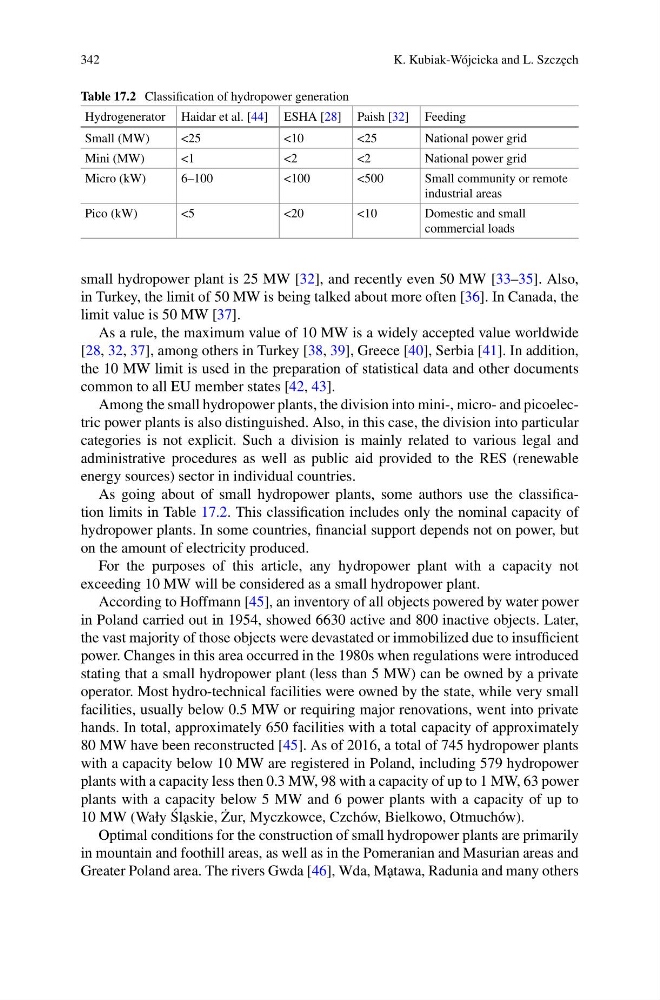
Table 17.2 Classification of hydropower generation
Hydrogenerator Haidar et al. [44] ESHA [28] Paish [32] Feeding
Small (MW)
<25
<10
<25
National power grid
Mini (MW)
<1
<2
<2
National power grid
Micro (kW)
6–100
<100
<500
Small community or remote
industrial areas
Pico (kW)
<5
<20
<10
Domestic and small
commercial loads
small hydropower plant is 25 MW [32], and recently even 50 MW [33–35]. Also,
in Turkey, the limit of 50 MW is being talked about more often [36]. In Canada, the
limit value is 50 MW [37].
As a rule, the maximum value of 10 MW is a widely accepted value worldwide
[28, 32, 37], among others in Turkey [38, 39], Greece [40], Serbia [41]. In addition,
the 10 MW limit is used in the preparation of statistical data and other documents
common to all EU member states [42, 43].
Among the small hydropower plants, the division into mini-, micro- and picoelectric power plants is also distinguished. Also, in this case, the division into particular
categories is not explicit. Such a division is mainly related to various legal and
administrative procedures as well as public aid provided to the RES (renewable
energy sources) sector in individual countries.
As going about of small hydropower plants, some authors use the classification limits in Table 17.2. This classification includes only the nominal capacity of
hydropower plants. In some countries, financial support depends not on power, but
on the amount of electricity produced.
For the purposes of this article, any hydropower plant with a capacity not
exceeding 10 MW will be considered as a small hydropower plant.
According to Hoffmann [45], an inventory of all objects powered by water power
in Poland carried out in 1954, showed 6630 active and 800 inactive objects. Later,
the vast majority of those objects were devastated or immobilized due to insufficient
power. Changes in this area occurred in the 1980s when regulations were introduced
stating that a small hydropower plant (less than 5 MW) can be owned by a private
operator. Most hydro-technical facilities were owned by the state, while very small
facilities, usually below 0.5 MW or requiring major renovations, went into private
hands. In total, approximately 650 facilities with a total capacity of approximately
80 MW have been reconstructed [45]. As of 2016, a total of 745 hydropower plants
with a capacity below 10 MW are registered in Poland, including 579 hydropower
plants with a capacity less then 0.3 MW, 98 with a capacity of up to 1 MW, 63 power
plants with a capacity below 5 MW and 6 power plants with a capacity of up to
10 MW (Wały ´
Sl˛ askie, ˙
Zur, Myczkowce, Czchów, Bielkowo, Otmuchów).
Optimal conditions for the construction of small hydropower plants are primarily
in mountain and foothill areas, as well as in the Pomeranian and Masurian areas and
Greater Poland area. The rivers Gwda [46], Wda, M˛ atawa, Radunia and many others
K. Kubiak-Wójcicka and L. Szcz˛ ech
Table 17.2 Classification of hydropower generation
Hydrogenerator Haidar et al. [44] ESHA [28] Paish [32] Feeding
Small (MW)
<25
<10
<25
National power grid
Mini (MW)
<1
<2
<2
National power grid
Micro (kW)
6–100
<100
<500
Small community or remote
industrial areas
Pico (kW)
<5
<20
<10
Domestic and small
commercial loads
small hydropower plant is 25 MW [32], and recently even 50 MW [33–35]. Also,
in Turkey, the limit of 50 MW is being talked about more often [36]. In Canada, the
limit value is 50 MW [37].
As a rule, the maximum value of 10 MW is a widely accepted value worldwide
[28, 32, 37], among others in Turkey [38, 39], Greece [40], Serbia [41]. In addition,
the 10 MW limit is used in the preparation of statistical data and other documents
common to all EU member states [42, 43].
Among the small hydropower plants, the division into mini-, micro- and picoelectric power plants is also distinguished. Also, in this case, the division into particular
categories is not explicit. Such a division is mainly related to various legal and
administrative procedures as well as public aid provided to the RES (renewable
energy sources) sector in individual countries.
As going about of small hydropower plants, some authors use the classification limits in Table 17.2. This classification includes only the nominal capacity of
hydropower plants. In some countries, financial support depends not on power, but
on the amount of electricity produced.
For the purposes of this article, any hydropower plant with a capacity not
exceeding 10 MW will be considered as a small hydropower plant.
According to Hoffmann [45], an inventory of all objects powered by water power
in Poland carried out in 1954, showed 6630 active and 800 inactive objects. Later,
the vast majority of those objects were devastated or immobilized due to insufficient
power. Changes in this area occurred in the 1980s when regulations were introduced
stating that a small hydropower plant (less than 5 MW) can be owned by a private
operator. Most hydro-technical facilities were owned by the state, while very small
facilities, usually below 0.5 MW or requiring major renovations, went into private
hands. In total, approximately 650 facilities with a total capacity of approximately
80 MW have been reconstructed [45]. As of 2016, a total of 745 hydropower plants
with a capacity below 10 MW are registered in Poland, including 579 hydropower
plants with a capacity less then 0.3 MW, 98 with a capacity of up to 1 MW, 63 power
plants with a capacity below 5 MW and 6 power plants with a capacity of up to
10 MW (Wały ´
Sl˛ askie, ˙
Zur, Myczkowce, Czchów, Bielkowo, Otmuchów).
Optimal conditions for the construction of small hydropower plants are primarily
in mountain and foothill areas, as well as in the Pomeranian and Masurian areas and
Greater Poland area. The rivers Gwda [46], Wda, M˛ atawa, Radunia and many others