

15 Flood Risk Management System in Poland
289
risk (category II) is related to losses mainly in agriculture (crop destruction) and
on local thoroughfares (roads, bridges). This risk category pertains to river valleys
used for agriculture or not provided with flood protection and floodland without
agriculture and industrial infrastructure. Low flood risk (category III) is recorded
when economic losses are insignificant and involve mainly local damage to roads
and river infrastructure. Potentially, flood risk could reach this level in unprotected
river valleys and meadows and pastures.
15.4.2 Stages of Flood Risk Management
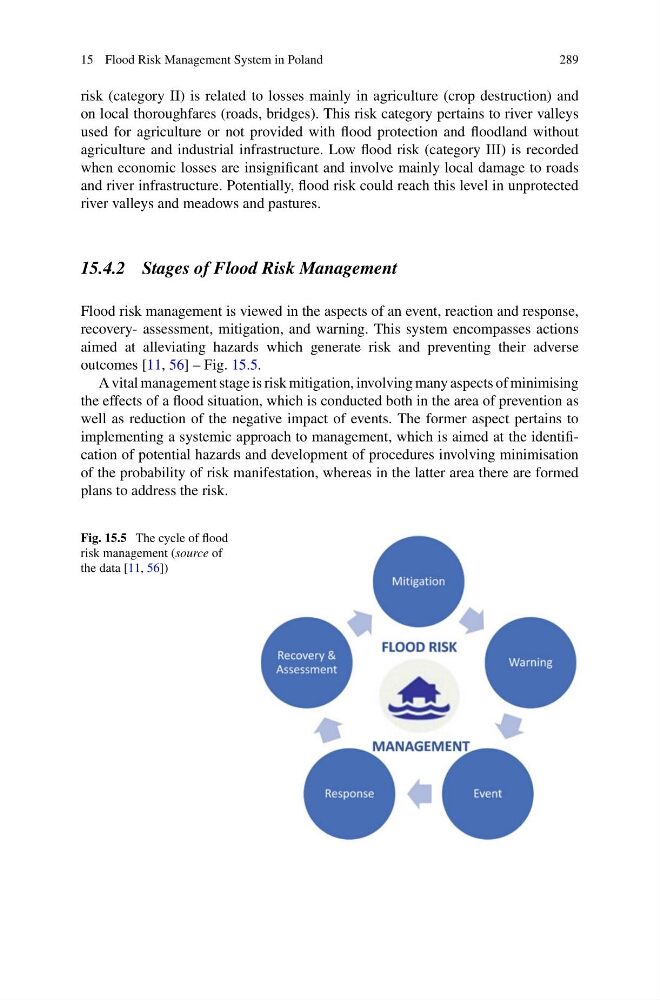
Flood risk management is viewed in the aspects of an event, reaction and response,
recovery- assessment, mitigation, and warning. This system encompasses actions
aimed at alleviating hazards which generate risk and preventing their adverse
outcomes [11, 56] – Fig. 15.5.
A vital management stage is risk mitigation, involving many aspects of minimising
the effects of a flood situation, which is conducted both in the area of prevention as
well as reduction of the negative impact of events. The former aspect pertains to
implementing a systemic approach to management, which is aimed at the identification of potential hazards and development of procedures involving minimisation
of the probability of risk manifestation, whereas in the latter area there are formed
plans to address the risk.
Fig. 15.5 The cycle of flood
risk management (source of
the data [11, 56])
289
risk (category II) is related to losses mainly in agriculture (crop destruction) and
on local thoroughfares (roads, bridges). This risk category pertains to river valleys
used for agriculture or not provided with flood protection and floodland without
agriculture and industrial infrastructure. Low flood risk (category III) is recorded
when economic losses are insignificant and involve mainly local damage to roads
and river infrastructure. Potentially, flood risk could reach this level in unprotected
river valleys and meadows and pastures.
15.4.2 Stages of Flood Risk Management
Flood risk management is viewed in the aspects of an event, reaction and response,
recovery- assessment, mitigation, and warning. This system encompasses actions
aimed at alleviating hazards which generate risk and preventing their adverse
outcomes [11, 56] – Fig. 15.5.
A vital management stage is risk mitigation, involving many aspects of minimising
the effects of a flood situation, which is conducted both in the area of prevention as
well as reduction of the negative impact of events. The former aspect pertains to
implementing a systemic approach to management, which is aimed at the identification of potential hazards and development of procedures involving minimisation
of the probability of risk manifestation, whereas in the latter area there are formed
plans to address the risk.
Fig. 15.5 The cycle of flood
risk management (source of
the data [11, 56])