

282
R. Graf
Keywords Flood risk · EU floods directive · Management · Flood hazard map ·
Flood risk map · Risk management plan · Mitigation · Poland
15.1 Introduction
Extreme natural phenomena are the cause of many disasters, and the greatest on the
world scale is water-related hazards [1–3]. At present, there is observed an increase
of the incidence and magnitude of floods, to which contributes the reduction of catchment retention, increasing the exposure and susceptibility of an area to the risk of
flood occurrence and the rising number of people inhabiting flood-prone areas [4–7].
Susceptibilities arise and increase for many reasons, including population growth,
urban development in risk-prone locations, land-use changes, environmental degradation, weak governance, and climate change. Flood, as a hydrological phenomenon
with socio-economic significance [8] is classified among the most dangerous and
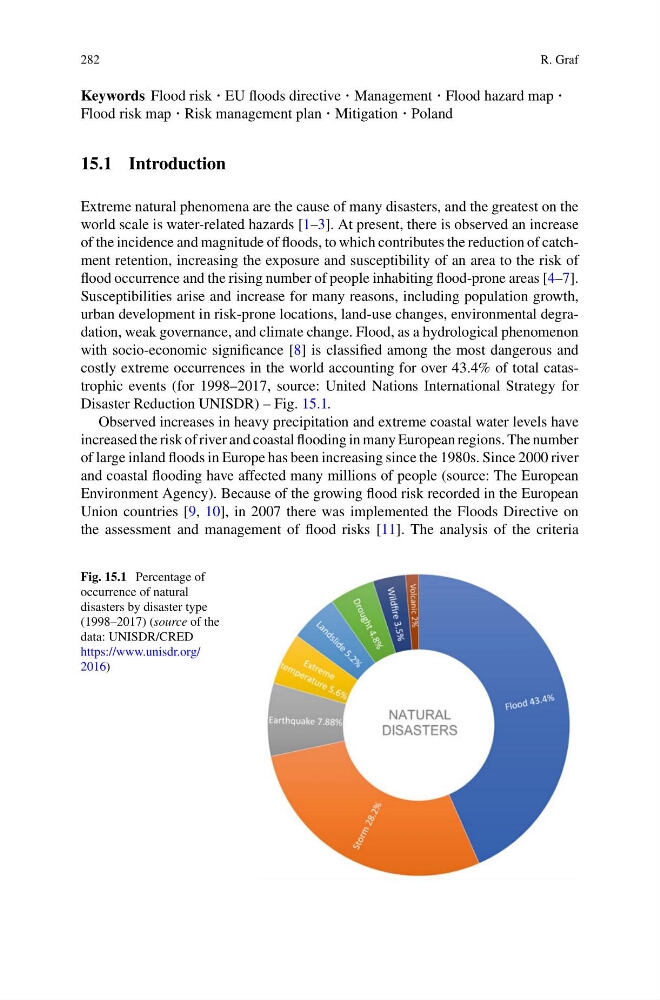
costly extreme occurrences in the world accounting for over 43.4% of total catastrophic events (for 1998–2017, source: United Nations International Strategy for
Disaster Reduction UNISDR) – Fig. 15.1.
Observed increases in heavy precipitation and extreme coastal water levels have
increased the risk of river and coastal flooding in many European regions. The number
of large inland floods in Europe has been increasing since the 1980s. Since 2000 river
and coastal flooding have affected many millions of people (source: The European
Environment Agency). Because of the growing flood risk recorded in the European
Union countries [9, 10], in 2007 there was implemented the Floods Directive on
the assessment and management of flood risks [11]. The analysis of the criteria
Fig. 15.1 Percentage of
occurrence of natural
disasters by disaster type
(1998–2017) (source of the
data: UNISDR/CRED
https://www.unisdr.org/
2016)
R. Graf
Keywords Flood risk · EU floods directive · Management · Flood hazard map ·
Flood risk map · Risk management plan · Mitigation · Poland
15.1 Introduction
Extreme natural phenomena are the cause of many disasters, and the greatest on the
world scale is water-related hazards [1–3]. At present, there is observed an increase
of the incidence and magnitude of floods, to which contributes the reduction of catchment retention, increasing the exposure and susceptibility of an area to the risk of
flood occurrence and the rising number of people inhabiting flood-prone areas [4–7].
Susceptibilities arise and increase for many reasons, including population growth,
urban development in risk-prone locations, land-use changes, environmental degradation, weak governance, and climate change. Flood, as a hydrological phenomenon
with socio-economic significance [8] is classified among the most dangerous and
costly extreme occurrences in the world accounting for over 43.4% of total catastrophic events (for 1998–2017, source: United Nations International Strategy for
Disaster Reduction UNISDR) – Fig. 15.1.
Observed increases in heavy precipitation and extreme coastal water levels have
increased the risk of river and coastal flooding in many European regions. The number
of large inland floods in Europe has been increasing since the 1980s. Since 2000 river
and coastal flooding have affected many millions of people (source: The European
Environment Agency). Because of the growing flood risk recorded in the European
Union countries [9, 10], in 2007 there was implemented the Floods Directive on
the assessment and management of flood risks [11]. The analysis of the criteria
Fig. 15.1 Percentage of
occurrence of natural
disasters by disaster type
(1998–2017) (source of the
data: UNISDR/CRED
https://www.unisdr.org/
2016)