

230
E. Tomaszewski and M. Kozek
12.1 Introduction
Drought is one of the most unfavourable effects of weather and climate variability.
It is usually defined as an exceptionally dry (rainless) period long enough so that
water deficit seriously disturbs the structure of water balance within a specific area
[1, 2]. Its basic feature is limited access to water resources. Drought is usually
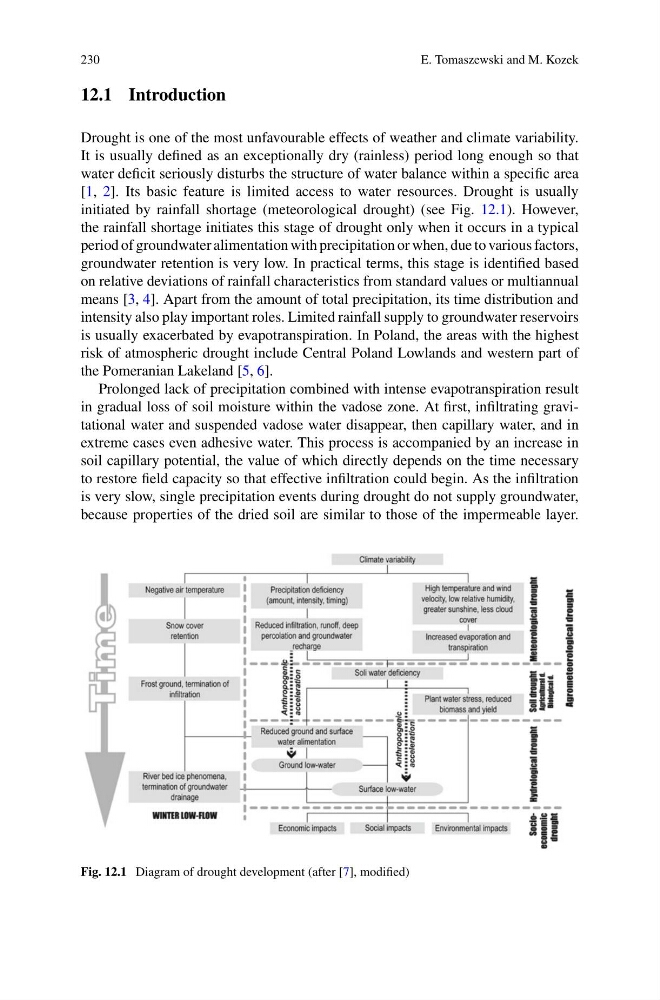
initiated by rainfall shortage (meteorological drought) (see Fig. 12.1). However,
the rainfall shortage initiates this stage of drought only when it occurs in a typical
period of groundwater alimentation with precipitation or when, due to various factors,
groundwater retention is very low. In practical terms, this stage is identified based
on relative deviations of rainfall characteristics from standard values or multiannual
means [3, 4]. Apart from the amount of total precipitation, its time distribution and
intensity also play important roles. Limited rainfall supply to groundwater reservoirs
is usually exacerbated by evapotranspiration. In Poland, the areas with the highest
risk of atmospheric drought include Central Poland Lowlands and western part of
the Pomeranian Lakeland [5, 6].
Prolonged lack of precipitation combined with intense evapotranspiration result
in gradual loss of soil moisture within the vadose zone. At first, infiltrating gravitational water and suspended vadose water disappear, then capillary water, and in
extreme cases even adhesive water. This process is accompanied by an increase in
soil capillary potential, the value of which directly depends on the time necessary
to restore field capacity so that effective infiltration could begin. As the infiltration
is very slow, single precipitation events during drought do not supply groundwater,
because properties of the dried soil are similar to those of the impermeable layer.
Fig. 12.1 Diagram of drought development (after [7], modified)
E. Tomaszewski and M. Kozek
12.1 Introduction
Drought is one of the most unfavourable effects of weather and climate variability.
It is usually defined as an exceptionally dry (rainless) period long enough so that
water deficit seriously disturbs the structure of water balance within a specific area
[1, 2]. Its basic feature is limited access to water resources. Drought is usually
initiated by rainfall shortage (meteorological drought) (see Fig. 12.1). However,
the rainfall shortage initiates this stage of drought only when it occurs in a typical
period of groundwater alimentation with precipitation or when, due to various factors,
groundwater retention is very low. In practical terms, this stage is identified based
on relative deviations of rainfall characteristics from standard values or multiannual
means [3, 4]. Apart from the amount of total precipitation, its time distribution and
intensity also play important roles. Limited rainfall supply to groundwater reservoirs
is usually exacerbated by evapotranspiration. In Poland, the areas with the highest
risk of atmospheric drought include Central Poland Lowlands and western part of
the Pomeranian Lakeland [5, 6].
Prolonged lack of precipitation combined with intense evapotranspiration result
in gradual loss of soil moisture within the vadose zone. At first, infiltrating gravitational water and suspended vadose water disappear, then capillary water, and in
extreme cases even adhesive water. This process is accompanied by an increase in
soil capillary potential, the value of which directly depends on the time necessary
to restore field capacity so that effective infiltration could begin. As the infiltration
is very slow, single precipitation events during drought do not supply groundwater,
because properties of the dried soil are similar to those of the impermeable layer.
Fig. 12.1 Diagram of drought development (after [7], modified)