

134
P. Jokiel and Z. Michalczyk
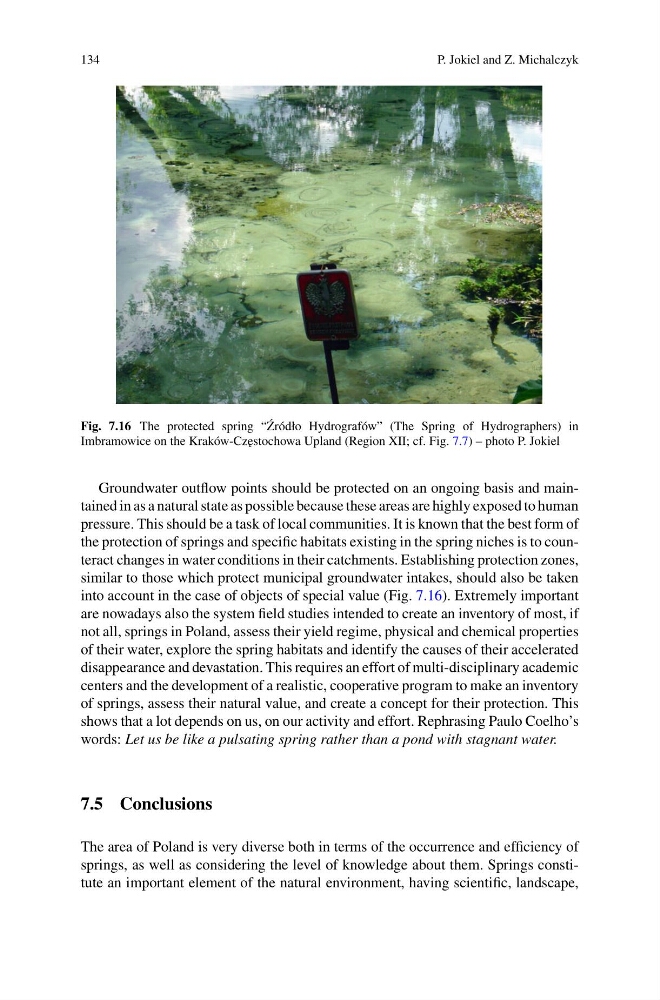
Fig. 7.16 The protected spring “ ´
Zródło Hydrografów” (The Spring of Hydrographers) in
Imbramowice on the Kraków-Cz˛ estochowa Upland (Region XII; cf. Fig. 7.7) – photo P. Jokiel
Groundwater outflow points should be protected on an ongoing basis and maintained in as a natural state as possible because these areas are highly exposed to human
pressure. This should be a task of local communities. It is known that the best form of
the protection of springs and specific habitats existing in the spring niches is to counteract changes in water conditions in their catchments. Establishing protection zones,
similar to those which protect municipal groundwater intakes, should also be taken
into account in the case of objects of special value (Fig. 7.16). Extremely important
are nowadays also the system field studies intended to create an inventory of most, if
not all, springs in Poland, assess their yield regime, physical and chemical properties
of their water, explore the spring habitats and identify the causes of their accelerated
disappearance and devastation. This requires an effort of multi-disciplinary academic
centers and the development of a realistic, cooperative program to make an inventory
of springs, assess their natural value, and create a concept for their protection. This
shows that a lot depends on us, on our activity and effort. Rephrasing Paulo Coelho’s
words: Let us be like a pulsating spring rather than a pond with stagnant water.
7.5 Conclusions
The area of Poland is very diverse both in terms of the occurrence and efficiency of
springs, as well as considering the level of knowledge about them. Springs constitute an important element of the natural environment, having scientific, landscape,
P. Jokiel and Z. Michalczyk
Fig. 7.16 The protected spring “ ´
Zródło Hydrografów” (The Spring of Hydrographers) in
Imbramowice on the Kraków-Cz˛ estochowa Upland (Region XII; cf. Fig. 7.7) – photo P. Jokiel
Groundwater outflow points should be protected on an ongoing basis and maintained in as a natural state as possible because these areas are highly exposed to human
pressure. This should be a task of local communities. It is known that the best form of
the protection of springs and specific habitats existing in the spring niches is to counteract changes in water conditions in their catchments. Establishing protection zones,
similar to those which protect municipal groundwater intakes, should also be taken
into account in the case of objects of special value (Fig. 7.16). Extremely important
are nowadays also the system field studies intended to create an inventory of most, if
not all, springs in Poland, assess their yield regime, physical and chemical properties
of their water, explore the spring habitats and identify the causes of their accelerated
disappearance and devastation. This requires an effort of multi-disciplinary academic
centers and the development of a realistic, cooperative program to make an inventory
of springs, assess their natural value, and create a concept for their protection. This
shows that a lot depends on us, on our activity and effort. Rephrasing Paulo Coelho’s
words: Let us be like a pulsating spring rather than a pond with stagnant water.
7.5 Conclusions
The area of Poland is very diverse both in terms of the occurrence and efficiency of
springs, as well as considering the level of knowledge about them. Springs constitute an important element of the natural environment, having scientific, landscape,