

114
P. Jokiel and Z. Michalczyk
7.1 The Spring Phenomenon
A spring is a form of natural, concentrated outflow of groundwater to the surface of
the land. Beside dissipate objects, such as bog-springs, leakages, and seepages, it is
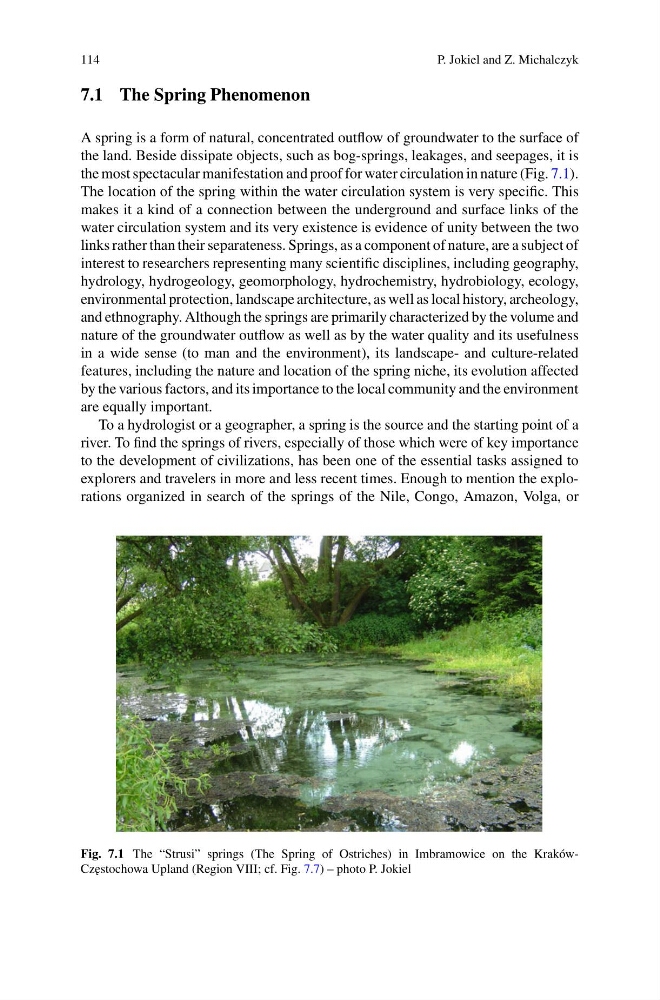
the most spectacular manifestation and proof for water circulation in nature (Fig. 7.1).
The location of the spring within the water circulation system is very specific. This
makes it a kind of a connection between the underground and surface links of the
water circulation system and its very existence is evidence of unity between the two
links rather than their separateness. Springs, as a component of nature, are a subject of
interest to researchers representing many scientific disciplines, including geography,
hydrology, hydrogeology, geomorphology, hydrochemistry, hydrobiology, ecology,
environmental protection, landscape architecture, as well as local history, archeology,
and ethnography. Although the springs are primarily characterized by the volume and
nature of the groundwater outflow as well as by the water quality and its usefulness
in a wide sense (to man and the environment), its landscape- and culture-related
features, including the nature and location of the spring niche, its evolution affected
by the various factors, and its importance to the local community and the environment
are equally important.
To a hydrologist or a geographer, a spring is the source and the starting point of a
river. To find the springs of rivers, especially of those which were of key importance
to the development of civilizations, has been one of the essential tasks assigned to
explorers and travelers in more and less recent times. Enough to mention the explorations organized in search of the springs of the Nile, Congo, Amazon, Volga, or
Fig. 7.1 The “Strusi” springs (The Spring of Ostriches) in Imbramowice on the KrakówCz˛ estochowa Upland (Region VIII; cf. Fig. 7.7) – photo P. Jokiel
P. Jokiel and Z. Michalczyk
7.1 The Spring Phenomenon
A spring is a form of natural, concentrated outflow of groundwater to the surface of
the land. Beside dissipate objects, such as bog-springs, leakages, and seepages, it is
the most spectacular manifestation and proof for water circulation in nature (Fig. 7.1).
The location of the spring within the water circulation system is very specific. This
makes it a kind of a connection between the underground and surface links of the
water circulation system and its very existence is evidence of unity between the two
links rather than their separateness. Springs, as a component of nature, are a subject of
interest to researchers representing many scientific disciplines, including geography,
hydrology, hydrogeology, geomorphology, hydrochemistry, hydrobiology, ecology,
environmental protection, landscape architecture, as well as local history, archeology,
and ethnography. Although the springs are primarily characterized by the volume and
nature of the groundwater outflow as well as by the water quality and its usefulness
in a wide sense (to man and the environment), its landscape- and culture-related
features, including the nature and location of the spring niche, its evolution affected
by the various factors, and its importance to the local community and the environment
are equally important.
To a hydrologist or a geographer, a spring is the source and the starting point of a
river. To find the springs of rivers, especially of those which were of key importance
to the development of civilizations, has been one of the essential tasks assigned to
explorers and travelers in more and less recent times. Enough to mention the explorations organized in search of the springs of the Nile, Congo, Amazon, Volga, or
Fig. 7.1 The “Strusi” springs (The Spring of Ostriches) in Imbramowice on the KrakówCz˛ estochowa Upland (Region VIII; cf. Fig. 7.7) – photo P. Jokiel