

6 Natural and Anthropogenic Lakes of River Valleys
99
6.4.2 Anthropogenic Lakes
A separate group of lakes are anthropogenic lakes, which were created as a result
of artificial regulation procedures [43]. These are the lakes located on a flood plain,
which were created mainly as a result of cutting off the side arms of the river from
the main river bed or closing the water space between the groynes as a result of
regulatory works carried out. These lakes are often referred to as quasi-ox-bows
or post-regulation reservoirs. The isolation of a lateral river bed or a fragment of
the river itself results from a process aimed at narrowing the main river bed [44].
The scope of work carried out, and the type of regulation structures used to play an
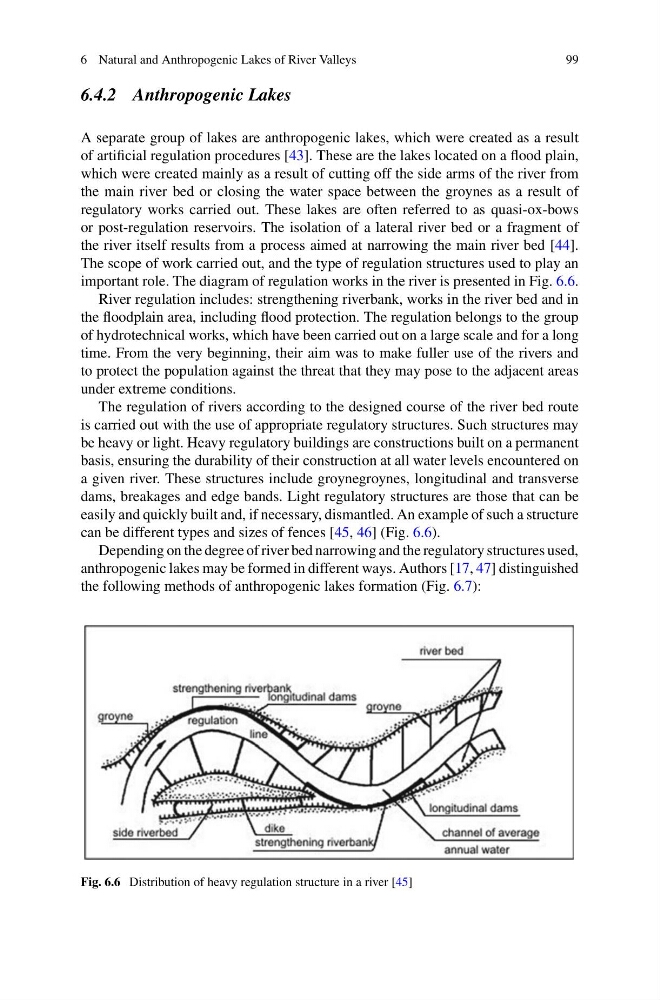
important role. The diagram of regulation works in the river is presented in Fig. 6.6.
River regulation includes: strengthening riverbank, works in the river bed and in
the floodplain area, including flood protection. The regulation belongs to the group
of hydrotechnical works, which have been carried out on a large scale and for a long
time. From the very beginning, their aim was to make fuller use of the rivers and
to protect the population against the threat that they may pose to the adjacent areas
under extreme conditions.
The regulation of rivers according to the designed course of the river bed route
is carried out with the use of appropriate regulatory structures. Such structures may
be heavy or light. Heavy regulatory buildings are constructions built on a permanent
basis, ensuring the durability of their construction at all water levels encountered on
a given river. These structures include groynegroynes, longitudinal and transverse
dams, breakages and edge bands. Light regulatory structures are those that can be
easily and quickly built and, if necessary, dismantled. An example of such a structure
can be different types and sizes of fences [45, 46] (Fig. 6.6).
Depending on the degree of river bed narrowing and the regulatory structures used,
anthropogenic lakes may be formed in different ways. Authors [17, 47] distinguished
the following methods of anthropogenic lakes formation (Fig. 6.7):
Fig. 6.6 Distribution of heavy regulation structure in a river [45]
99
6.4.2 Anthropogenic Lakes
A separate group of lakes are anthropogenic lakes, which were created as a result
of artificial regulation procedures [43]. These are the lakes located on a flood plain,
which were created mainly as a result of cutting off the side arms of the river from
the main river bed or closing the water space between the groynes as a result of
regulatory works carried out. These lakes are often referred to as quasi-ox-bows
or post-regulation reservoirs. The isolation of a lateral river bed or a fragment of
the river itself results from a process aimed at narrowing the main river bed [44].
The scope of work carried out, and the type of regulation structures used to play an
important role. The diagram of regulation works in the river is presented in Fig. 6.6.
River regulation includes: strengthening riverbank, works in the river bed and in
the floodplain area, including flood protection. The regulation belongs to the group
of hydrotechnical works, which have been carried out on a large scale and for a long
time. From the very beginning, their aim was to make fuller use of the rivers and
to protect the population against the threat that they may pose to the adjacent areas
under extreme conditions.
The regulation of rivers according to the designed course of the river bed route
is carried out with the use of appropriate regulatory structures. Such structures may
be heavy or light. Heavy regulatory buildings are constructions built on a permanent
basis, ensuring the durability of their construction at all water levels encountered on
a given river. These structures include groynegroynes, longitudinal and transverse
dams, breakages and edge bands. Light regulatory structures are those that can be
easily and quickly built and, if necessary, dismantled. An example of such a structure
can be different types and sizes of fences [45, 46] (Fig. 6.6).
Depending on the degree of river bed narrowing and the regulatory structures used,
anthropogenic lakes may be formed in different ways. Authors [17, 47] distinguished
the following methods of anthropogenic lakes formation (Fig. 6.7):
Fig. 6.6 Distribution of heavy regulation structure in a river [45]