

2 Aerodynamics
81
gave some qualitative concepts. Later, famous scientists such as Kelly in
England, Langley in America, and Otto Lilienthal in Germany made further
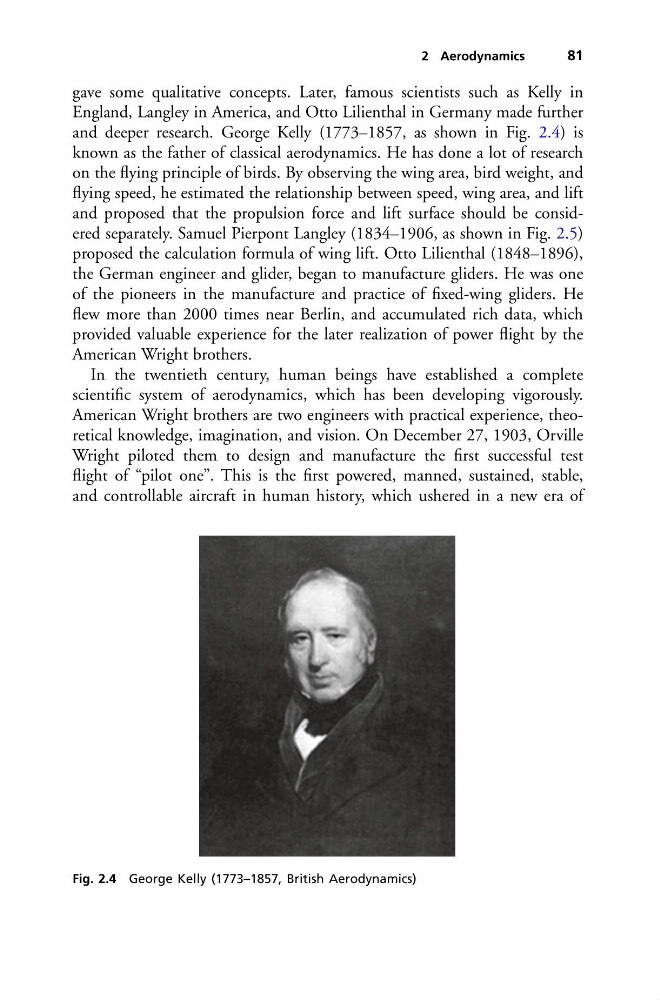
and deeper research. George Kelly (1773–1857, as shown in Fig. 2.4) is
known as the father of classical aerodynamics. He has done a lot of research
on the flying principle of birds. By observing the wing area, bird weight, and
flying speed, he estimated the relationship between speed, wing area, and lift
and proposed that the propulsion force and lift surface should be considered separately. Samuel Pierpont Langley (1834–1906, as shown in Fig. 2.5)
proposed the calculation formula of wing lift. Otto Lilienthal (1848–1896),
the German engineer and glider, began to manufacture gliders. He was one
of the pioneers in the manufacture and practice of fixed-wing gliders. He
flew more than 2000 times near Berlin, and accumulated rich data, which
provided valuable experience for the later realization of power flight by the
American Wright brothers.
In the twentieth century, human beings have established a complete
scientific system of aerodynamics, which has been developing vigorously.
American Wright brothers are two engineers with practical experience, theoretical knowledge, imagination, and vision. On December 27, 1903, Orville
Wright piloted them to design and manufacture the first successful test
flight of “pilot one”. This is the first powered, manned, sustained, stable,
and controllable aircraft in human history, which ushered in a new era of
Fig. 2.4 George Kelly (1773–1857, British Aerodynamics)
81
gave some qualitative concepts. Later, famous scientists such as Kelly in
England, Langley in America, and Otto Lilienthal in Germany made further
and deeper research. George Kelly (1773–1857, as shown in Fig. 2.4) is
known as the father of classical aerodynamics. He has done a lot of research
on the flying principle of birds. By observing the wing area, bird weight, and
flying speed, he estimated the relationship between speed, wing area, and lift
and proposed that the propulsion force and lift surface should be considered separately. Samuel Pierpont Langley (1834–1906, as shown in Fig. 2.5)
proposed the calculation formula of wing lift. Otto Lilienthal (1848–1896),
the German engineer and glider, began to manufacture gliders. He was one
of the pioneers in the manufacture and practice of fixed-wing gliders. He
flew more than 2000 times near Berlin, and accumulated rich data, which
provided valuable experience for the later realization of power flight by the
American Wright brothers.
In the twentieth century, human beings have established a complete
scientific system of aerodynamics, which has been developing vigorously.
American Wright brothers are two engineers with practical experience, theoretical knowledge, imagination, and vision. On December 27, 1903, Orville
Wright piloted them to design and manufacture the first successful test
flight of “pilot one”. This is the first powered, manned, sustained, stable,
and controllable aircraft in human history, which ushered in a new era of
Fig. 2.4 George Kelly (1773–1857, British Aerodynamics)