

1 Foundation of Fluid Mechanics
73
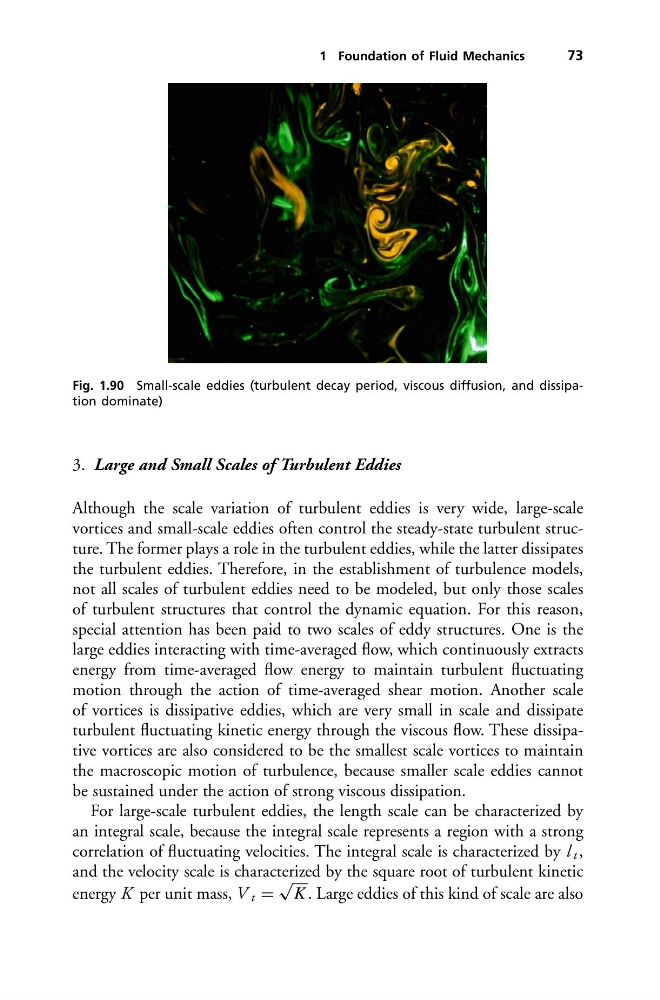
Fig. 1.90 Small-scale eddies (turbulent decay period, viscous diffusion, and dissipation dominate)
3. Large and Small Scales of Turbulent Eddies
Although the scale variation of turbulent eddies is very wide, large-scale
vortices and small-scale eddies often control the steady-state turbulent structure. The former plays a role in the turbulent eddies, while the latter dissipates
the turbulent eddies. Therefore, in the establishment of turbulence models,
not all scales of turbulent eddies need to be modeled, but only those scales
of turbulent structures that control the dynamic equation. For this reason,
special attention has been paid to two scales of eddy structures. One is the
large eddies interacting with time-averaged flow, which continuously extracts
energy from time-averaged flow energy to maintain turbulent fluctuating
motion through the action of time-averaged shear motion. Another scale
of vortices is dissipative eddies, which are very small in scale and dissipate
turbulent fluctuating kinetic energy through the viscous flow. These dissipative vortices are also considered to be the smallest scale vortices to maintain
the macroscopic motion of turbulence, because smaller scale eddies cannot
be sustained under the action of strong viscous dissipation.
For large-scale turbulent eddies, the length scale can be characterized by
an integral scale, because the integral scale represents a region with a strong
correlation of fluctuating velocities. The integral scale is characterized by l t ,
and the velocity scale is characterized by the square root of turbulent kinetic
energy K per unit mass, V t =
√
K . Large eddies of this kind of scale are also
73
Fig. 1.90 Small-scale eddies (turbulent decay period, viscous diffusion, and dissipation dominate)
3. Large and Small Scales of Turbulent Eddies
Although the scale variation of turbulent eddies is very wide, large-scale
vortices and small-scale eddies often control the steady-state turbulent structure. The former plays a role in the turbulent eddies, while the latter dissipates
the turbulent eddies. Therefore, in the establishment of turbulence models,
not all scales of turbulent eddies need to be modeled, but only those scales
of turbulent structures that control the dynamic equation. For this reason,
special attention has been paid to two scales of eddy structures. One is the
large eddies interacting with time-averaged flow, which continuously extracts
energy from time-averaged flow energy to maintain turbulent fluctuating
motion through the action of time-averaged shear motion. Another scale
of vortices is dissipative eddies, which are very small in scale and dissipate
turbulent fluctuating kinetic energy through the viscous flow. These dissipative vortices are also considered to be the smallest scale vortices to maintain
the macroscopic motion of turbulence, because smaller scale eddies cannot
be sustained under the action of strong viscous dissipation.
For large-scale turbulent eddies, the length scale can be characterized by
an integral scale, because the integral scale represents a region with a strong
correlation of fluctuating velocities. The integral scale is characterized by l t ,
and the velocity scale is characterized by the square root of turbulent kinetic
energy K per unit mass, V t =
√
K . Large eddies of this kind of scale are also