

1 Foundation of Fluid Mechanics
63
close the Reynolds equation by introducing the transport equation of turbulent momentum. Kolmogorov (1942) and Prandtl (1945) first proposed a
closed model (later called One-Equation Model) by introducing a turbulent
kinetic energy equation, based on the eddy viscosity hypothesis. In 1967,
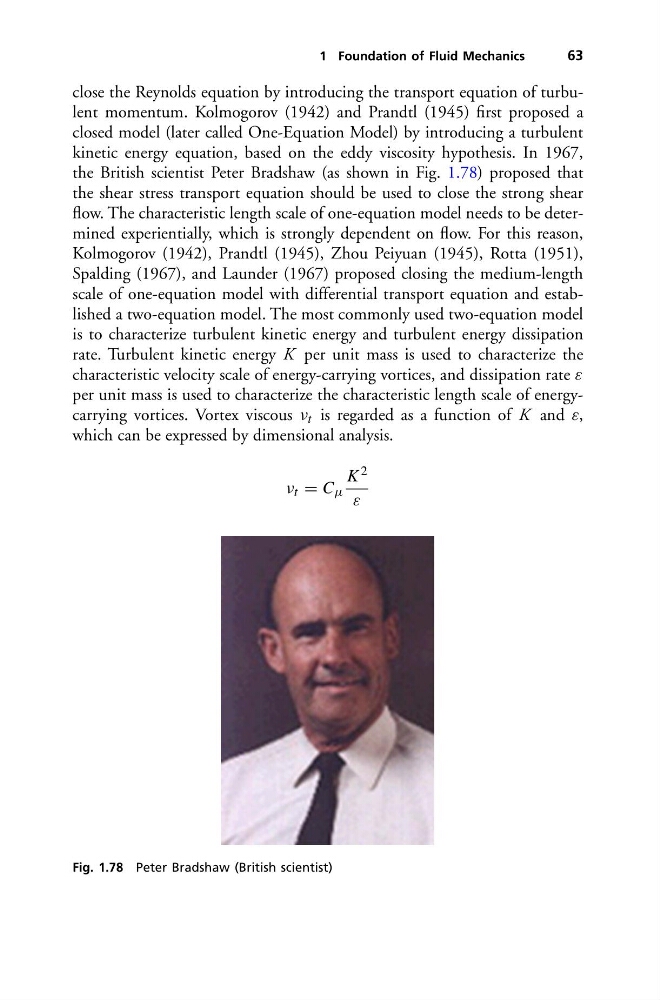
the British scientist Peter Bradshaw (as shown in Fig. 1.78) proposed that
the shear stress transport equation should be used to close the strong shear
flow. The characteristic length scale of one-equation model needs to be determined experientially, which is strongly dependent on flow. For this reason,
Kolmogorov (1942), Prandtl (1945), Zhou Peiyuan (1945), Rotta (1951),
Spalding (1967), and Launder (1967) proposed closing the medium-length
scale of one-equation model with differential transport equation and established a two-equation model. The most commonly used two-equation model
is to characterize turbulent kinetic energy and turbulent energy dissipation
rate. Turbulent kinetic energy K per unit mass is used to characterize the
characteristic velocity scale of energy-carrying vortices, and dissipation rate ε
per unit mass is used to characterize the characteristic length scale of energycarrying vortices. Vortex viscous ν t is regarded as a function of K and ε,
which can be expressed by dimensional analysis.
ν t = C μ
K 2
ε
Fig. 1.78 Peter Bradshaw (British scientist)
63
close the Reynolds equation by introducing the transport equation of turbulent momentum. Kolmogorov (1942) and Prandtl (1945) first proposed a
closed model (later called One-Equation Model) by introducing a turbulent
kinetic energy equation, based on the eddy viscosity hypothesis. In 1967,
the British scientist Peter Bradshaw (as shown in Fig. 1.78) proposed that
the shear stress transport equation should be used to close the strong shear
flow. The characteristic length scale of one-equation model needs to be determined experientially, which is strongly dependent on flow. For this reason,
Kolmogorov (1942), Prandtl (1945), Zhou Peiyuan (1945), Rotta (1951),
Spalding (1967), and Launder (1967) proposed closing the medium-length
scale of one-equation model with differential transport equation and established a two-equation model. The most commonly used two-equation model
is to characterize turbulent kinetic energy and turbulent energy dissipation
rate. Turbulent kinetic energy K per unit mass is used to characterize the
characteristic velocity scale of energy-carrying vortices, and dissipation rate ε
per unit mass is used to characterize the characteristic length scale of energycarrying vortices. Vortex viscous ν t is regarded as a function of K and ε,
which can be expressed by dimensional analysis.
ν t = C μ
K 2
ε
Fig. 1.78 Peter Bradshaw (British scientist)