

3 Hydrodynamics
237
1
h 1
0
0
2
A
h 2
At
2
0
z
z
t
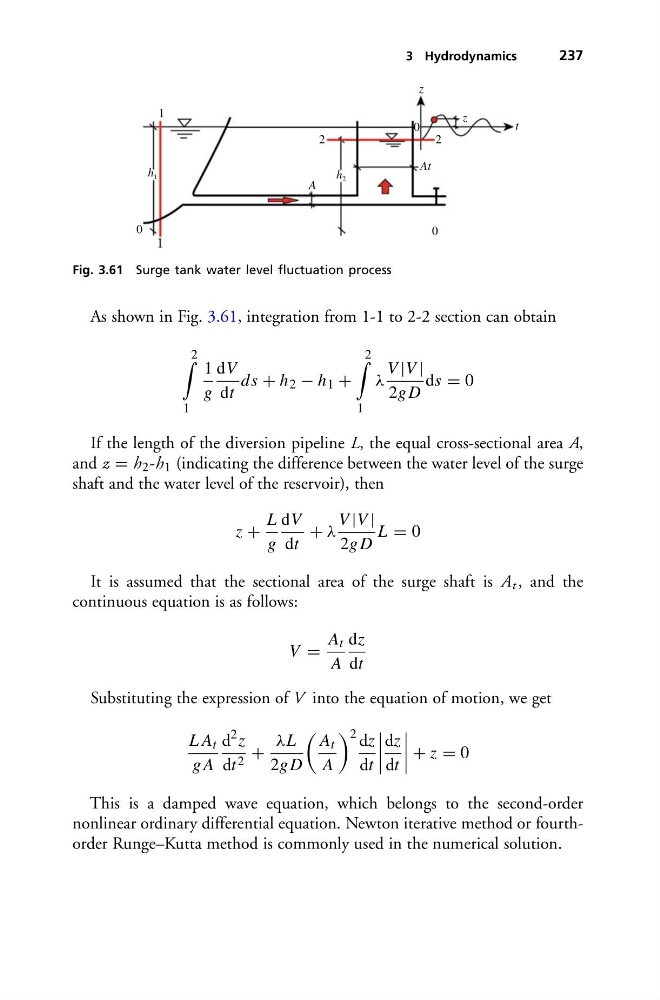
Fig. 3.61 Surge tank water level fluctuation process
As shown in Fig. 3.61, integration from 1-1 to 2-2 section can obtain
2
1
1
g
dV
dt
ds + h 2 − h 1 +
2
1
λ
V |V |
2g D
ds = 0
If the length of the diversion pipeline L, the equal cross-sectional area A,
and z = h 2 -h 1 (indicating the difference between the water level of the surge
shaft and the water level of the reservoir), then
z +
L
g
dV
dt
+ λ
V |V |
2g D
L = 0
It is assumed that the sectional area of the surge shaft is A t , and the
continuous equation is as follows:
V =
A t
A
dz
dt
Substituting the expression of V into the equation of motion, we get
L A t
g A
d
2 z
dt 2 +
λL
2g D
A t
A
2 dz
dt
dz
dt
+ z = 0
This is a damped wave equation, which belongs to the second-order
nonlinear ordinary differential equation. Newton iterative method or fourthorder Runge–Kutta method is commonly used in the numerical solution.
237
1
h 1
0
0
2
A
h 2
At
2
0
z
z
t
Fig. 3.61 Surge tank water level fluctuation process
As shown in Fig. 3.61, integration from 1-1 to 2-2 section can obtain
2
1
1
g
dV
dt
ds + h 2 − h 1 +
2
1
λ
V |V |
2g D
ds = 0
If the length of the diversion pipeline L, the equal cross-sectional area A,
and z = h 2 -h 1 (indicating the difference between the water level of the surge
shaft and the water level of the reservoir), then
z +
L
g
dV
dt
+ λ
V |V |
2g D
L = 0
It is assumed that the sectional area of the surge shaft is A t , and the
continuous equation is as follows:
V =
A t
A
dz
dt
Substituting the expression of V into the equation of motion, we get
L A t
g A
d
2 z
dt 2 +
λL
2g D
A t
A
2 dz
dt
dz
dt
+ z = 0
This is a damped wave equation, which belongs to the second-order
nonlinear ordinary differential equation. Newton iterative method or fourthorder Runge–Kutta method is commonly used in the numerical solution.