

12
P. Liu
(1) In steady flow, the traces of fluid particles coincide with streamlines. In
unsteady flow, streamlines and traces do not coincide.
(2) In steady flow, streamline is a non-deviating curve of fluid particles.
(3) At constant points, streamlines cannot intersect, bifurcate, intersect, or
turn, and streamlines can only be a smooth curve. That is to say, at the
same time, a point can only pass through a streamline.
(4) Exceptions at singularities and zero velocities are not satisfied (3).
It should be pointed out that the velocity at a point in space essentially
refers to the velocity at which t instantaneously occupies the fluid particle
at that point. Mathematically, a space full of certain physical quantities is
called a field, and the space occupied by fluid flow is called a flow field. If the
physical quantity is velocity, it describes the velocity field. If it is pressure, it is
called a pressure field. In high-speed flow, the density and temperature of the
airflow also change with the flow, so there is a density field and a temperature
field. These are all included in the concept of flow field.
When the Euler method is used to describe the flow field, the observer
directly measures the velocity of the fluid particle through the space point.
Then, if a fluid particle is tracked arbitrarily in a certain period, how can its
velocity change and how to correctly express the acceleration of the particle
motion in the Eulerian coordinate system? From this, the concept of Eulerian
derivative is proposed, which is also called the body-dependent derivative in
hydrodynamics. An example is given to illustrate the acceleration of locally
tracking a fixed fluid particle. Suppose that at any time t, the velocity u = (t,
x, y, z ) of the fluid particle occupying (x, y, z ) space point, and at t + t
time, the tracked fluid particle moves to the space point (x + x, y + y, z
+ z ), and its velocity u = u(t + t, x + x, y + y, z + z ). According
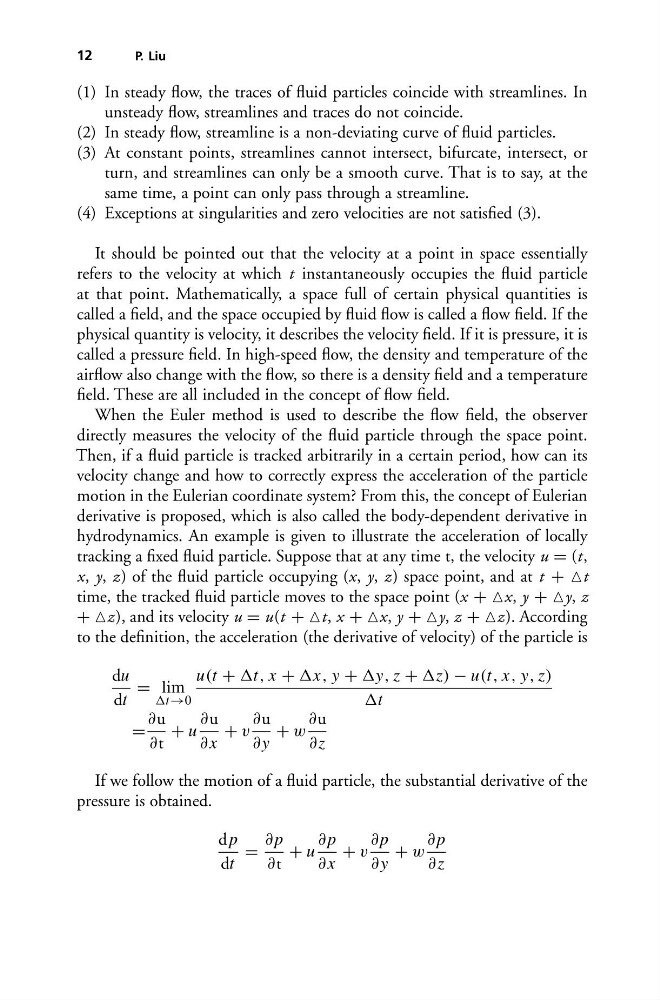
to the definition, the acceleration (the derivative of velocity) of the particle is
du
dt
= lim
t→0
u(t + t, x + x, y + y, z + z) − u(t, x, y, z)
t
=
∂u
∂t
+ u
∂u
∂ x
+ v
∂u
∂ y
+ w
∂u
∂z
If we follow the motion of a fluid particle, the substantial derivative of the
pressure is obtained.
d p
dt
=
∂ p
∂t
+ u
∂ p
∂ x
+ v
∂ p
∂ y
+ w
∂ p
∂z
P. Liu
(1) In steady flow, the traces of fluid particles coincide with streamlines. In
unsteady flow, streamlines and traces do not coincide.
(2) In steady flow, streamline is a non-deviating curve of fluid particles.
(3) At constant points, streamlines cannot intersect, bifurcate, intersect, or
turn, and streamlines can only be a smooth curve. That is to say, at the
same time, a point can only pass through a streamline.
(4) Exceptions at singularities and zero velocities are not satisfied (3).
It should be pointed out that the velocity at a point in space essentially
refers to the velocity at which t instantaneously occupies the fluid particle
at that point. Mathematically, a space full of certain physical quantities is
called a field, and the space occupied by fluid flow is called a flow field. If the
physical quantity is velocity, it describes the velocity field. If it is pressure, it is
called a pressure field. In high-speed flow, the density and temperature of the
airflow also change with the flow, so there is a density field and a temperature
field. These are all included in the concept of flow field.
When the Euler method is used to describe the flow field, the observer
directly measures the velocity of the fluid particle through the space point.
Then, if a fluid particle is tracked arbitrarily in a certain period, how can its
velocity change and how to correctly express the acceleration of the particle
motion in the Eulerian coordinate system? From this, the concept of Eulerian
derivative is proposed, which is also called the body-dependent derivative in
hydrodynamics. An example is given to illustrate the acceleration of locally
tracking a fixed fluid particle. Suppose that at any time t, the velocity u = (t,
x, y, z ) of the fluid particle occupying (x, y, z ) space point, and at t + t
time, the tracked fluid particle moves to the space point (x + x, y + y, z
+ z ), and its velocity u = u(t + t, x + x, y + y, z + z ). According
to the definition, the acceleration (the derivative of velocity) of the particle is
du
dt
= lim
t→0
u(t + t, x + x, y + y, z + z) − u(t, x, y, z)
t
=
∂u
∂t
+ u
∂u
∂ x
+ v
∂u
∂ y
+ w
∂u
∂z
If we follow the motion of a fluid particle, the substantial derivative of the
pressure is obtained.
d p
dt
=
∂ p
∂t
+ u
∂ p
∂ x
+ v
∂ p
∂ y
+ w
∂ p
∂z