

3 Hydrodynamics
225
greater the turbulent shear stress, the greater the generation term of turbulent energy, and the more effective the turbulent mixing. In the process of
diffusion, on the one hand, it makes its motion characteristics adjust along
the depth of water and the direction of flow, which must be accompanied by
the diffusion of momentum and energy along the transverse and longitudinal
directions; On the other hand, the strong turbulent mixing produces a huge
turbulent shear stress, which makes a part of the mechanical energy of the
water flow quickly convert into turbulent pulsating energy and a part of the
heat energy consumption. This part of mechanical energy loss is called the
hydraulic jump energy loss. The interface area between the mainstream and
the surface water roll is not only the generation area of turbulent vortex, but
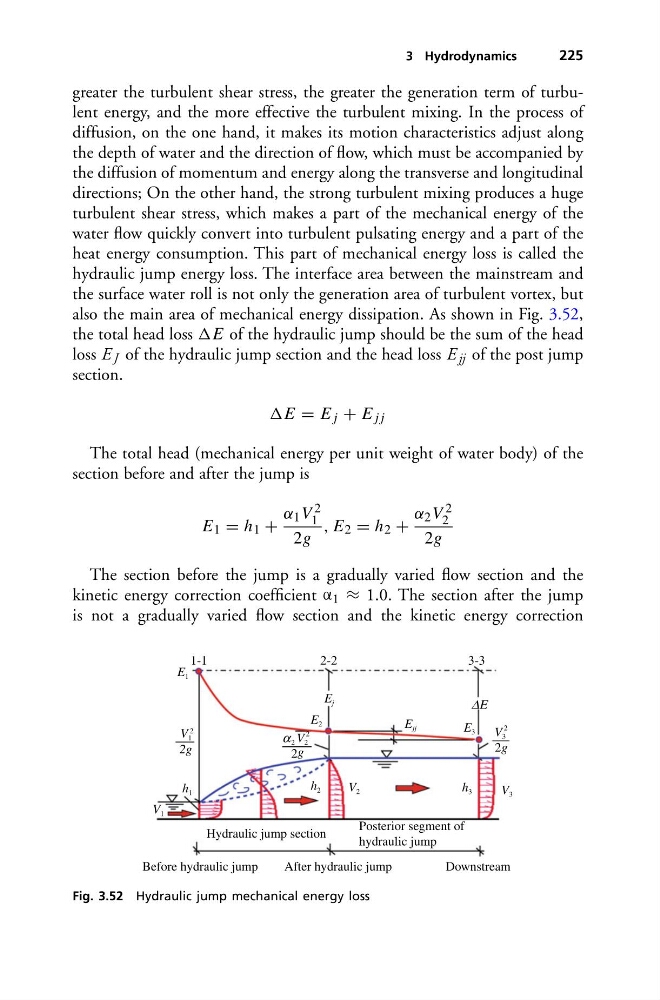
also the main area of mechanical energy dissipation. As shown in Fig. 3.52,
the total head loss of the hydraulic jump should be the sum of the head
loss E J of the hydraulic jump section and the head loss E jj of the post jump
section.
= E j + E j j
The total head (mechanical energy per unit weight of water body) of the
section before and after the jump is
E 1 = h 1 +
α 1 V 2
1
2g
, E 2 = h 2 +
α 2 V 2
2
2g
The section before the jump is a gradually varied flow section and the
kinetic energy correction coefficient α 1 ≈ 1.0. The section after the jump
is not a gradually varied flow section and the kinetic energy correction
1-1
2-2
3-3
ΔE
E 1
E 2
α 2 V 2
2
2g
E j
E jj
E 3
h 3
V 3
V 3
2
2g
V 1
2
2g
h 1
h 2
Before hydraulic jump
After hydraulic jump
Downstream
Posterior segment of
hydraulic jump
Hydraulic jump section
V 2
V 1
Fig. 3.52 Hydraulic jump mechanical energy loss
225
greater the turbulent shear stress, the greater the generation term of turbulent energy, and the more effective the turbulent mixing. In the process of
diffusion, on the one hand, it makes its motion characteristics adjust along
the depth of water and the direction of flow, which must be accompanied by
the diffusion of momentum and energy along the transverse and longitudinal
directions; On the other hand, the strong turbulent mixing produces a huge
turbulent shear stress, which makes a part of the mechanical energy of the
water flow quickly convert into turbulent pulsating energy and a part of the
heat energy consumption. This part of mechanical energy loss is called the
hydraulic jump energy loss. The interface area between the mainstream and
the surface water roll is not only the generation area of turbulent vortex, but
also the main area of mechanical energy dissipation. As shown in Fig. 3.52,
the total head loss of the hydraulic jump should be the sum of the head
loss E J of the hydraulic jump section and the head loss E jj of the post jump
section.
= E j + E j j
The total head (mechanical energy per unit weight of water body) of the
section before and after the jump is
E 1 = h 1 +
α 1 V 2
1
2g
, E 2 = h 2 +
α 2 V 2
2
2g
The section before the jump is a gradually varied flow section and the
kinetic energy correction coefficient α 1 ≈ 1.0. The section after the jump
is not a gradually varied flow section and the kinetic energy correction
1-1
2-2
3-3
ΔE
E 1
E 2
α 2 V 2
2
2g
E j
E jj
E 3
h 3
V 3
V 3
2
2g
V 1
2
2g
h 1
h 2
Before hydraulic jump
After hydraulic jump
Downstream
Posterior segment of
hydraulic jump
Hydraulic jump section
V 2
V 1
Fig. 3.52 Hydraulic jump mechanical energy loss