

152
P. Liu
wing using a simple quadrupole motion model. The results of this
kind of method are very valuable, because it can help researchers to
obtain some important qualitative knowledge, such as the influence
of law of speed and other parameters on aerodynamic noise intensity, similarity criterion, aerodynamic noise spectrum characteristics,
directivity law, and noise reduction guiding principle.
(2) Semiempirical method
Because the turbulence problem has not been solved completely, there
are some difficulties in numerical simulation and quantitative analysis, so the semiempirical method based on experimental database
and theoretical analysis is more often used. This method has the
advantages of intuition and stability, and is an important means to
study aerodynamic noise. The aircraft noise prediction program of
the NASA Langley experimental center relies heavily on semiempirical methods. In recent years, through microphone array, a large
number of high-quality models and acoustic data of full-scale aircraft
have been measured, which improves the accuracy of semiempirical
method.
(3) Pure numerical method
In essence, sound wave is a part of the flow field, so the generation and
propagation process of the sound wave can be obtained by directly
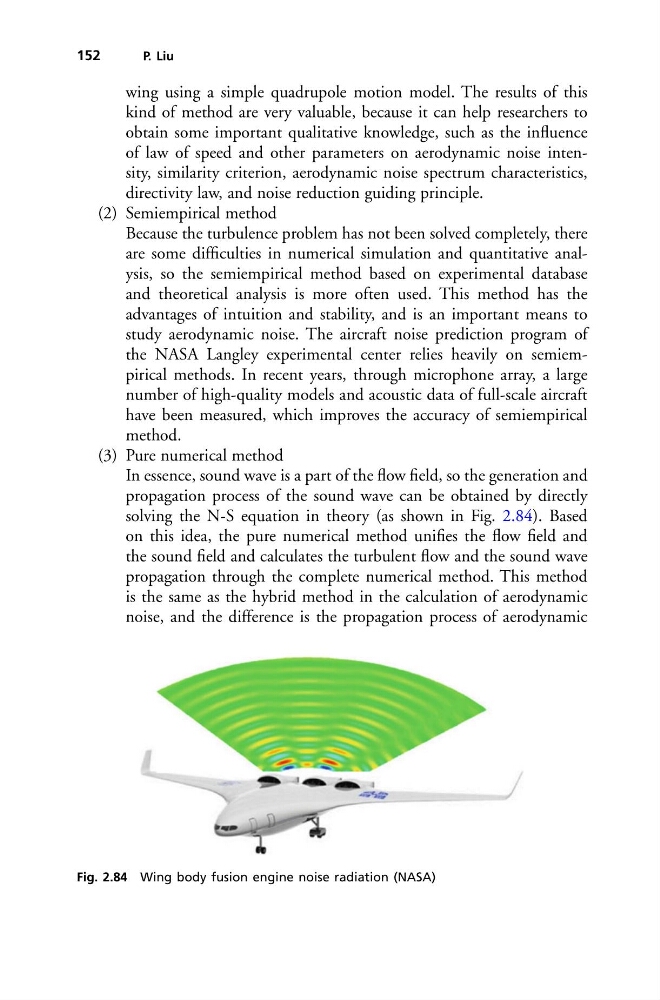
solving the N-S equation in theory (as shown in Fig. 2.84). Based
on this idea, the pure numerical method unifies the flow field and
the sound field and calculates the turbulent flow and the sound wave
propagation through the complete numerical method. This method
is the same as the hybrid method in the calculation of aerodynamic
noise, and the difference is the propagation process of aerodynamic
Fig. 2.84 Wing body fusion engine noise radiation (NASA)
P. Liu
wing using a simple quadrupole motion model. The results of this
kind of method are very valuable, because it can help researchers to
obtain some important qualitative knowledge, such as the influence
of law of speed and other parameters on aerodynamic noise intensity, similarity criterion, aerodynamic noise spectrum characteristics,
directivity law, and noise reduction guiding principle.
(2) Semiempirical method
Because the turbulence problem has not been solved completely, there
are some difficulties in numerical simulation and quantitative analysis, so the semiempirical method based on experimental database
and theoretical analysis is more often used. This method has the
advantages of intuition and stability, and is an important means to
study aerodynamic noise. The aircraft noise prediction program of
the NASA Langley experimental center relies heavily on semiempirical methods. In recent years, through microphone array, a large
number of high-quality models and acoustic data of full-scale aircraft
have been measured, which improves the accuracy of semiempirical
method.
(3) Pure numerical method
In essence, sound wave is a part of the flow field, so the generation and
propagation process of the sound wave can be obtained by directly
solving the N-S equation in theory (as shown in Fig. 2.84). Based
on this idea, the pure numerical method unifies the flow field and
the sound field and calculates the turbulent flow and the sound wave
propagation through the complete numerical method. This method
is the same as the hybrid method in the calculation of aerodynamic
noise, and the difference is the propagation process of aerodynamic
Fig. 2.84 Wing body fusion engine noise radiation (NASA)