

148
P. Liu
The quadrupole source is a body source, which is closely related to the
nonlinear flow in the control plane. If there is no mass or heat injection into the medium, and there is no obstacle, only the stress related
to viscosity can radiate sound waves (turbulent stress), then this is the
quadrupole sound source (stress field sound source). If there is no object
in the airflow, the force can only be generated in the same size and opposite direction, which is equivalent to a pair of dipoles with the same size
and opposite phase. The main sound source in the high subsonic turbulent jet is the quadrupole sound source. There is neither net mass flow
nor net force in the integration along the spherical boundary around the
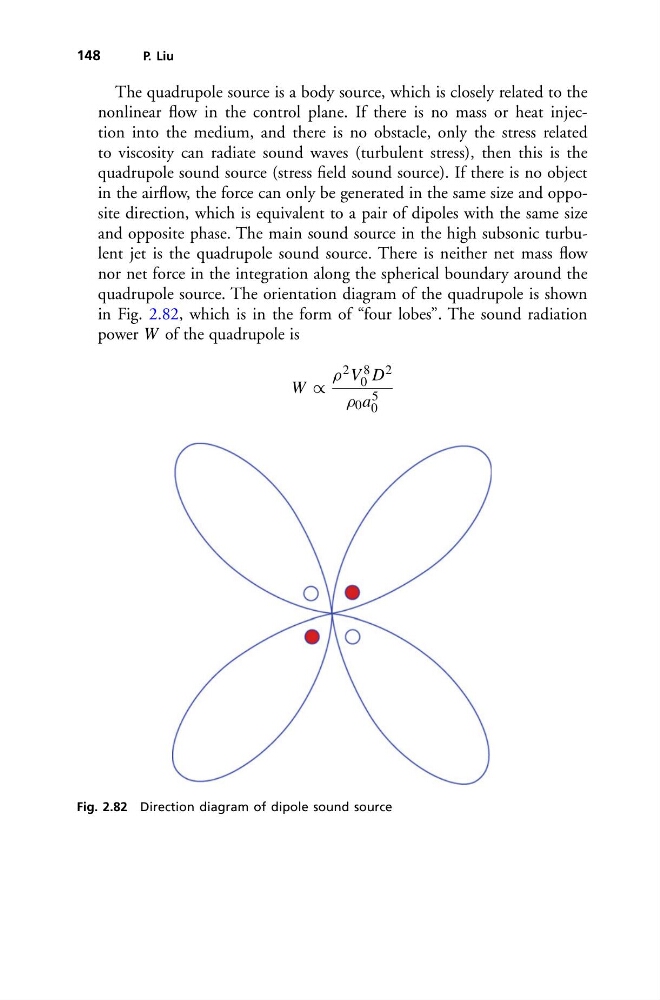
quadrupole source. The orientation diagram of the quadrupole is shown
in Fig. 2.82, which is in the form of “four lobes”. The sound radiation
power W of the quadrupole is
W ∝
ρ 2 V 8
0 D 2
ρ 0 a 5
0
Fig. 2.82 Direction diagram of dipole sound source
P. Liu
The quadrupole source is a body source, which is closely related to the
nonlinear flow in the control plane. If there is no mass or heat injection into the medium, and there is no obstacle, only the stress related
to viscosity can radiate sound waves (turbulent stress), then this is the
quadrupole sound source (stress field sound source). If there is no object
in the airflow, the force can only be generated in the same size and opposite direction, which is equivalent to a pair of dipoles with the same size
and opposite phase. The main sound source in the high subsonic turbulent jet is the quadrupole sound source. There is neither net mass flow
nor net force in the integration along the spherical boundary around the
quadrupole source. The orientation diagram of the quadrupole is shown
in Fig. 2.82, which is in the form of “four lobes”. The sound radiation
power W of the quadrupole is
W ∝
ρ 2 V 8
0 D 2
ρ 0 a 5
0
Fig. 2.82 Direction diagram of dipole sound source