

2 Aerodynamics
143
(2) Flow field controlled by strong viscous effect
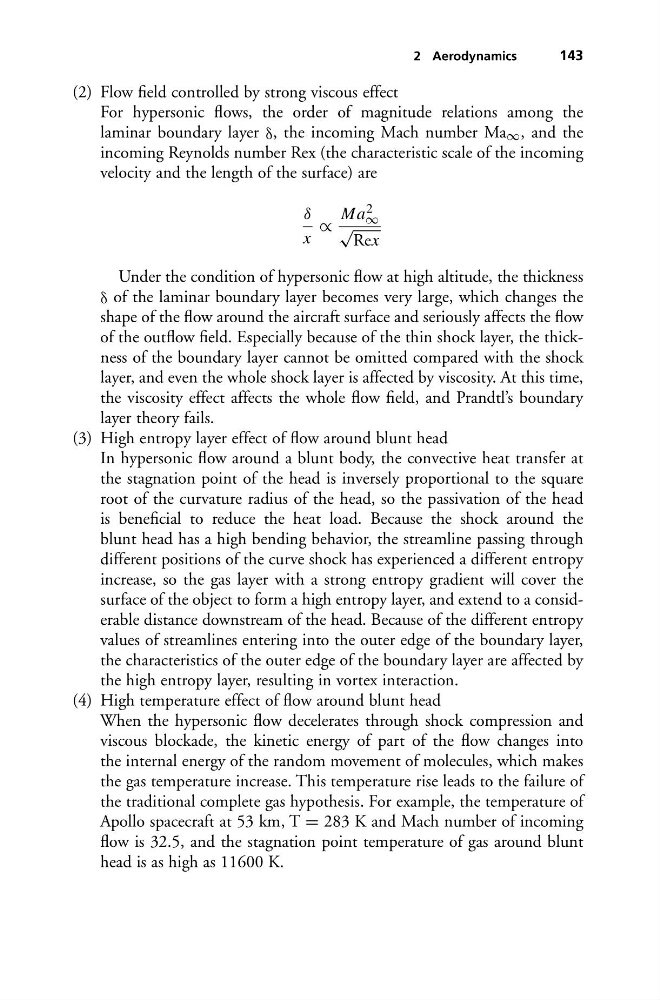
For hypersonic flows, the order of magnitude relations among the
laminar boundary layer δ, the incoming Mach number Ma ∞ , and the
incoming Reynolds number Rex (the characteristic scale of the incoming
velocity and the length of the surface) are
δ
x
∝
Ma 2
∞
√
Rex
Under the condition of hypersonic flow at high altitude, the thickness
δ of the laminar boundary layer becomes very large, which changes the
shape of the flow around the aircraft surface and seriously affects the flow
of the outflow field. Especially because of the thin shock layer, the thickness of the boundary layer cannot be omitted compared with the shock
layer, and even the whole shock layer is affected by viscosity. At this time,
the viscosity effect affects the whole flow field, and Prandtl’s boundary
layer theory fails.
(3) High entropy layer effect of flow around blunt head
In hypersonic flow around a blunt body, the convective heat transfer at
the stagnation point of the head is inversely proportional to the square
root of the curvature radius of the head, so the passivation of the head
is beneficial to reduce the heat load. Because the shock around the
blunt head has a high bending behavior, the streamline passing through
different positions of the curve shock has experienced a different entropy
increase, so the gas layer with a strong entropy gradient will cover the
surface of the object to form a high entropy layer, and extend to a considerable distance downstream of the head. Because of the different entropy
values of streamlines entering into the outer edge of the boundary layer,
the characteristics of the outer edge of the boundary layer are affected by
the high entropy layer, resulting in vortex interaction.
(4) High temperature effect of flow around blunt head
When the hypersonic flow decelerates through shock compression and
viscous blockade, the kinetic energy of part of the flow changes into
the internal energy of the random movement of molecules, which makes
the gas temperature increase. This temperature rise leads to the failure of
the traditional complete gas hypothesis. For example, the temperature of
Apollo spacecraft at 53 km, T = 283 K and Mach number of incoming
flow is 32.5, and the stagnation point temperature of gas around blunt
head is as high as 11600 K.
143
(2) Flow field controlled by strong viscous effect
For hypersonic flows, the order of magnitude relations among the
laminar boundary layer δ, the incoming Mach number Ma ∞ , and the
incoming Reynolds number Rex (the characteristic scale of the incoming
velocity and the length of the surface) are
δ
x
∝
Ma 2
∞
√
Rex
Under the condition of hypersonic flow at high altitude, the thickness
δ of the laminar boundary layer becomes very large, which changes the
shape of the flow around the aircraft surface and seriously affects the flow
of the outflow field. Especially because of the thin shock layer, the thickness of the boundary layer cannot be omitted compared with the shock
layer, and even the whole shock layer is affected by viscosity. At this time,
the viscosity effect affects the whole flow field, and Prandtl’s boundary
layer theory fails.
(3) High entropy layer effect of flow around blunt head
In hypersonic flow around a blunt body, the convective heat transfer at
the stagnation point of the head is inversely proportional to the square
root of the curvature radius of the head, so the passivation of the head
is beneficial to reduce the heat load. Because the shock around the
blunt head has a high bending behavior, the streamline passing through
different positions of the curve shock has experienced a different entropy
increase, so the gas layer with a strong entropy gradient will cover the
surface of the object to form a high entropy layer, and extend to a considerable distance downstream of the head. Because of the different entropy
values of streamlines entering into the outer edge of the boundary layer,
the characteristics of the outer edge of the boundary layer are affected by
the high entropy layer, resulting in vortex interaction.
(4) High temperature effect of flow around blunt head
When the hypersonic flow decelerates through shock compression and
viscous blockade, the kinetic energy of part of the flow changes into
the internal energy of the random movement of molecules, which makes
the gas temperature increase. This temperature rise leads to the failure of
the traditional complete gas hypothesis. For example, the temperature of
Apollo spacecraft at 53 km, T = 283 K and Mach number of incoming
flow is 32.5, and the stagnation point temperature of gas around blunt
head is as high as 11600 K.