

2 Aerodynamics
141
ratio before and after shock wave, test gas, wall temperature to total temperature ratio, and thermal and chemical properties of the flow field. Common
ground simulation equipment includes shock tube, arc heating wind tunnel,
hypersonic wind tunnel, and free ballistic target.
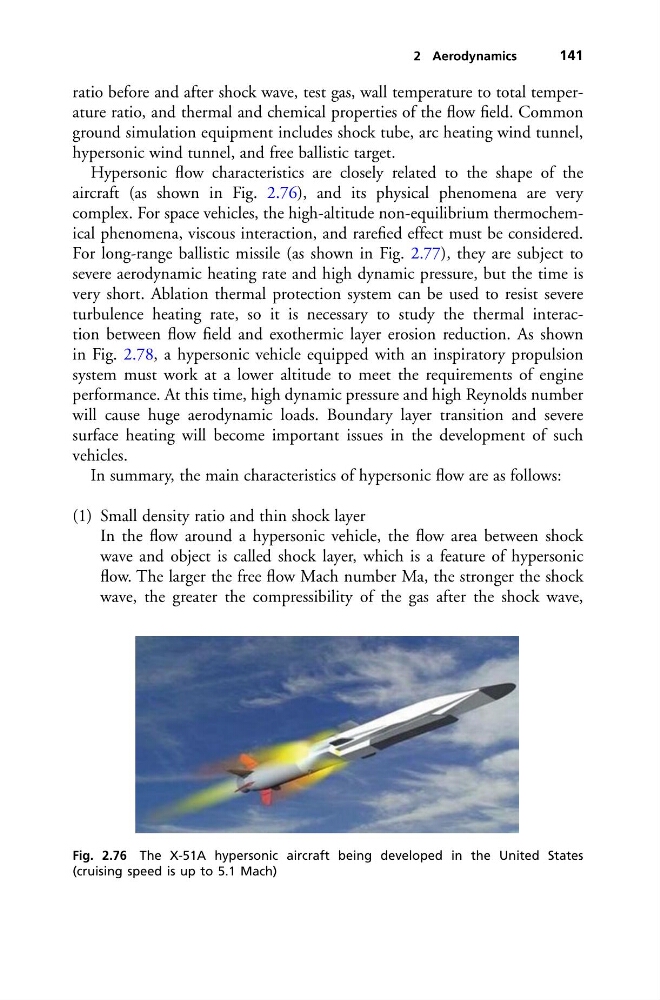
Hypersonic flow characteristics are closely related to the shape of the
aircraft (as shown in Fig. 2.76), and its physical phenomena are very
complex. For space vehicles, the high-altitude non-equilibrium thermochemical phenomena, viscous interaction, and rarefied effect must be considered.
For long-range ballistic missile (as shown in Fig. 2.77), they are subject to
severe aerodynamic heating rate and high dynamic pressure, but the time is
very short. Ablation thermal protection system can be used to resist severe
turbulence heating rate, so it is necessary to study the thermal interaction between flow field and exothermic layer erosion reduction. As shown
in Fig. 2.78, a hypersonic vehicle equipped with an inspiratory propulsion
system must work at a lower altitude to meet the requirements of engine
performance. At this time, high dynamic pressure and high Reynolds number
will cause huge aerodynamic loads. Boundary layer transition and severe
surface heating will become important issues in the development of such
vehicles.
In summary, the main characteristics of hypersonic flow are as follows:
(1) Small density ratio and thin shock layer
In the flow around a hypersonic vehicle, the flow area between shock
wave and object is called shock layer, which is a feature of hypersonic
flow. The larger the free flow Mach number Ma, the stronger the shock
wave, the greater the compressibility of the gas after the shock wave,
Fig. 2.76 The X-51A hypersonic aircraft being developed in the United States
(cruising speed is up to 5.1 Mach)
141
ratio before and after shock wave, test gas, wall temperature to total temperature ratio, and thermal and chemical properties of the flow field. Common
ground simulation equipment includes shock tube, arc heating wind tunnel,
hypersonic wind tunnel, and free ballistic target.
Hypersonic flow characteristics are closely related to the shape of the
aircraft (as shown in Fig. 2.76), and its physical phenomena are very
complex. For space vehicles, the high-altitude non-equilibrium thermochemical phenomena, viscous interaction, and rarefied effect must be considered.
For long-range ballistic missile (as shown in Fig. 2.77), they are subject to
severe aerodynamic heating rate and high dynamic pressure, but the time is
very short. Ablation thermal protection system can be used to resist severe
turbulence heating rate, so it is necessary to study the thermal interaction between flow field and exothermic layer erosion reduction. As shown
in Fig. 2.78, a hypersonic vehicle equipped with an inspiratory propulsion
system must work at a lower altitude to meet the requirements of engine
performance. At this time, high dynamic pressure and high Reynolds number
will cause huge aerodynamic loads. Boundary layer transition and severe
surface heating will become important issues in the development of such
vehicles.
In summary, the main characteristics of hypersonic flow are as follows:
(1) Small density ratio and thin shock layer
In the flow around a hypersonic vehicle, the flow area between shock
wave and object is called shock layer, which is a feature of hypersonic
flow. The larger the free flow Mach number Ma, the stronger the shock
wave, the greater the compressibility of the gas after the shock wave,
Fig. 2.76 The X-51A hypersonic aircraft being developed in the United States
(cruising speed is up to 5.1 Mach)