

manure of treated animals as a fertilizer. Sulfonamides [42, 48, 83], fluoroquinolones
[39, 50], clarithromycin [48], and clindamycin [39] were investigated with respect to
their uptake and metabolization by plants. Studies published so far were looking for
metabolites from ofloxacin and enrofloxacin as well as clindamycin and several
sulfonamides in field-grown vegetables (in this case reclaimed water was used for
irrigation) [39]. Thereby, although only a smaller number of metabolites could be
detected, the authors achieved quantification in real vegetable samples. Further
studies described the detection of a series of clarithromycin and sulfadiazine metabolites in lettuce [48], the investigations on the intraspecies variability of cabbage
varieties with respect to accumulation and metabolization of ciprofloxacin [50], and
metabolism of sulfonamides in cucumber [42] and wetland plants [83]. One specific
outcome of the latter research was the proposal of metabolic pathways for several
sulfonamides.
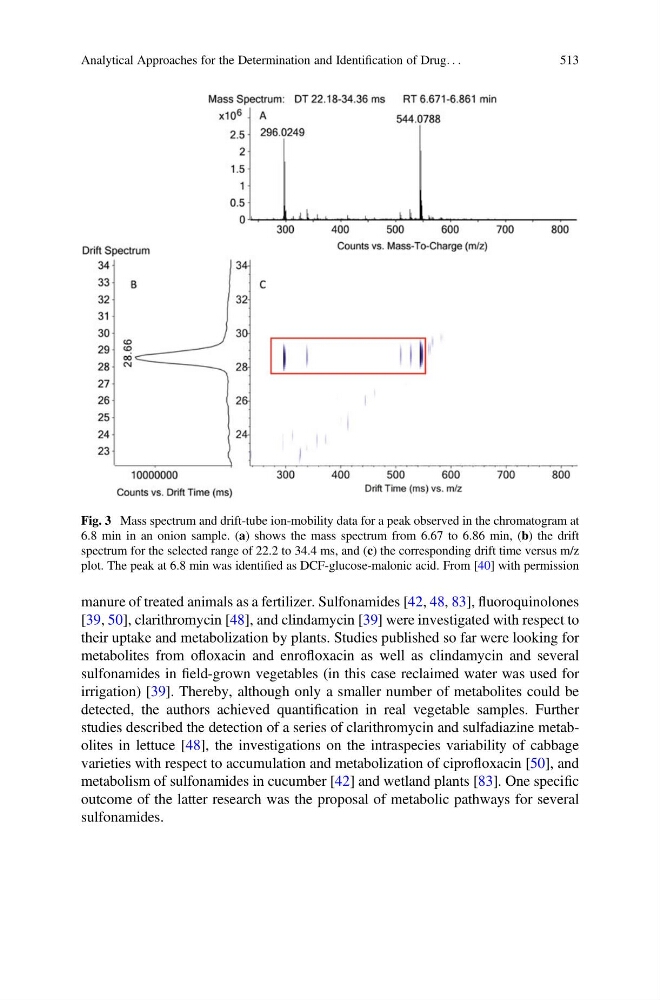
Fig. 3 Mass spectrum and drift-tube ion-mobility data for a peak observed in the chromatogram at
6.8 min in an onion sample. (a) shows the mass spectrum from 6.67 to 6.86 min, (b) the drift
spectrum for the selected range of 22.2 to 34.4 ms, and (c) the corresponding drift time versus m/z
plot. The peak at 6.8 min was identified as DCF-glucose-malonic acid. From [40] with permission
Analytical Approaches for the Determination and Identification of Drug. . .
513
[39, 50], clarithromycin [48], and clindamycin [39] were investigated with respect to
their uptake and metabolization by plants. Studies published so far were looking for
metabolites from ofloxacin and enrofloxacin as well as clindamycin and several
sulfonamides in field-grown vegetables (in this case reclaimed water was used for
irrigation) [39]. Thereby, although only a smaller number of metabolites could be
detected, the authors achieved quantification in real vegetable samples. Further
studies described the detection of a series of clarithromycin and sulfadiazine metabolites in lettuce [48], the investigations on the intraspecies variability of cabbage
varieties with respect to accumulation and metabolization of ciprofloxacin [50], and
metabolism of sulfonamides in cucumber [42] and wetland plants [83]. One specific
outcome of the latter research was the proposal of metabolic pathways for several
sulfonamides.
Fig. 3 Mass spectrum and drift-tube ion-mobility data for a peak observed in the chromatogram at
6.8 min in an onion sample. (a) shows the mass spectrum from 6.67 to 6.86 min, (b) the drift
spectrum for the selected range of 22.2 to 34.4 ms, and (c) the corresponding drift time versus m/z
plot. The peak at 6.8 min was identified as DCF-glucose-malonic acid. From [40] with permission
Analytical Approaches for the Determination and Identification of Drug. . .
513