

Since QuEChERS requires no external forces, less matrix components are
extracted. However, most of the reported studies employed the easy and rapid
clean-up step using d-SPE, in order to reduce matrix effect and improve limits of
detection and quantification. C18, primary secondary amine (PSA), and magnesium
sulfate (MgSO 4 ) are the most known and commonly used d-SPE sorbents for extract
clean-up. MgSO 4 is used as dehydrating agent to remove water excess in organic
solvents; C18 eliminates non-polar matrix interferences such as fats, lipids, and
some minerals; and PSA is commonly used to retain polar organic acids such as fatty
acids and pigments by strong hydrogen bonds. Since only a few studies (there are
exactly six studies) employed QuEChERS for soil extraction, we will discuss them
in details from here on. The C18 is nearly always used in all the reported studies,
either solely or in combination with MgSO 4 and PSA. Lee and coworkers used C18
sorbent solely for extract clean-up, and satisfactory recoveries were obtained ranging
between 60.2 and 120.3% [103]. The addition of magnesium sulfate and primary
secondary amines was excluded in their study, because the first liberates energy that
might influence on the stability of the tested compounds whereas the second have the
ability to chelate/bind with compounds such as sulfonamides. De Carlo and
coworkers [102] tested C18 + MgSO 4 and PSA + MgSO 4 separately, and the best
results were obtained with C18 + MgSO 4 . The clean-up performed adding
C18 + MgSO 4 allowed to recover all target analytes, whereas with PSA + MgSO 4 ,
only two out of the five target analytes were recovered. This can be explained by the
adsorption of analytes on the PSA by strong hydrogen bonds established between the
hydrogen-donor hydroxyl group of the studied analyte and the hydrogen-acceptor
nitrogen of PSA, together with other weaker hydrogen-bonding interactions. Same
observation was obtained with Martínez-Piernas and coworkers [104], where higher
recoveries were obtained using the mixture C18 + MgSO 4 while the presence of PSA
reduced the extraction efficiency. This is also referred to the ability of PSA to act as a
chelating agent with acidic compounds such as clofibric acid, furosemide,
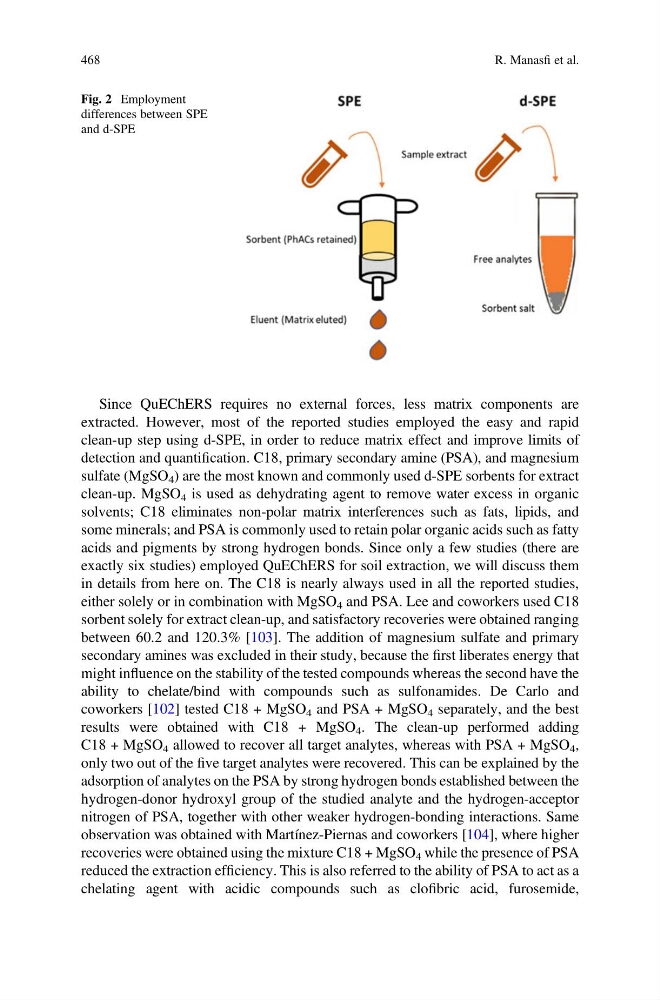
Fig. 2 Employment
differences between SPE
and d-SPE
468
R. Manasfi et al.
extracted. However, most of the reported studies employed the easy and rapid
clean-up step using d-SPE, in order to reduce matrix effect and improve limits of
detection and quantification. C18, primary secondary amine (PSA), and magnesium
sulfate (MgSO 4 ) are the most known and commonly used d-SPE sorbents for extract
clean-up. MgSO 4 is used as dehydrating agent to remove water excess in organic
solvents; C18 eliminates non-polar matrix interferences such as fats, lipids, and
some minerals; and PSA is commonly used to retain polar organic acids such as fatty
acids and pigments by strong hydrogen bonds. Since only a few studies (there are
exactly six studies) employed QuEChERS for soil extraction, we will discuss them
in details from here on. The C18 is nearly always used in all the reported studies,
either solely or in combination with MgSO 4 and PSA. Lee and coworkers used C18
sorbent solely for extract clean-up, and satisfactory recoveries were obtained ranging
between 60.2 and 120.3% [103]. The addition of magnesium sulfate and primary
secondary amines was excluded in their study, because the first liberates energy that
might influence on the stability of the tested compounds whereas the second have the
ability to chelate/bind with compounds such as sulfonamides. De Carlo and
coworkers [102] tested C18 + MgSO 4 and PSA + MgSO 4 separately, and the best
results were obtained with C18 + MgSO 4 . The clean-up performed adding
C18 + MgSO 4 allowed to recover all target analytes, whereas with PSA + MgSO 4 ,
only two out of the five target analytes were recovered. This can be explained by the
adsorption of analytes on the PSA by strong hydrogen bonds established between the
hydrogen-donor hydroxyl group of the studied analyte and the hydrogen-acceptor
nitrogen of PSA, together with other weaker hydrogen-bonding interactions. Same
observation was obtained with Martínez-Piernas and coworkers [104], where higher
recoveries were obtained using the mixture C18 + MgSO 4 while the presence of PSA
reduced the extraction efficiency. This is also referred to the ability of PSA to act as a
chelating agent with acidic compounds such as clofibric acid, furosemide,
Fig. 2 Employment
differences between SPE
and d-SPE
468
R. Manasfi et al.