

2.5 Other Extraction Methods (Soxhlet and Solid-Liquid
Extraction)
Soxhlet extraction is known for being a traditional extraction procedure. The sample
is placed in a thimble-holder, and fresh extraction solvent from a distillation flask
fills the sample. When solvent completely fills the thimble-holder, a siphon takes the
solvent, with the extracted compounds, returning it back to the distillation flask
[27]. This operation is repeated several times as extraction is completed according to
the criteria of the study. The complexity, the high amounts of solvent needed and the
great time of run required, has caused Soxhlet to be relegated to the background
(at least in the pharmaceutical area), giving way to the latest techniques. Moreover,
extraction methods such as USE have the ability to penetrate deep into the solid
matrix, usually by means of the creation of cavities, which allows to obtain a good
extraction performance that Soxhlet is not available to achieve [27].
For liquid matrices such as the analysis of surface water or wastewater, solidliquid extraction (SLE) is the most effective and easiest to use technique. It does not
need major pretreatments. Normally, prior filtration helps remove particulate matter
from the samples. It is very effective and used to clean the matrix in combination
with other extraction techniques. In order to extract the target compounds of the
matrix, an organic solvent or water is mixed with the sample until equilibrium, and
the liquid is removed from the mixture (extract). Commonly, heat is applied in order
to enhance the extraction efficiency, as well as buffer compounds to have control of
the pH. SLE has advantages such as simplicity and few amounts of solvent;
however, this extraction procedure is little selective, and that is the main reason
that modern extraction techniques have broader paths than SLE.
Only one report showed the capability of SLE to extract acetaminophen from
Brassica juncea using 1 mL of HCl 0.1 M and nitrogen [28]. A comparative analysis
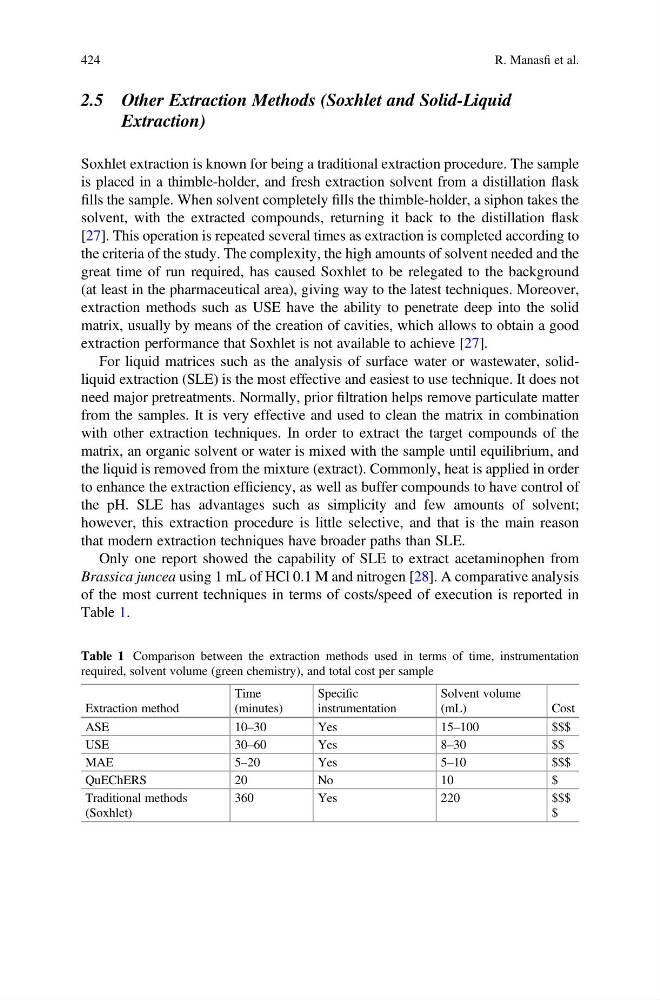
of the most current techniques in terms of costs/speed of execution is reported in
Table 1.
Table 1 Comparison between the extraction methods used in terms of time, instrumentation
required, solvent volume (green chemistry), and total cost per sample
Extraction method
Time
(minutes)
Specific
instrumentation
Solvent volume
(mL)
Cost
ASE
10–30
Yes
15–100
$$$
USE
30–60
Yes
8–30
$$
MAE
5–20
Yes
5–10
$$$
QuEChERS
20
No
10
$
Traditional methods
(Soxhlet)
360
Yes
220
$$$
$
424
R. Manasfi et al.
Extraction)
Soxhlet extraction is known for being a traditional extraction procedure. The sample
is placed in a thimble-holder, and fresh extraction solvent from a distillation flask
fills the sample. When solvent completely fills the thimble-holder, a siphon takes the
solvent, with the extracted compounds, returning it back to the distillation flask
[27]. This operation is repeated several times as extraction is completed according to
the criteria of the study. The complexity, the high amounts of solvent needed and the
great time of run required, has caused Soxhlet to be relegated to the background
(at least in the pharmaceutical area), giving way to the latest techniques. Moreover,
extraction methods such as USE have the ability to penetrate deep into the solid
matrix, usually by means of the creation of cavities, which allows to obtain a good
extraction performance that Soxhlet is not available to achieve [27].
For liquid matrices such as the analysis of surface water or wastewater, solidliquid extraction (SLE) is the most effective and easiest to use technique. It does not
need major pretreatments. Normally, prior filtration helps remove particulate matter
from the samples. It is very effective and used to clean the matrix in combination
with other extraction techniques. In order to extract the target compounds of the
matrix, an organic solvent or water is mixed with the sample until equilibrium, and
the liquid is removed from the mixture (extract). Commonly, heat is applied in order
to enhance the extraction efficiency, as well as buffer compounds to have control of
the pH. SLE has advantages such as simplicity and few amounts of solvent;
however, this extraction procedure is little selective, and that is the main reason
that modern extraction techniques have broader paths than SLE.
Only one report showed the capability of SLE to extract acetaminophen from
Brassica juncea using 1 mL of HCl 0.1 M and nitrogen [28]. A comparative analysis
of the most current techniques in terms of costs/speed of execution is reported in
Table 1.
Table 1 Comparison between the extraction methods used in terms of time, instrumentation
required, solvent volume (green chemistry), and total cost per sample
Extraction method
Time
(minutes)
Specific
instrumentation
Solvent volume
(mL)
Cost
ASE
10–30
Yes
15–100
$$$
USE
30–60
Yes
8–30
$$
MAE
5–20
Yes
5–10
$$$
QuEChERS
20
No
10
$
Traditional methods
(Soxhlet)
360
Yes
220
$$$
$
424
R. Manasfi et al.