

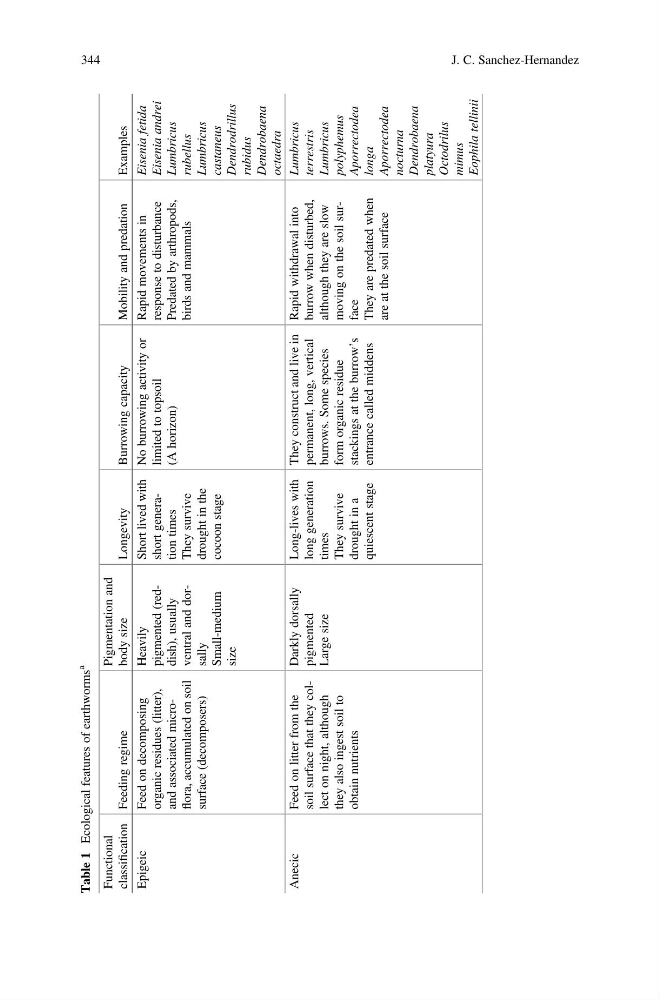
Table 1
Ecological features of earthworms
a
Functional
classification Feeding regime
Pigmentation and
body size
Longevity
Burrowing capacity
Mobility and predation
Examples
Epigeic
Feed on decomposing
organic residues (litter),
and associated microflora, accumulated on soil
surface (decomposers)
Heavily
pigmented (reddish), usually
ventral and dorsally
Small-medium
size
Short lived with
short generation times
They survive
drought in the
cocoon stage
No burrowing activity or
limited to topsoil
(A horizon)
Rapid movements in
response to disturbance
Predated by arthropods,
birds and mammals
Eisenia fetida
Eisenia andrei
Lumbricus
rubellus
Lumbricus
castaneus
Dendrodrillus
rubidus
Dendrobaena
octaedra
Anecic
Feed on litter from the
soil surface that they collect on night, although
they also ingest soil to
obtain nutrients
Darkly dorsally
pigmented
Large size
Long-lives with
long generation
times
They survive
drought in a
quiescent stage
They construct and live in
permanent, long, vertical
burrows. Some species
form organic residue
stackings at the burrow’s
entrance called middens
Rapid withdrawal into
burrow when disturbed,
although they are slow
moving on the soil surface
They are predated when
are at the soil surface
Lumbricus
terrestris
Lumbricus
polyphemus
Aporrectodea
longa
Aporrectodea
nocturna
Dendrobaena
platyura
Octodrilus
mimus
Eophila tellinii
344
J. C. Sanchez-Hernandez
Ecological features of earthworms
a
Functional
classification Feeding regime
Pigmentation and
body size
Longevity
Burrowing capacity
Mobility and predation
Examples
Epigeic
Feed on decomposing
organic residues (litter),
and associated microflora, accumulated on soil
surface (decomposers)
Heavily
pigmented (reddish), usually
ventral and dorsally
Small-medium
size
Short lived with
short generation times
They survive
drought in the
cocoon stage
No burrowing activity or
limited to topsoil
(A horizon)
Rapid movements in
response to disturbance
Predated by arthropods,
birds and mammals
Eisenia fetida
Eisenia andrei
Lumbricus
rubellus
Lumbricus
castaneus
Dendrodrillus
rubidus
Dendrobaena
octaedra
Anecic
Feed on litter from the
soil surface that they collect on night, although
they also ingest soil to
obtain nutrients
Darkly dorsally
pigmented
Large size
Long-lives with
long generation
times
They survive
drought in a
quiescent stage
They construct and live in
permanent, long, vertical
burrows. Some species
form organic residue
stackings at the burrow’s
entrance called middens
Rapid withdrawal into
burrow when disturbed,
although they are slow
moving on the soil surface
They are predated when
are at the soil surface
Lumbricus
terrestris
Lumbricus
polyphemus
Aporrectodea
longa
Aporrectodea
nocturna
Dendrobaena
platyura
Octodrilus
mimus
Eophila tellinii
344
J. C. Sanchez-Hernandez