

soils. Amongst these, soil-dwelling and deep-burrowing worms, such as the anecic
Lumbricus terrestris and endogeic Aporrectodea caliginosa and Allolobophora
chlorotica, are of relevance for their beneficial contribution to improving soil
physico-chemical properties in agroecosystems. Nonetheless, when assessing
emerging contaminant exposures, most literature available so far is almost exclusively centred on Eisenia spp.
In the review by Pelosi et al. [3], in search of the most sensitive earthworm
species for pesticide homologation tests in Europe, the authors resolved that
L. terrestris and A. caliginosa were amongst the most sensitive species. Moreover,
since they contribute a high percentage to soil organism’s biomass and are ecologically important in terrestrial ecosystems of many temperate regions, including
cultivated soils, they are more suitable sentinels of soil pollution. In this chapter,
considerations extracted from the review by Velki and Ecimovik [11] on the use of
earthworms on ecotoxicology testing in terrestrial systems have been embraced, for
instance, (1) the importance of using biomarkers that can be derived to higher
hierarchy consequences, (2) the need to assess toxicity of naturally occurring
chemical mixtures, (3) the use of microcosm models as a proxy of more realistic
field conditions and (4) the need to consider additional environmental stressing
factors such as those related to forecast climate change. Other considerations such
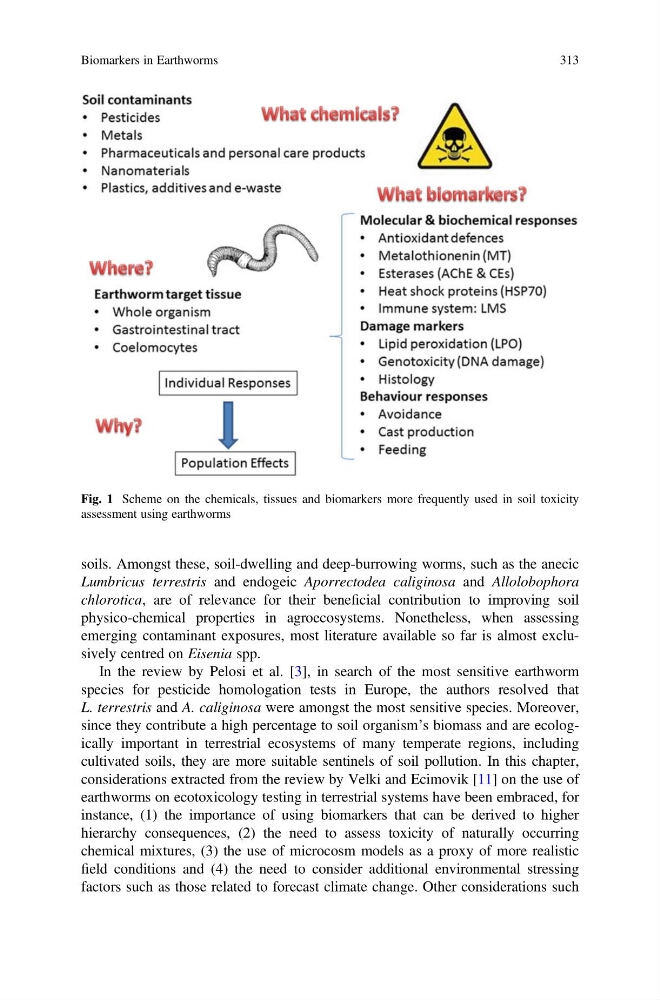
Fig. 1 Scheme on the chemicals, tissues and biomarkers more frequently used in soil toxicity
assessment using earthworms
Biomarkers in Earthworms
313
Lumbricus terrestris and endogeic Aporrectodea caliginosa and Allolobophora
chlorotica, are of relevance for their beneficial contribution to improving soil
physico-chemical properties in agroecosystems. Nonetheless, when assessing
emerging contaminant exposures, most literature available so far is almost exclusively centred on Eisenia spp.
In the review by Pelosi et al. [3], in search of the most sensitive earthworm
species for pesticide homologation tests in Europe, the authors resolved that
L. terrestris and A. caliginosa were amongst the most sensitive species. Moreover,
since they contribute a high percentage to soil organism’s biomass and are ecologically important in terrestrial ecosystems of many temperate regions, including
cultivated soils, they are more suitable sentinels of soil pollution. In this chapter,
considerations extracted from the review by Velki and Ecimovik [11] on the use of
earthworms on ecotoxicology testing in terrestrial systems have been embraced, for
instance, (1) the importance of using biomarkers that can be derived to higher
hierarchy consequences, (2) the need to assess toxicity of naturally occurring
chemical mixtures, (3) the use of microcosm models as a proxy of more realistic
field conditions and (4) the need to consider additional environmental stressing
factors such as those related to forecast climate change. Other considerations such
Fig. 1 Scheme on the chemicals, tissues and biomarkers more frequently used in soil toxicity
assessment using earthworms
Biomarkers in Earthworms
313