

plant (WWTP). Prior to spiking probe compounds, the test systems were
preconditioned for 2 days. The pH, redox potential, and dissolved oxygen were
controlled by electrode measurements. Poisoned experiments with sodium azide
(NaN 3 ) at 1 g L
À1 were also added. Abiotic control was needed by using sterilized
soil for estimating enantioselective sorption processes which are usually minor
processes. Experiments were also carried out in dark and light conditions because
MTP and CBZ might also undergo phototransformation upon natural light irradiation. At different time points, 10-mL supernatant were collected and filtered on 0.22μM nylon filter before SPE and LC-HRMS for kinetic studies and TP identification.
MTP-(S)
MTP-(R)
α-HMTP-(E1)
MTPA-(E1)
e
v
i
t
a
l
e
R
e
c
n
a
d
n
u
b
a
Time (min)
EIC 268.191 ± 0.002
EIC 268.154 ± 0.002
EIC 284.187 ± 0.002
EIC 254.175 ± 0.002
MTPA-(E2)
α-HMTP-(E2)
O-DMTP-(E1)
O-DMTP-(E2)
2
1
3
0
4
Time (min)
CBZ (E1)
CBZ (E2)
e
v
i
t
a
l
e
R
e
c
n
a
d
n
u
b
A
EIC 293.1050
a
b
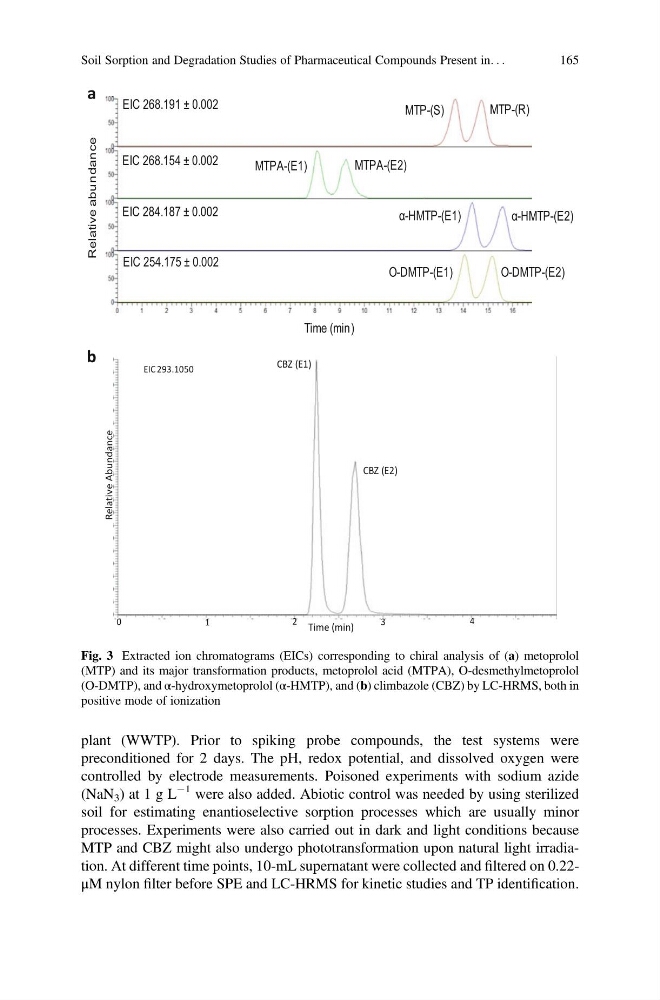
Fig. 3 Extracted ion chromatograms (EICs) corresponding to chiral analysis of (a) metoprolol
(MTP) and its major transformation products, metoprolol acid (MTPA), O-desmethylmetoprolol
(O-DMTP), and α-hydroxymetoprolol (α-HMTP), and (b) climbazole (CBZ) by LC-HRMS, both in
positive mode of ionization
Soil Sorption and Degradation Studies of Pharmaceutical Compounds Present in. . .
165
preconditioned for 2 days. The pH, redox potential, and dissolved oxygen were
controlled by electrode measurements. Poisoned experiments with sodium azide
(NaN 3 ) at 1 g L
À1 were also added. Abiotic control was needed by using sterilized
soil for estimating enantioselective sorption processes which are usually minor
processes. Experiments were also carried out in dark and light conditions because
MTP and CBZ might also undergo phototransformation upon natural light irradiation. At different time points, 10-mL supernatant were collected and filtered on 0.22μM nylon filter before SPE and LC-HRMS for kinetic studies and TP identification.
MTP-(S)
MTP-(R)
α-HMTP-(E1)
MTPA-(E1)
e
v
i
t
a
l
e
R
e
c
n
a
d
n
u
b
a
Time (min)
EIC 268.191 ± 0.002
EIC 268.154 ± 0.002
EIC 284.187 ± 0.002
EIC 254.175 ± 0.002
MTPA-(E2)
α-HMTP-(E2)
O-DMTP-(E1)
O-DMTP-(E2)
2
1
3
0
4
Time (min)
CBZ (E1)
CBZ (E2)
e
v
i
t
a
l
e
R
e
c
n
a
d
n
u
b
A
EIC 293.1050
a
b
Fig. 3 Extracted ion chromatograms (EICs) corresponding to chiral analysis of (a) metoprolol
(MTP) and its major transformation products, metoprolol acid (MTPA), O-desmethylmetoprolol
(O-DMTP), and α-hydroxymetoprolol (α-HMTP), and (b) climbazole (CBZ) by LC-HRMS, both in
positive mode of ionization
Soil Sorption and Degradation Studies of Pharmaceutical Compounds Present in. . .
165