

in activated sludge to soil and to better know what chirality can teach about
biodegradation significance in soil. For this purpose, two probe chiral compounds
were selected: (1) metoprolol (MTP), a highly prescribed β-blocker, and
(2) climbazole (CLB), an imidazole fungicide often used as an active ingredient in
antidandruff shampoos removing dandruff at approximatively 15 g L
À1 rate (see
Fig. 3 for chemical structures). MTP and CLB are chiral pharmaceuticals due to the
presence of an asymmetric carbon in their chemical structure, and both are marketed
as racemic mixtures of two enantiomers. These compounds were selected because
MTP undergoes biodegradation under aerobic conditions, while CLB undergoes
biodegradation under anoxic/anaerobic conditions, covering then different soil conditions under irrigation with treated wastewater.
Transformation pathways have to be known because many significant environmental transformations are enantioselective and the possibility of overlapping of
different enantioselective reactions may exist. The best scenario would be to find
chiral PhACs that undergo a very predominant enantioselective biotransformation
pathway. First, the transformation pathways of MTP and CBZ were determined
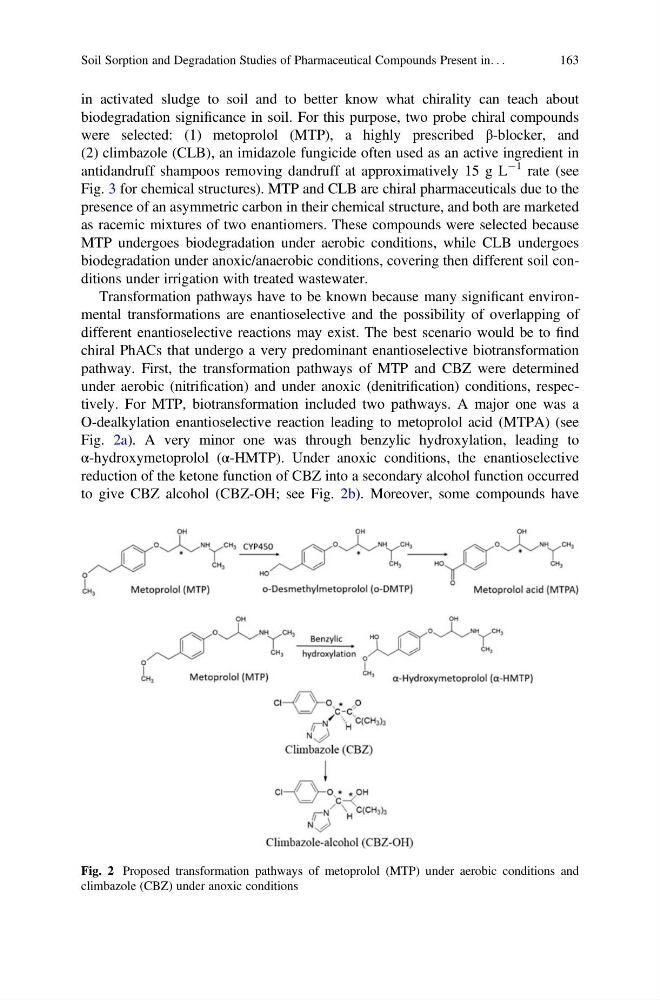
under aerobic (nitrification) and under anoxic (denitrification) conditions, respectively. For MTP, biotransformation included two pathways. A major one was a
O-dealkylation enantioselective reaction leading to metoprolol acid (MTPA) (see
Fig. 2a). A very minor one was through benzylic hydroxylation, leading to
α-hydroxymetoprolol (α-HMTP). Under anoxic conditions, the enantioselective
reduction of the ketone function of CBZ into a secondary alcohol function occurred
to give CBZ alcohol (CBZ-OH; see Fig. 2b). Moreover, some compounds have
Fig. 2 Proposed transformation pathways of metoprolol (MTP) under aerobic conditions and
climbazole (CBZ) under anoxic conditions
Soil Sorption and Degradation Studies of Pharmaceutical Compounds Present in. . .
163
biodegradation significance in soil. For this purpose, two probe chiral compounds
were selected: (1) metoprolol (MTP), a highly prescribed β-blocker, and
(2) climbazole (CLB), an imidazole fungicide often used as an active ingredient in
antidandruff shampoos removing dandruff at approximatively 15 g L
À1 rate (see
Fig. 3 for chemical structures). MTP and CLB are chiral pharmaceuticals due to the
presence of an asymmetric carbon in their chemical structure, and both are marketed
as racemic mixtures of two enantiomers. These compounds were selected because
MTP undergoes biodegradation under aerobic conditions, while CLB undergoes
biodegradation under anoxic/anaerobic conditions, covering then different soil conditions under irrigation with treated wastewater.
Transformation pathways have to be known because many significant environmental transformations are enantioselective and the possibility of overlapping of
different enantioselective reactions may exist. The best scenario would be to find
chiral PhACs that undergo a very predominant enantioselective biotransformation
pathway. First, the transformation pathways of MTP and CBZ were determined
under aerobic (nitrification) and under anoxic (denitrification) conditions, respectively. For MTP, biotransformation included two pathways. A major one was a
O-dealkylation enantioselective reaction leading to metoprolol acid (MTPA) (see
Fig. 2a). A very minor one was through benzylic hydroxylation, leading to
α-hydroxymetoprolol (α-HMTP). Under anoxic conditions, the enantioselective
reduction of the ketone function of CBZ into a secondary alcohol function occurred
to give CBZ alcohol (CBZ-OH; see Fig. 2b). Moreover, some compounds have
Fig. 2 Proposed transformation pathways of metoprolol (MTP) under aerobic conditions and
climbazole (CBZ) under anoxic conditions
Soil Sorption and Degradation Studies of Pharmaceutical Compounds Present in. . .
163