

matrix when extracted by methods that do not significantly change the chemical
nature or the structure of the matrix. NER are the sum of three types of residues:
(1) those strongly entrapped in the soil, (2) those covalently bound to soil and
considered as irreversibly bound, and (3) those derived from biotic degradation
[54, 55]. Type I NER are relevant for the environment because they are presumed
to be reversible once degradation of the humic matter fraction occurs that could lead
to contaminant release [56]. NER have to be quantified by isotope-labelled (either
with radioactive or stable isotopes) chemicals at the most stable part of the molecule,
and consequently their analysis is often not possible at environmental concentrations
of contaminants. Nowadays, there are no standardized procedures for their determination due to the lack of a common regulation in EU [55]. The most studied NER
contaminants in the last 50 years have been soil-bound residues of pesticides
[56, 57]. In contrast, information on pharmaceutical NER is very scarce because
obtaining experimental data requires significant investments in terms of time and
money. In these conditions, knowledge on pesticide NER will be likely very useful
to predict the formation of pharmaceutical NER. For instance, Li et al. [58] reported
recently the phytotransformation and metabolic pathways of
14 C-carbamazepine in
carrot and celery. This study highlighted that
14 C detected in bound residues was
lower than in extractable residues (>85% of the uptake
14 C radioactivity) in plant
tissues and a total of nine radioactive transformation products of carbamazepine
were identified.
2.2.4 Soil pH
Many contaminants are ionizable under environmental conditions. Ionic compounds
are more soluble in water than their neutral counterpart and typically nonvolatile.
Strongly pH-dependent distributions were found for many chemicals, including
basic aromatic amines [59], basic N-heterocyclic compounds [60], basic and acid
pesticides [61], basic and acid pharmaceuticals [62]. These studies reported a
decrease of sorption corresponding with an increase of pH. Normally, wastewater
is slightly alkaline, which attenuates the acidic nature of the soil. Several equations
to predict the correlation between pH and the sorption capacity have been developed,
but unfortunately, the complexity of the interaction has not allowed for the application of a unique model. Theoretically, cationic pharmaceuticals should be able to
sorb negatively charged soil components, such as clay and organic matter
[63]. Vazquez-Roig et al. [64] showed the influence of pH on fluoroquinolone
antibiotics due to their two pKa values. Ofloxacin has two pKa, 5.97 and 8.28, and
at environmental pH tends to be zwitterionic but can also be cationic, anionic, or
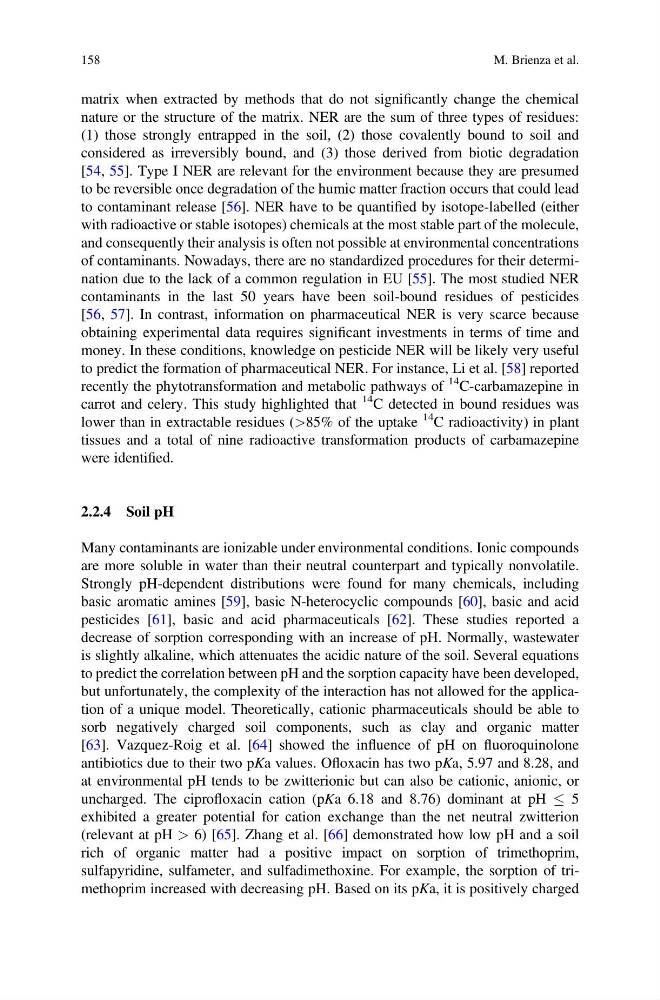
uncharged. The ciprofloxacin cation (pKa 6.18 and 8.76) dominant at pH
5
exhibited a greater potential for cation exchange than the net neutral zwitterion
(relevant at pH > 6) [65]. Zhang et al. [66] demonstrated how low pH and a soil
rich of organic matter had a positive impact on sorption of trimethoprim,
sulfapyridine, sulfameter, and sulfadimethoxine. For example, the sorption of trimethoprim increased with decreasing pH. Based on its pKa, it is positively charged
158
M. Brienza et al.
nature or the structure of the matrix. NER are the sum of three types of residues:
(1) those strongly entrapped in the soil, (2) those covalently bound to soil and
considered as irreversibly bound, and (3) those derived from biotic degradation
[54, 55]. Type I NER are relevant for the environment because they are presumed
to be reversible once degradation of the humic matter fraction occurs that could lead
to contaminant release [56]. NER have to be quantified by isotope-labelled (either
with radioactive or stable isotopes) chemicals at the most stable part of the molecule,
and consequently their analysis is often not possible at environmental concentrations
of contaminants. Nowadays, there are no standardized procedures for their determination due to the lack of a common regulation in EU [55]. The most studied NER
contaminants in the last 50 years have been soil-bound residues of pesticides
[56, 57]. In contrast, information on pharmaceutical NER is very scarce because
obtaining experimental data requires significant investments in terms of time and
money. In these conditions, knowledge on pesticide NER will be likely very useful
to predict the formation of pharmaceutical NER. For instance, Li et al. [58] reported
recently the phytotransformation and metabolic pathways of
14 C-carbamazepine in
carrot and celery. This study highlighted that
14 C detected in bound residues was
lower than in extractable residues (>85% of the uptake
14 C radioactivity) in plant
tissues and a total of nine radioactive transformation products of carbamazepine
were identified.
2.2.4 Soil pH
Many contaminants are ionizable under environmental conditions. Ionic compounds
are more soluble in water than their neutral counterpart and typically nonvolatile.
Strongly pH-dependent distributions were found for many chemicals, including
basic aromatic amines [59], basic N-heterocyclic compounds [60], basic and acid
pesticides [61], basic and acid pharmaceuticals [62]. These studies reported a
decrease of sorption corresponding with an increase of pH. Normally, wastewater
is slightly alkaline, which attenuates the acidic nature of the soil. Several equations
to predict the correlation between pH and the sorption capacity have been developed,
but unfortunately, the complexity of the interaction has not allowed for the application of a unique model. Theoretically, cationic pharmaceuticals should be able to
sorb negatively charged soil components, such as clay and organic matter
[63]. Vazquez-Roig et al. [64] showed the influence of pH on fluoroquinolone
antibiotics due to their two pKa values. Ofloxacin has two pKa, 5.97 and 8.28, and
at environmental pH tends to be zwitterionic but can also be cationic, anionic, or
uncharged. The ciprofloxacin cation (pKa 6.18 and 8.76) dominant at pH
5
exhibited a greater potential for cation exchange than the net neutral zwitterion
(relevant at pH > 6) [65]. Zhang et al. [66] demonstrated how low pH and a soil
rich of organic matter had a positive impact on sorption of trimethoprim,
sulfapyridine, sulfameter, and sulfadimethoxine. For example, the sorption of trimethoprim increased with decreasing pH. Based on its pKa, it is positively charged
158
M. Brienza et al.