

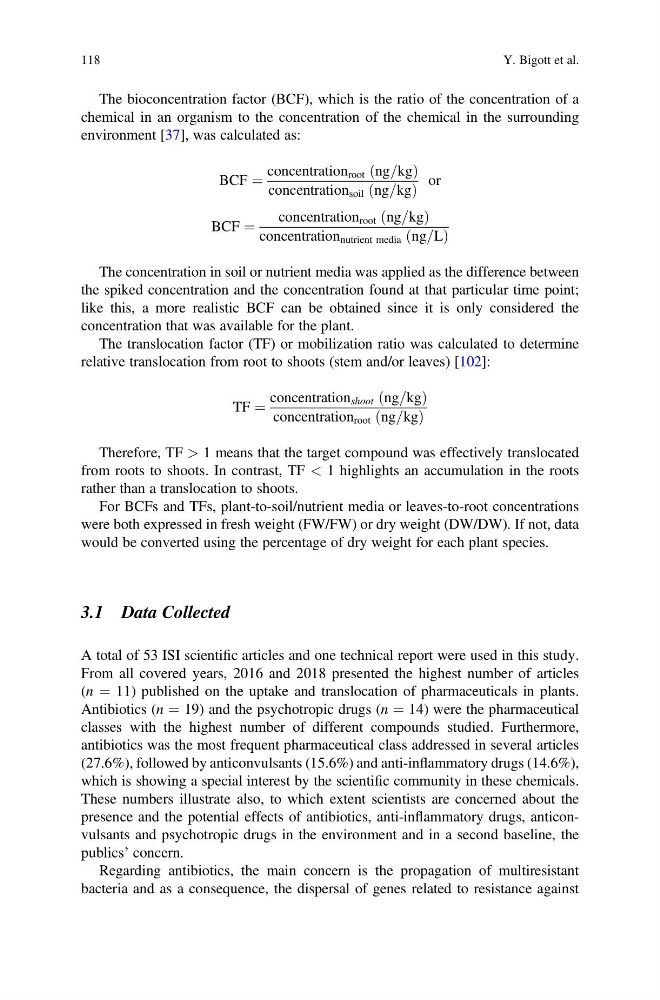
The bioconcentration factor (BCF), which is the ratio of the concentration of a
chemical in an organism to the concentration of the chemical in the surrounding
environment [37], was calculated as:
BCF ¼
concentration root ng=kg
ð
Þ
concentration soil ng=kg
ð
Þ
or
BCF ¼
concentration root ng=kg
ð
Þ
concentration nutrient media ng=L
ð
Þ
The concentration in soil or nutrient media was applied as the difference between
the spiked concentration and the concentration found at that particular time point;
like this, a more realistic BCF can be obtained since it is only considered the
concentration that was available for the plant.
The translocation factor (TF) or mobilization ratio was calculated to determine
relative translocation from root to shoots (stem and/or leaves) [102]:
TF ¼
concentration shoot ng=kg
ð
Þ
concentration root ng=kg
ð
Þ
Therefore, TF > 1 means that the target compound was effectively translocated
from roots to shoots. In contrast, TF < 1 highlights an accumulation in the roots
rather than a translocation to shoots.
For BCFs and TFs, plant-to-soil/nutrient media or leaves-to-root concentrations
were both expressed in fresh weight (FW/FW) or dry weight (DW/DW). If not, data
would be converted using the percentage of dry weight for each plant species.
3.1 Data Collected
A total of 53 ISI scientific articles and one technical report were used in this study.
From all covered years, 2016 and 2018 presented the highest number of articles
(n ¼ 11) published on the uptake and translocation of pharmaceuticals in plants.
Antibiotics (n ¼ 19) and the psychotropic drugs (n ¼ 14) were the pharmaceutical
classes with the highest number of different compounds studied. Furthermore,
antibiotics was the most frequent pharmaceutical class addressed in several articles
(27.6%), followed by anticonvulsants (15.6%) and anti-inflammatory drugs (14.6%),
which is showing a special interest by the scientific community in these chemicals.
These numbers illustrate also, to which extent scientists are concerned about the
presence and the potential effects of antibiotics, anti-inflammatory drugs, anticonvulsants and psychotropic drugs in the environment and in a second baseline, the
publics’ concern.
Regarding antibiotics, the main concern is the propagation of multiresistant
bacteria and as a consequence, the dispersal of genes related to resistance against
118
Y. Bigott et al.
chemical in an organism to the concentration of the chemical in the surrounding
environment [37], was calculated as:
BCF ¼
concentration root ng=kg
ð
Þ
concentration soil ng=kg
ð
Þ
or
BCF ¼
concentration root ng=kg
ð
Þ
concentration nutrient media ng=L
ð
Þ
The concentration in soil or nutrient media was applied as the difference between
the spiked concentration and the concentration found at that particular time point;
like this, a more realistic BCF can be obtained since it is only considered the
concentration that was available for the plant.
The translocation factor (TF) or mobilization ratio was calculated to determine
relative translocation from root to shoots (stem and/or leaves) [102]:
TF ¼
concentration shoot ng=kg
ð
Þ
concentration root ng=kg
ð
Þ
Therefore, TF > 1 means that the target compound was effectively translocated
from roots to shoots. In contrast, TF < 1 highlights an accumulation in the roots
rather than a translocation to shoots.
For BCFs and TFs, plant-to-soil/nutrient media or leaves-to-root concentrations
were both expressed in fresh weight (FW/FW) or dry weight (DW/DW). If not, data
would be converted using the percentage of dry weight for each plant species.
3.1 Data Collected
A total of 53 ISI scientific articles and one technical report were used in this study.
From all covered years, 2016 and 2018 presented the highest number of articles
(n ¼ 11) published on the uptake and translocation of pharmaceuticals in plants.
Antibiotics (n ¼ 19) and the psychotropic drugs (n ¼ 14) were the pharmaceutical
classes with the highest number of different compounds studied. Furthermore,
antibiotics was the most frequent pharmaceutical class addressed in several articles
(27.6%), followed by anticonvulsants (15.6%) and anti-inflammatory drugs (14.6%),
which is showing a special interest by the scientific community in these chemicals.
These numbers illustrate also, to which extent scientists are concerned about the
presence and the potential effects of antibiotics, anti-inflammatory drugs, anticonvulsants and psychotropic drugs in the environment and in a second baseline, the
publics’ concern.
Regarding antibiotics, the main concern is the propagation of multiresistant
bacteria and as a consequence, the dispersal of genes related to resistance against
118
Y. Bigott et al.