

[39]. Once in the symplast, these compounds can move through the xylem in the
direction of the transpiration stream and accumulated mostly in transpiring organs
(i.e. leaves) [8, 37]. Ionizable compounds may be subject to additional processes
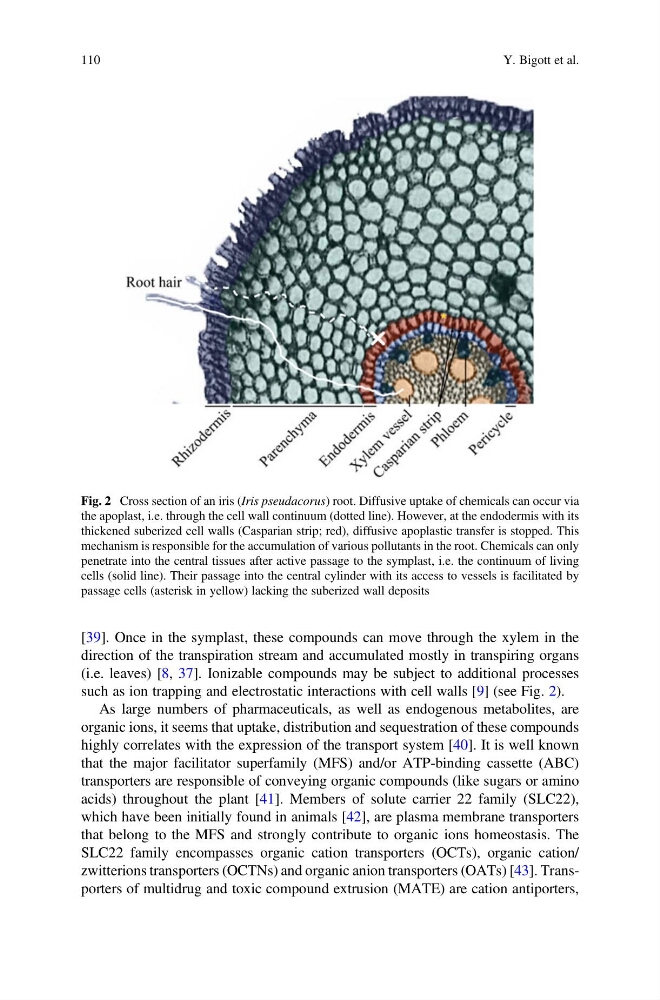
such as ion trapping and electrostatic interactions with cell walls [9] (see Fig. 2).
As large numbers of pharmaceuticals, as well as endogenous metabolites, are
organic ions, it seems that uptake, distribution and sequestration of these compounds
highly correlates with the expression of the transport system [40]. It is well known
that the major facilitator superfamily (MFS) and/or ATP-binding cassette (ABC)
transporters are responsible of conveying organic compounds (like sugars or amino
acids) throughout the plant [41]. Members of solute carrier 22 family (SLC22),
which have been initially found in animals [42], are plasma membrane transporters
that belong to the MFS and strongly contribute to organic ions homeostasis. The
SLC22 family encompasses organic cation transporters (OCTs), organic cation/
zwitterions transporters (OCTNs) and organic anion transporters (OATs) [43]. Transporters of multidrug and toxic compound extrusion (MATE) are cation antiporters,
Fig. 2 Cross section of an iris (Iris pseudacorus) root. Diffusive uptake of chemicals can occur via
the apoplast, i.e. through the cell wall continuum (dotted line). However, at the endodermis with its
thickened suberized cell walls (Casparian strip; red), diffusive apoplastic transfer is stopped. This
mechanism is responsible for the accumulation of various pollutants in the root. Chemicals can only
penetrate into the central tissues after active passage to the symplast, i.e. the continuum of living
cells (solid line). Their passage into the central cylinder with its access to vessels is facilitated by
passage cells (asterisk in yellow) lacking the suberized wall deposits
110
Y. Bigott et al.
direction of the transpiration stream and accumulated mostly in transpiring organs
(i.e. leaves) [8, 37]. Ionizable compounds may be subject to additional processes
such as ion trapping and electrostatic interactions with cell walls [9] (see Fig. 2).
As large numbers of pharmaceuticals, as well as endogenous metabolites, are
organic ions, it seems that uptake, distribution and sequestration of these compounds
highly correlates with the expression of the transport system [40]. It is well known
that the major facilitator superfamily (MFS) and/or ATP-binding cassette (ABC)
transporters are responsible of conveying organic compounds (like sugars or amino
acids) throughout the plant [41]. Members of solute carrier 22 family (SLC22),
which have been initially found in animals [42], are plasma membrane transporters
that belong to the MFS and strongly contribute to organic ions homeostasis. The
SLC22 family encompasses organic cation transporters (OCTs), organic cation/
zwitterions transporters (OCTNs) and organic anion transporters (OATs) [43]. Transporters of multidrug and toxic compound extrusion (MATE) are cation antiporters,
Fig. 2 Cross section of an iris (Iris pseudacorus) root. Diffusive uptake of chemicals can occur via
the apoplast, i.e. through the cell wall continuum (dotted line). However, at the endodermis with its
thickened suberized cell walls (Casparian strip; red), diffusive apoplastic transfer is stopped. This
mechanism is responsible for the accumulation of various pollutants in the root. Chemicals can only
penetrate into the central tissues after active passage to the symplast, i.e. the continuum of living
cells (solid line). Their passage into the central cylinder with its access to vessels is facilitated by
passage cells (asterisk in yellow) lacking the suberized wall deposits
110
Y. Bigott et al.