

719
• Water concentration (v/v) of emulsion and high water cut increase the rate of
flocculation.
• At higher temperature, the thermal energy of droplets increases, and the rate of
collision increases which leads to flocculation.
• The high-density difference leads to settling of the drop so that the flocculation
at the bottom is higher.
• By applying an electrostatic field, the droplets move towards the electrode, and
the droplets aggregate towards the electrode.
Coalescence is a phenomenon in which two drops fuse or merge together and
form large drops [8]. Generally, this is an irreversible process (no breakage of large
drop), drops become bigger, and gravitational forces acting on drops help in settling
the drops. With an increase in the rate of flocculation, an increase in the rate of
coalescence is observed in an emulsion having films with low interfacial viscosity.
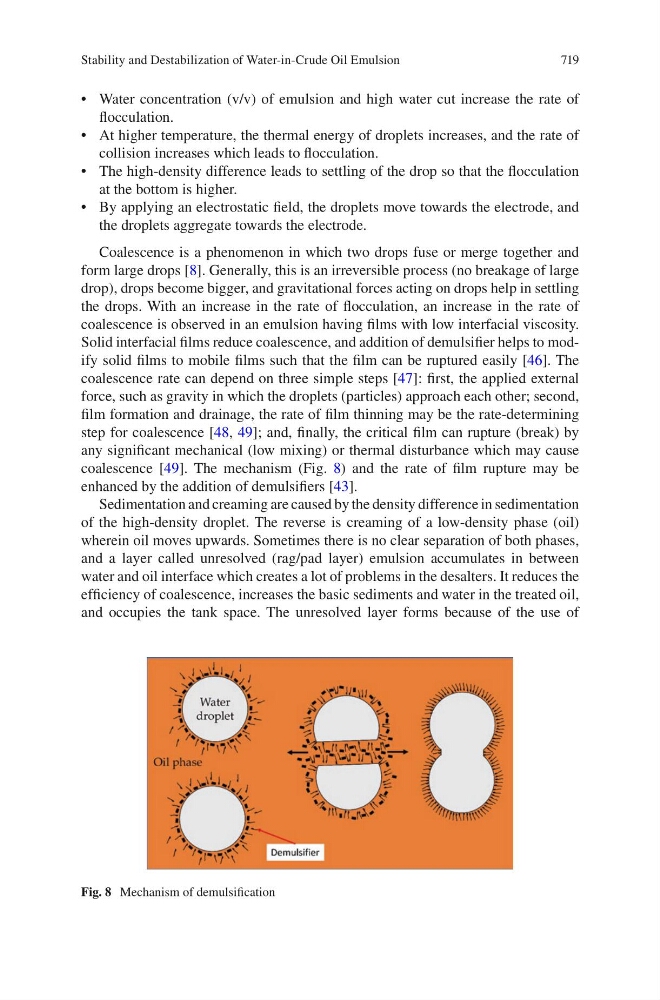
Solid interfacial films reduce coalescence, and addition of demulsifier helps to modify solid films to mobile films such that the film can be ruptured easily [46]. The
coalescence rate can depend on three simple steps [47]: first, the applied external
force, such as gravity in which the droplets (particles) approach each other; second,
film formation and drainage, the rate of film thinning may be the rate-determining
step for coalescence [48, 49]; and, finally, the critical film can rupture (break) by
any significant mechanical (low mixing) or thermal disturbance which may cause
coalescence [49]. The mechanism (Fig. 8) and the rate of film rupture may be
enhanced by the addition of demulsifiers [43].
Sedimentation and creaming are caused by the density difference in sedimentation
of the high-density droplet. The reverse is creaming of a low-density phase (oil)
wherein oil moves upwards. Sometimes there is no clear separation of both phases,
and a layer called unresolved (rag/pad layer) emulsion accumulates in between
water and oil interface which creates a lot of problems in the desalters. It reduces the
efficiency of coalescence, increases the basic sediments and water in the treated oil,
and occupies the tank space. The unresolved layer forms because of the use of
Fig. 8 Mechanism of demulsification
Stability and Destabilization of Water-in-Crude Oil Emulsion