

712
which is stabilized by surface-active agent present in an emulsion. This is discussed
in brief in the next section. The water percentage in the water-in-oil emulsion varies
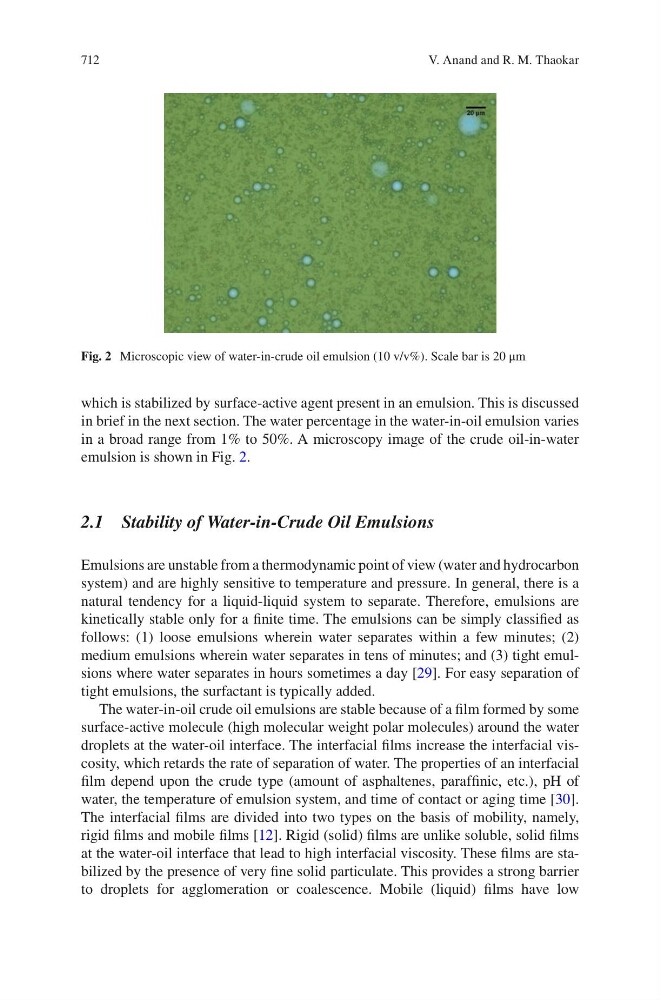
in a broad range from 1% to 50%. A microscopy image of the crude oil-in-water
emulsion is shown in Fig. 2.
2.1 Stability of Water-in-Crude Oil Emulsions
Emulsions are unstable from a thermodynamic point of view (water and hydrocarbon
system) and are highly sensitive to temperature and pressure. In general, there is a
natural tendency for a liquid-liquid system to separate. Therefore, emulsions are
kinetically stable only for a finite time. The emulsions can be simply classified as
follows: (1) loose emulsions wherein water separates within a few minutes; (2)
medium emulsions wherein water separates in tens of minutes; and (3) tight emulsions where water separates in hours sometimes a day [29]. For easy separation of
tight emulsions, the surfactant is typically added.
The water-in-oil crude oil emulsions are stable because of a film formed by some
surface-active molecule (high molecular weight polar molecules) around the water
droplets at the water-oil interface. The interfacial films increase the interfacial viscosity, which retards the rate of separation of water. The properties of an interfacial
film depend upon the crude type (amount of asphaltenes, paraffinic, etc.), pH of
water, the temperature of emulsion system, and time of contact or aging time [30].
The interfacial films are divided into two types on the basis of mobility, namely,
rigid films and mobile films [12]. Rigid (solid) films are unlike soluble, solid films
at the water-oil interface that lead to high interfacial viscosity. These films are stabilized by the presence of very fine solid particulate. This provides a strong barrier
to droplets for agglomeration or coalescence. Mobile (liquid) films have low
Fig. 2 Microscopic view of water-in-crude oil emulsion (10 v/v%). Scale bar is 20 μm
V. Anand and R. M. Thaokar