

709
1.1 Crude Oil: Elemental Composition and Classification
Crude oil composition obtained from wells and offshore varies from region to region
and also depends on the life of the well and the reservoir. The stability of the crude
oil may also depend on the life of wells and the individual composition of crude oil.
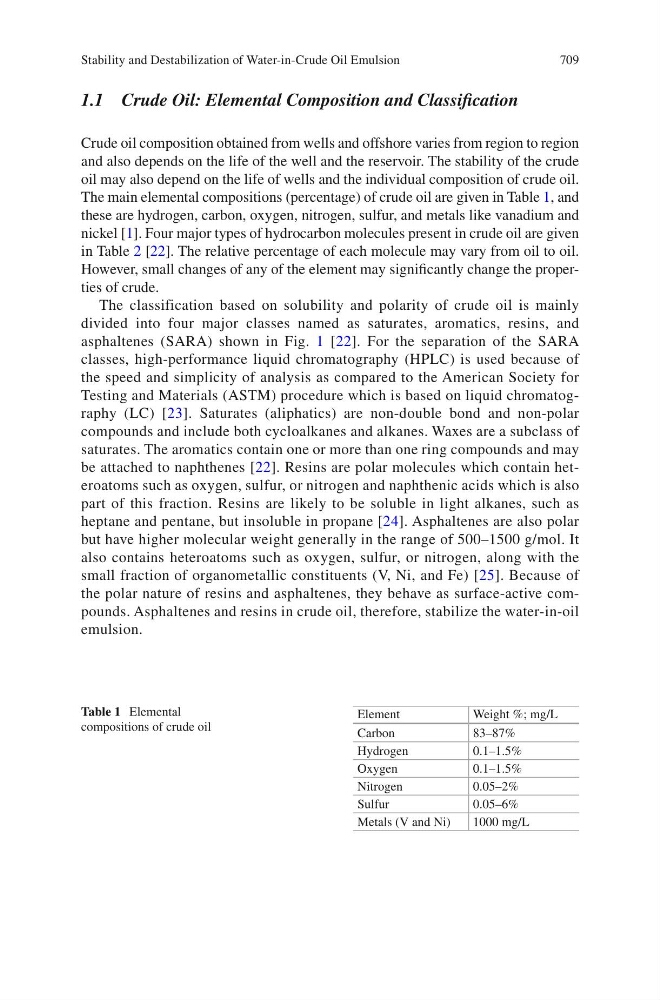
The main elemental compositions (percentage) of crude oil are given in Table 1, and
these are hydrogen, carbon, oxygen, nitrogen, sulfur, and metals like vanadium and
nickel [1]. Four major types of hydrocarbon molecules present in crude oil are given
in Table 2 [22]. The relative percentage of each molecule may vary from oil to oil.
However, small changes of any of the element may significantly change the properties of crude.
The classification based on solubility and polarity of crude oil is mainly
divided into four major classes named as saturates, aromatics, resins, and
asphaltenes (SARA) shown in Fig. 1 [22]. For the separation of the SARA
classes, high- performance liquid chromatography (HPLC) is used because of
the speed and simplicity of analysis as compared to the American Society for
Testing and Materials (ASTM) procedure which is based on liquid chromatography (LC) [23]. Saturates (aliphatics) are non-double bond and non-polar
compounds and include both cycloalkanes and alkanes. Waxes are a subclass of
saturates. The aromatics contain one or more than one ring compounds and may
be attached to naphthenes [22]. Resins are polar molecules which contain heteroatoms such as oxygen, sulfur, or nitrogen and naphthenic acids which is also
part of this fraction. Resins are likely to be soluble in light alkanes, such as
heptane and pentane, but insoluble in propane [24]. Asphaltenes are also polar
but have higher molecular weight generally in the range of 500–1500 g/mol. It
also contains heteroatoms such as oxygen, sulfur, or nitrogen, along with the
small fraction of organometallic constituents (V, Ni, and Fe) [25]. Because of
the polar nature of resins and asphaltenes, they behave as surface- active compounds. Asphaltenes and resins in crude oil, therefore, stabilize the water-in-oil
emulsion.
Table 1 Elemental
compositions of crude oil
Element
Weight %; mg/L
Carbon
83–87%
Hydrogen
0.1–1.5%
Oxygen
0.1–1.5%
Nitrogen
0.05–2%
Sulfur
0.05–6%
Metals (V and Ni)
1000 mg/L
Stability and Destabilization of Water-in-Crude Oil Emulsion