

698
co-catalyst at ethylene pressure of 6 atm at 50 °C. The mixed-valence complex system (11c) exhibited lower activity (254 kg PE/mol V h) compared to that of the 11a
and 11b. Replacement of dithiolato ligand with thiobis(phenoxy) moiety (11d)
vastly improved the catalytic activity. The catalyst in presence of AltBu 3 as the cocatalyst exhibited a catalytic activity of 11,708 kg PE/(mol V h) for polymerization
of ethylene [53].
V(III) complexes possessing O,N-chelating aminophenolate ligands (11e and
11f) were tested as catalysts for ethylene polymerization. These systems in presence
of Et 2 AlCl and EtAlCl 2 co-catalysts exhibited moderate activity (27–159 kg PE/
mol V h), and the molecular weight of the resulting polymer was relatively high
(M w = 6.7 × 10
5
) [54]. Bis(phenoxy)pyridine ligand-based V(III) complex (11g)
along with methylaluminoxane co-catalyst was suitable for polymerization of propylene with activity value of 803 kg polymer/(mol V h) [55]. The polypropylene
produced under 5 atm propylene pressure and 0 °C exhibited M w value of 1.17 × 10
6
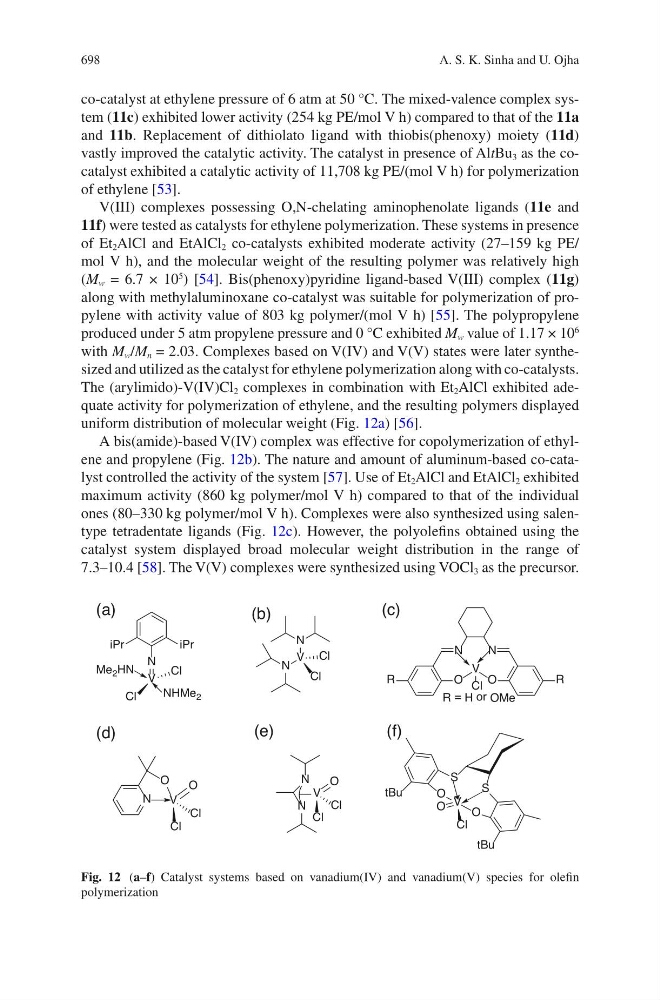
with M w /M n = 2.03. Complexes based on V(IV) and V(V) states were later synthesized and utilized as the catalyst for ethylene polymerization along with co- catalysts.
The (arylimido)-V(IV)Cl 2 complexes in combination with Et 2 AlCl exhibited adequate activity for polymerization of ethylene, and the resulting polymers displayed
uniform distribution of molecular weight (Fig. 12a) [56].
A bis(amide)-based V(IV) complex was effective for copolymerization of ethylene and propylene (Fig. 12b). The nature and amount of aluminum-based co-catalyst controlled the activity of the system [57]. Use of Et 2 AlCl and EtAlCl 2 exhibited
maximum activity (860 kg polymer/mol V h) compared to that of the individual
ones (80–330 kg polymer/mol V h). Complexes were also synthesized using salentype tetradentate ligands (Fig. 12c). However, the polyolefins obtained using the
catalyst system displayed broad molecular weight distribution in the range of
7.3–10.4 [58]. The V(V) complexes were synthesized using VOCl 3 as the precursor.
V
N
Cl
N
Cl
V
N
iPr
iPr
Cl
Cl
NHMe 2
Me 2 HN
(a)
(b)
O
N
R
N
V O
R
Cl
R = H or OMe
(c)
N
O
V
O
Cl
Cl
(d)
N
N
V
O
Cl
Cl
(e)
S
S
V
O
O
O
Cl
tBu
tBu
(f)
Fig. 12 (a–f) Catalyst systems based on vanadium(IV) and vanadium(V) species for olefin
polymerization
A. S. K. Sinha and U. Ojha