

692
from the Pd-based catalyst systems is amorphous and highly branched in nature
with density value up to 0.85. This allowed the researchers to produce blended polyethylene by using mixed catalyst systems. For example, combining a palladium
α-diimine-based catalyst with a metallocene catalyst in a specific ratio, the crystallinity of resulting polyethylene may be controlled.
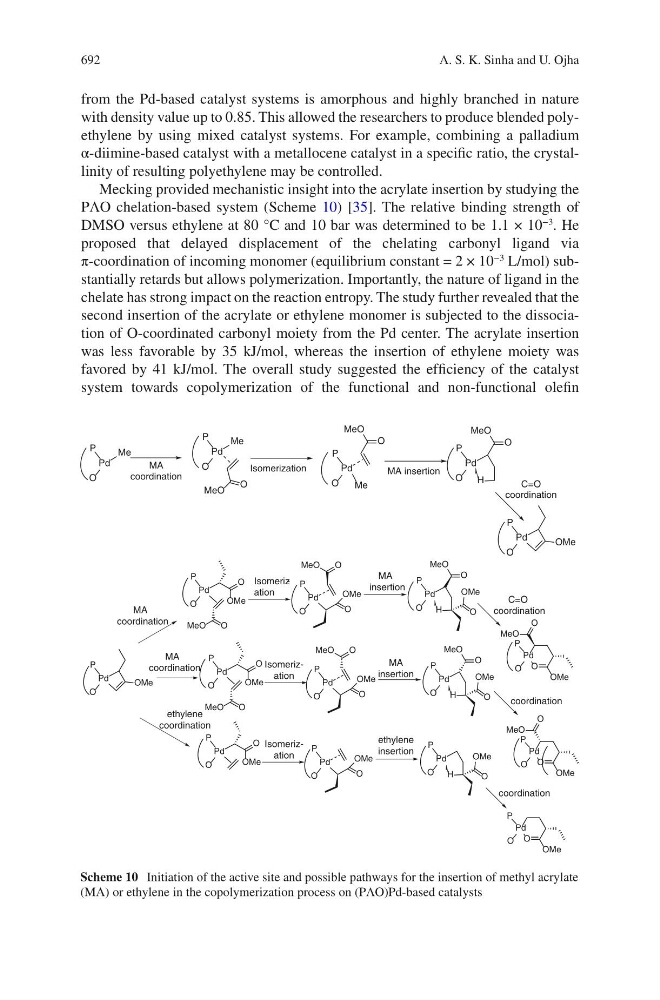
Mecking provided mechanistic insight into the acrylate insertion by studying the
PΛO chelation-based system (Scheme 10) [35]. The relative binding strength of
DMSO versus ethylene at 80 °C and 10 bar was determined to be 1.1 × 10
−3
. He
proposed that delayed displacement of the chelating carbonyl ligand via
π-coordination of incoming monomer (equilibrium constant = 2 × 10
−3
L/mol) substantially retards but allows polymerization. Importantly, the nature of ligand in the
chelate has strong impact on the reaction entropy. The study further revealed that the
second insertion of the acrylate or ethylene monomer is subjected to the dissociation of O-coordinated carbonyl moiety from the Pd center. The acrylate insertion
was less favorable by 35 kJ/mol, whereas the insertion of ethylene moiety was
favored by 41 kJ/mol. The overall study suggested the efficiency of the catalyst
system towards copolymerization of the functional and non-functional olefin
P
Pd
O
Me
P
Pd
O
Me
MeO
O
MA
coordination
Isomerization
P
Pd
O
Me
MeO
O
MA insertion
P
Pd
O
H
MeO
O
P
Pd
O
OMe
C=O
coordination
P
Pd
O
OMe
P
Pd
O
O
OMe
MeO
O
P
Pd
O
O
OMe
MeO
O
P
Pd
O
O
MeO
O
OMe
P
Pd
O
H
MeO
O
OMe
O
Pd
O
P
O
OMe
MeO
O
P
Pd
O
O
MeO
O
OMe
P
Pd
O
H
MeO
O
OMe
O
Pd
O
P
O
OMe
MeO
O
P
Pd
O
O
OMe
P
Pd
O
O
OMe
P
Pd
O
H
OMe
O
Pd
O
P
O
OMe
MA
coordination
Isomeriz -
ation
MA
insertion
C=O
coordination
MA
coordination
ethylene
coordination
Isomerization
MA
insertion
coordination
coordination
ethylene
insertion
Isomerization
Scheme 10 Initiation of the active site and possible pathways for the insertion of methyl acrylate
(MA) or ethylene in the copolymerization process on (PΛO)Pd-based catalysts
A. S. K. Sinha and U. Ojha