

678
the organometallic compound. However, some disagreement still exists regarding
the nature of active center, i.e., the growing polymer chain is attached to the transition metal or the non-transition metal.
2.2 Mechanism Based on Bimetallic Complex
Natta and Mazzanti proposed a bimetallic mechanism while studying the ethylene
polymerization using a soluble complex of titanium chloride and aluminum alkyl
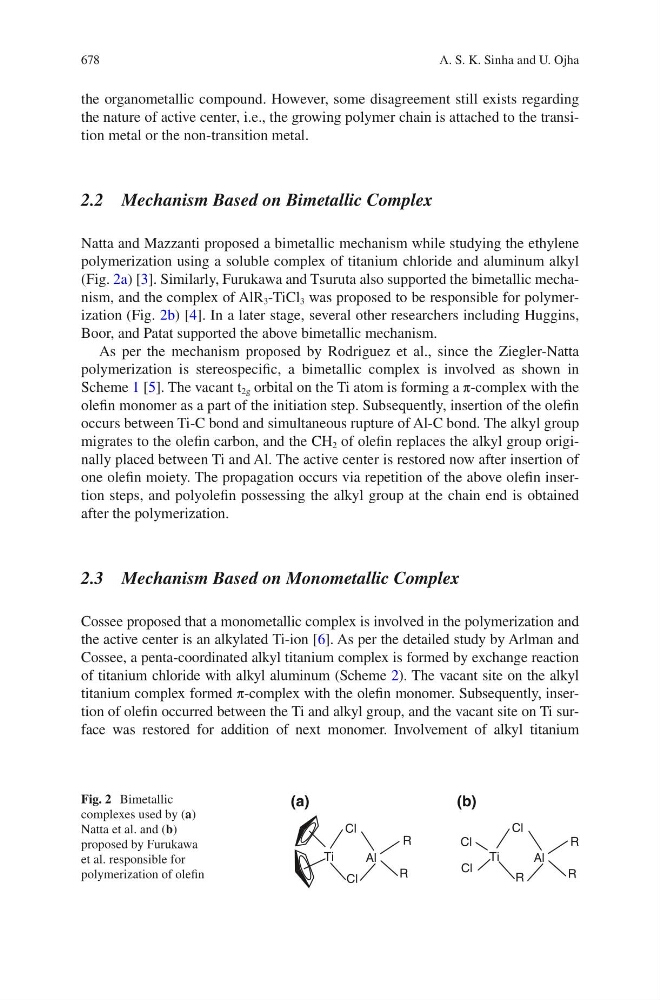
(Fig. 2a) [3]. Similarly, Furukawa and Tsuruta also supported the bimetallic mechanism, and the complex of AlR 3 -TiCl 3 was proposed to be responsible for polymerization (Fig. 2b) [4]. In a later stage, several other researchers including Huggins,
Boor, and Patat supported the above bimetallic mechanism.
As per the mechanism proposed by Rodriguez et al., since the Ziegler-Natta
polymerization is stereospecific, a bimetallic complex is involved as shown in
Scheme 1 [5]. The vacant t 2g orbital on the Ti atom is forming a π-complex with the
olefin monomer as a part of the initiation step. Subsequently, insertion of the olefin
occurs between Ti-C bond and simultaneous rupture of Al-C bond. The alkyl group
migrates to the olefin carbon, and the CH 2 of olefin replaces the alkyl group originally placed between Ti and Al. The active center is restored now after insertion of
one olefin moiety. The propagation occurs via repetition of the above olefin insertion steps, and polyolefin possessing the alkyl group at the chain end is obtained
after the polymerization.
2.3 Mechanism Based on Monometallic Complex
Cossee proposed that a monometallic complex is involved in the polymerization and
the active center is an alkylated Ti-ion [6]. As per the detailed study by Arlman and
Cossee, a penta-coordinated alkyl titanium complex is formed by exchange reaction
of titanium chloride with alkyl aluminum (Scheme 2). The vacant site on the alkyl
titanium complex formed π-complex with the olefin monomer. Subsequently, insertion of olefin occurred between the Ti and alkyl group, and the vacant site on Ti surface was restored for addition of next monomer. Involvement of alkyl titanium
R
Cl
Cl
Cl
R
R
Ti
Al
R
Cl
R
Cl
Ti
Al
(a)
(b)
Fig. 2 Bimetallic
complexes used by (a)
Natta et al. and (b)
proposed by Furukawa
et al. responsible for
polymerization of olefin
A. S. K. Sinha and U. Ojha