

664
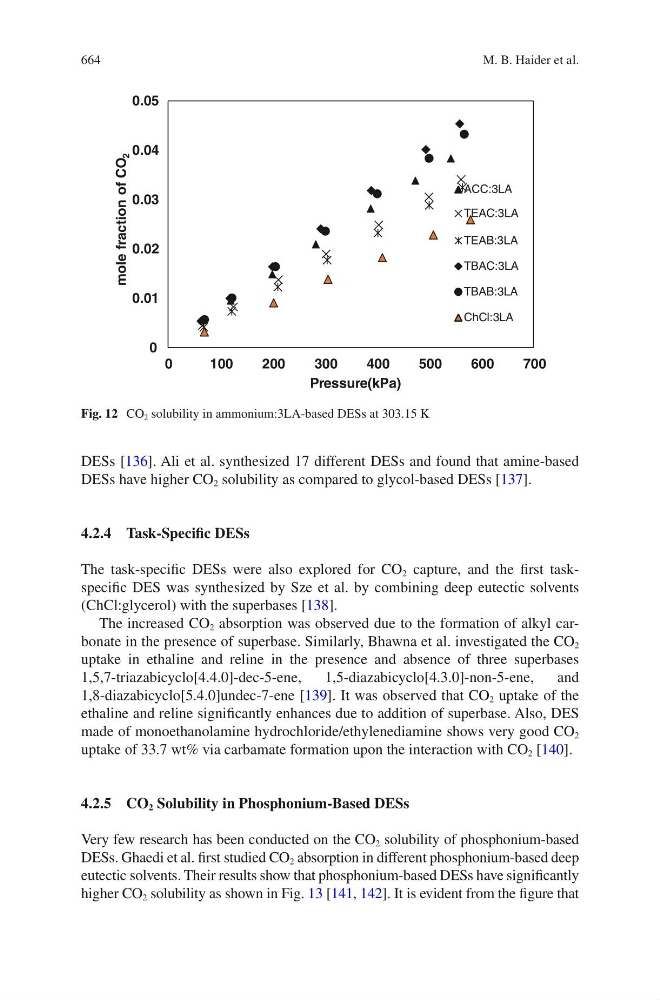
DESs [136]. Ali et al. synthesized 17 different DESs and found that amine- based
DESs have higher CO 2 solubility as compared to glycol-based DESs [137].
4.2.4 Task-Specific DESs
The task-specific DESs were also explored for CO 2 capture, and the first taskspecific DES was synthesized by Sze et al. by combining deep eutectic solvents
(ChCl:glycerol) with the superbases [138].
The increased CO 2 absorption was observed due to the formation of alkyl carbonate in the presence of superbase. Similarly, Bhawna et al. investigated the CO 2
uptake in ethaline and reline in the presence and absence of three superbases
1,5,7-triazabicyclo[4.4.0]-dec-5-ene,
1,5-diazabicyclo[4.3.0]-non-5-ene,
and
1,8-diazabicyclo[5.4.0]undec-7-ene [139]. It was observed that CO 2 uptake of the
ethaline and reline significantly enhances due to addition of superbase. Also, DES
made of monoethanolamine hydrochloride/ethylenediamine shows very good CO 2
uptake of 33.7 wt% via carbamate formation upon the interaction with CO 2 [140].
4.2.5 CO 2 Solubility in Phosphonium-Based DESs
Very few research has been conducted on the CO 2 solubility of phosphonium-based
DESs. Ghaedi et al. first studied CO 2 absorption in different phosphonium-based deep
eutectic solvents. Their results show that phosphonium-based DESs have significantly
higher CO 2 solubility as shown in Fig. 13 [141, 142]. It is evident from the figure that
0
0.01
0.02
0.03
0.04
0.05
0
100
200
300
400
500
600
700
mole fraction of CO
2
Pressure(kPa)
ACC:3LA
TEAC:3LA
TEAB:3LA
TBAC:3LA
TBAB:3LA
ChCl:3LA
Fig. 12 CO 2 solubility in ammonium:3LA-based DESs at 303.15 K
M. B. Haider et al.