

662
4.2.2 HBDs with OH Moiety
Solubility of CO 2 in ethaline (ChCl:2ethylene glycol) and glycine (ChCl:2glycerol)
DESs was investigated by Leron et al. [127, 128]. Their results suggest that CO 2
capture in the ethaline DESs was comparable to the ionic liquids [BMIM][PF 6 ] and
[BMIM][BF 4 ] [51, 52]. Li et al. compared the CO 2 dissolution in the ChCl:diethylene
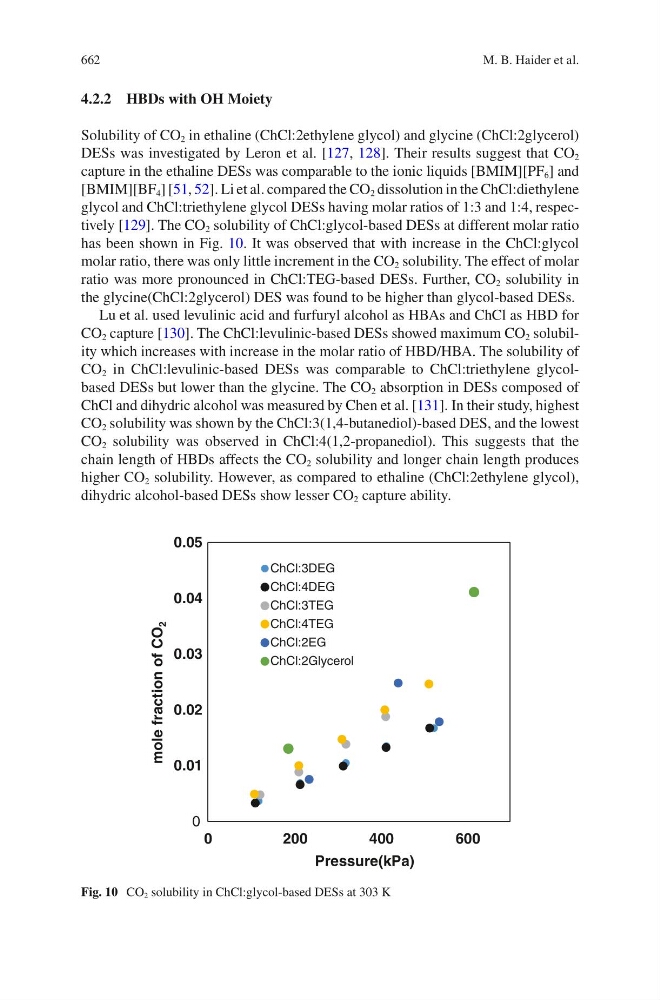
glycol and ChCl:triethylene glycol DESs having molar ratios of 1:3 and 1:4, respectively [129]. The CO 2 solubility of ChCl:glycol-based DESs at different molar ratio
has been shown in Fig. 10. It was observed that with increase in the ChCl:glycol
molar ratio, there was only little increment in the CO 2 solubility. The effect of molar
ratio was more pronounced in ChCl:TEG-based DESs. Further, CO 2 solubility in
the glycine(ChCl:2glycerol) DES was found to be higher than glycol-based DESs.
Lu et al. used levulinic acid and furfuryl alcohol as HBAs and ChCl as HBD for
CO 2 capture [130]. The ChCl:levulinic-based DESs showed maximum CO 2 solubility which increases with increase in the molar ratio of HBD/HBA. The solubility of
CO 2 in ChCl:levulinic-based DESs was comparable to ChCl:triethylene glycolbased DESs but lower than the glycine. The CO 2 absorption in DESs composed of
ChCl and dihydric alcohol was measured by Chen et al. [131]. In their study, highest
CO 2 solubility was shown by the ChCl:3(1,4-butanediol)-based DES, and the lowest
CO 2 solubility was observed in ChCl:4(1,2-propanediol). This suggests that the
chain length of HBDs affects the CO 2 solubility and longer chain length produces
higher CO 2 solubility. However, as compared to ethaline (ChCl:2ethylene glycol),
dihydric alcohol-based DESs show lesser CO 2 capture ability.
0
0.01
0.02
0.03
0.04
0.05
0
200
400
600
mole fraction of CO
2
Pressure(kPa)
ChCl:3DEG
ChCl:4DEG
ChCl:3TEG
ChCl:4TEG
ChCl:2EG
ChCl:2Glycerol
Fig. 10 CO 2 solubility in ChCl:glycol-based DESs at 303 K
M. B. Haider et al.