

659
the HBA and HBD. DESs have find their application in various fields including gas
separation because of their green physiochemical properties [110, 111]. Garcia et al.
presented a comprehensive review on the DESs application in gas separation highlighting the properties which need to be focused while selecting the solvent [112].
Like ionic liquids, one of the most important aspects of DESs is their ability to
be tailored for the particular application. However, DESs have edge over ILs when
compared in terms of stoichiometry. This means different HBD/HBA molar ratio
can be used for the synthesis of DESs. However, reaction in a fixed stoichiometry is
done for the synthesis of ILs. Combination of various HBD and HBA as well as
different HBD/HBA molar ratio helps in designing a desired DES for a particular
application. Therefore, DESs have found their application in many fields such as
extractive desulfurization, gas separation, extraction of target compounds, biodiesel
production, biocatalysis, polysaccharides processing, nanotechnology, and others
[108, 112–119]. Some of the important physicochemical properties of DESs have
been discussed here.
4.1.1 Phase Behavior
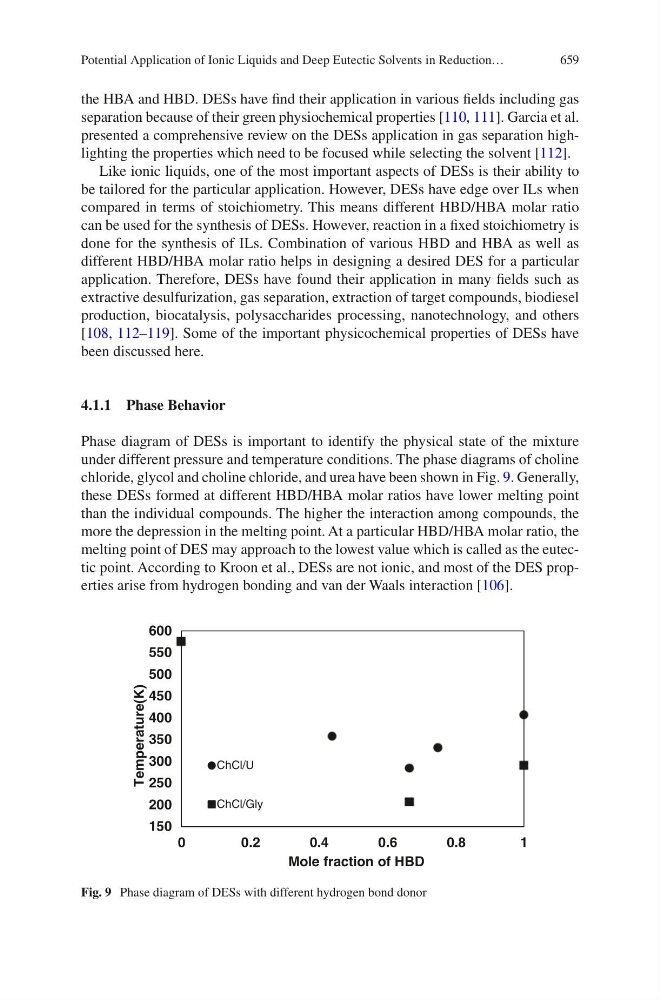
Phase diagram of DESs is important to identify the physical state of the mixture
under different pressure and temperature conditions. The phase diagrams of choline
chloride, glycol and choline chloride, and urea have been shown in Fig. 9. Generally,
these DESs formed at different HBD/HBA molar ratios have lower melting point
than the individual compounds. The higher the interaction among compounds, the
more the depression in the melting point. At a particular HBD/HBA molar ratio, the
melting point of DES may approach to the lowest value which is called as the eutectic point. According to Kroon et al., DESs are not ionic, and most of the DES properties arise from hydrogen bonding and van der Waals interaction [106].
150
200
250
300
350
400
450
500
550
600
0
0.2
0.4
0.6
0.8
1
Temperature(K)
Mole fraction of HBD
ChCl/U
ChCl/Gly
Fig. 9 Phase diagram of DESs with different hydrogen bond donor
Potential Application of Ionic Liquids and Deep Eutectic Solvents in Reduction…