

657
than the aqueous amine solution. Ionic liquids are intensively studied solvents with
exceptional properties such as negligible volatility, excellent chemical and thermal
stability, and high heat capacity [95, 96]. However, ILs require complex purification
steps which add to the cost of these solvents [37, 97]. Moreover, their high viscosity
and environmental acceptability further limit their application for CO 2 capture [98, 99].
4 Deep Eutectic Solvents
Abbott and co-workers synthesized a new kind of solvents known as deep eutectic
solvents (DESs) which are believed as a substitute to ILs. These are formed by mixing suitable molar ratio of hydrogen bond donor (HBD) and hydrogen bond acceptor (HBA) [104, 105]. Due to hydrogen bonding, these mixtures are homogeneous
liquids as room temperature. DESs contain large asymmetric ions having low lattice
energy resulting into the lower melting point. Charge delocalization through hydrogen bonding produces lower melting point of these mixtures. Common types of the
hydrogen bond donor (HBD) and hydrogen bond acceptor (HBA) used for deep
eutectic mixtures are shown in Fig. 7.
The first DES was synthesized by Abbot et al. using choline chloride (ChCl) as
HBA and urea as HBD [104]. The DES formed at HBA/HBD molar ratio of 1:2
showed significantly lower melting point (12 °C) than the pure HBA and pure HBD. It
should be interesting to note that mixing of HBD and HBA does not always produce
lower melting point, but instead a glass transition temperature may be observed [106].
These kinds of solvents are regarded as low transition temperature mixtures [97, 106].
DESs are easy to synthesize and do not require complex purification steps. A schematic of ChCl and ethylene glycol-based DES synthesis has been shown in Fig. 8.
However, DESs are considered to be IL analogues sharing similar physicochemical properties. It should be noted that DESs are fundamentally different from the
ILs. DESs are formed by simple mixing of the HBDs and HBAs in fixed molar ratio,
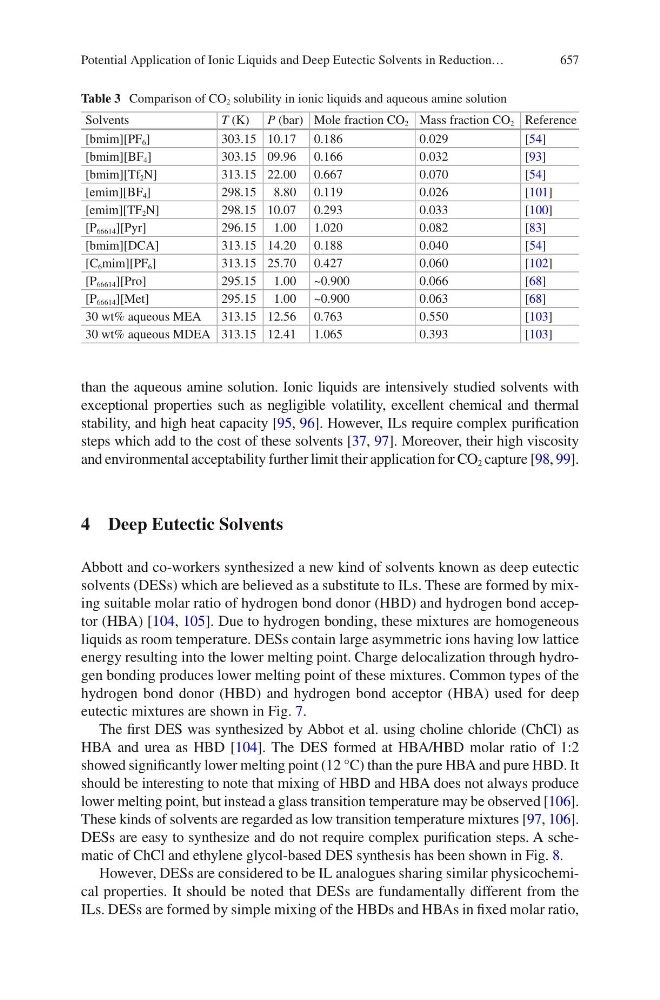
Table 3 Comparison of CO 2 solubility in ionic liquids and aqueous amine solution
Solvents
T (K) P (bar) Mole fraction CO 2 Mass fraction CO 2 Reference
[bmim][PF 6 ]
303.15 10.17 0.186
0.029
[54]
[bmim][BF 4 ]
303.15 09.96 0.166
0.032
[93]
[bmim][Tf 2 N]
313.15 22.00 0.667
0.070
[54]
[emim][BF 4 ]
298.15 8.80 0.119
0.026
[101]
[emim][TF 2 N]
298.15 10.07 0.293
0.033
[100]
[P 66614 ][Pyr]
296.15 1.00 1.020
0.082
[83]
[bmim][DCA]
313.15 14.20 0.188
0.040
[54]
[C 6 mim][PF 6 ]
313.15 25.70 0.427
0.060
[102]
[P 66614 ][Pro]
295.15 1.00 ~0.900
0.066
[68]
[P 66614 ][Met]
295.15 1.00 ~0.900
0.063
[68]
30 wt% aqueous MEA
313.15 12.56 0.763
0.550
[103]
30 wt% aqueous MDEA 313.15 12.41 1.065
0.393
[103]
Potential Application of Ionic Liquids and Deep Eutectic Solvents in Reduction…