

650
3.1 Properties of Ionic Liquids
The understanding of thermophysical properties of ILs is essential for their industrial application and greatly depends on the choice of cation and anion. Here, the
important IL characteristics are discussed.
Thermal Stability: ILs are thermally stable at high temperature range. This can be
further changed depending on the choice of anion and cation. Generally, for
same cation with increase in the anion size, the stability of ILs generally increases
and decreases with increase in the size of cation [40, 41].
Melting Point: The ILs melting point is one of the most important characteristics.
The melting point of ILs is normally below 100 °C. Room temperature ILs have
their melting point below room temperature and hence the name. The low melting point of ILs arises from the asymmetry of anion and cation which decrease
the lattice energy and prevent their crystallization.
Volatility: The most celebrated property is its negligible vapor pressure compared
to conventional organic solvents. According to Brennecke et al., ionic liquids do
not evaporate [42]. Here, strong ionic bond between anion and cation reduces the
volatility of ILs.
Viscosity: Ionic liquids, in general, have more viscosity compared to conventional
organic solvents. There enhanced viscous nature arises from ionic bond between
anion and cation. This is one of the major factors affecting their use in the industry. Viscosity in turn is a strong function of the nature of anions and cation [42].
For example, higher alkyl chain length ILs have more viscosity compared to
lower alkyl chain length ILs [43]. Viscosity of ILs in general decreases with the
increase in the temperature [44].
Table 1 Comparison between the ionic liquids and salts
Ionic liquid
Salts
van der Waals force is prevalent
Ionic bonds are prevalent
Melting point is below 100 °C
Melting point is usually above 500 °C
They are electrolytes and itself a solvent
They form electrolytes when mixed with
solvents
Generally, liquid at room temperature
They are solid at room temperature
Ionic liquid has lower symmetry
Highly symmetrical in nature
Al
O
Cl
N
+
-
O
O
O
-
OH
S
O
O
Cl
-
tosylate
chloride
Nitrate
Chloroaluminate
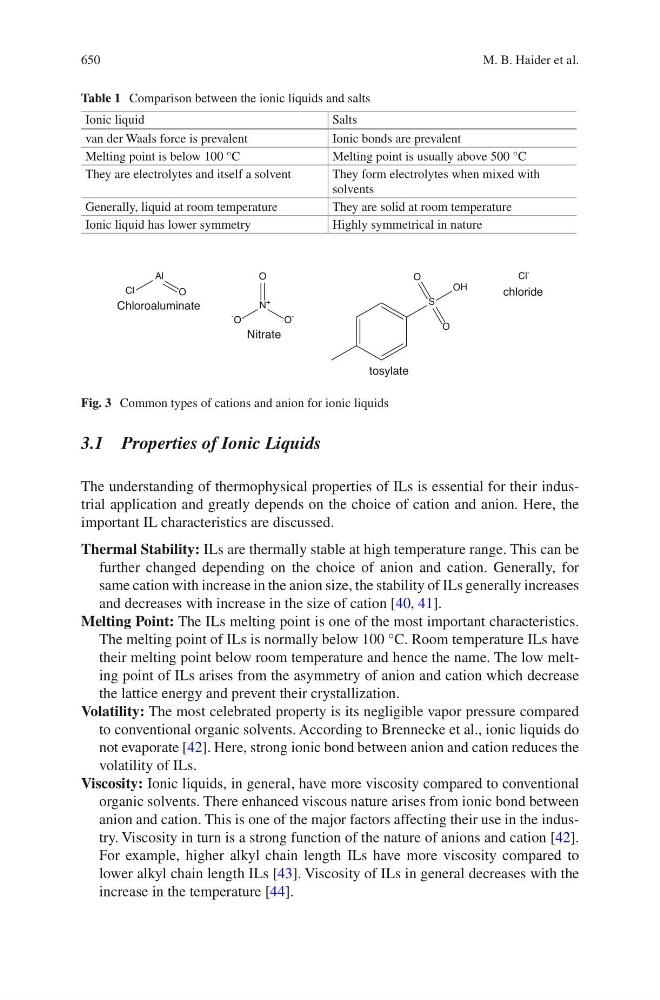
Fig. 3 Common types of cations and anion for ionic liquids
M. B. Haider et al.