

624
heterogeneous and homogeneous approaches have been reported intensively in the
literature [139, 140].
3.2.5 Homogenous Catalysts
Inoue in 1976 established the first homogeneous catalyst hydrogenation of CO 2 to
formic acid [141]. After carrying out a series of experiments, this group has identified that the trace amount of water enhances the catalytic activity. Most of the pincer
complexes established for hydrogenation reactions are insoluble in water; hence,
the reactions are performed in DMSO with trace water molecules. In 1993, Leitner
and co-workers have reported [142] a rhodium catalysts that soluble in water and
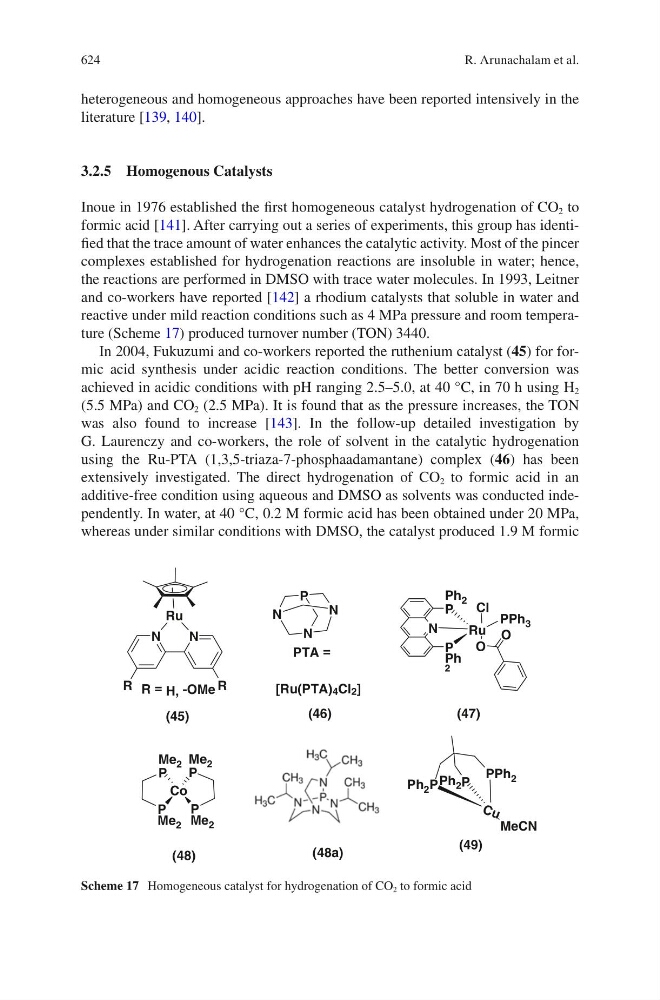
reactive under mild reaction conditions such as 4 MPa pressure and room temperature (Scheme 17) produced turnover number (TON) 3440.
In 2004, Fukuzumi and co-workers reported the ruthenium catalyst (45) for formic acid synthesis under acidic reaction conditions. The better conversion was
achieved in acidic conditions with pH ranging 2.5–5.0, at 40 °C, in 70 h using H 2
(5.5 MPa) and CO 2 (2.5 MPa). It is found that as the pressure increases, the TON
was also found to increase [143]. In the follow-up detailed investigation by
G. Laurenczy and co-workers, the role of solvent in the catalytic hydrogenation
using the Ru-PTA (1,3,5-triaza-7-phosphaadamantane) complex (46) has been
extensively investigated. The direct hydrogenation of CO 2 to formic acid in an
additive- free condition using aqueous and DMSO as solvents was conducted independently. In water, at 40 °C, 0.2 M formic acid has been obtained under 20 MPa,
whereas under similar conditions with DMSO, the catalyst produced 1.9 M formic
Ph 2 P
PPh 2
Ph 2 P
C u
MeCN
N
N
Ru
R
R
R = H, -OMe
Me 2
P
P
Me 2
P
Me 2
Me 2
P
Co
N
P
N
N
[Ru(PTA) 4 Cl 2 ]
PTA =
N
Ph 2
P
P
Ph
2
Ru
PPh 3
O
Cl
O
(45)
(46)
(47)
(48)
(48a)
(49)
Scheme 17 Homogeneous catalyst for hydrogenation of CO 2 to formic acid
R. Arunachalam et al.